
In June 1984, in Heavenshore, the converted garage in the Stockholm suburb of Huddinge, an eighteen-year-old who had named his band after a Hungarian countess, and whose record deal came through a small label his own father ran, cut a first album in under three days. The singer and guitarist who then ripped the bass guitar almost out of the mix, buried his own voice under the cymbals and let the tape hiss between the songs was Quorthon, and the record, released that October, was Bathory by Bathory. The goat on the sleeve was meant to be printed in gold. It came back yellow.
The quarrel over heavy metal vs black metal starts in rooms like that one, because every tool on the floor had come from the older music: the distorted guitar, the minor-key riff, the drum kit, the studded costume, the pentagram lifted from British sleeves. Nothing new was bought. What changed was how much each tool was allowed to do, and on almost every count black metal chose less.
A lapidary handed a rough sapphire adds nothing to it. He cements the stone to the end of a wooden dop, grinds the crust off it against a wheel fed with grit and water, and takes the shape down in stages until a lump that swallowed the light stands as a cabochon, a smooth dome barely half its old weight. Only then does the lap come out, a soft disc charged with finer and finer powder, and a stone made entirely by removal throws back more light than the rough ever held. Black metal did that to heavy metal between 1984 and 1994. Every cut was something the older music believed it could not live without.
Heavy metal vs black metal, counted in what was removed
The first thing to go was the floor of the sound. Heavy metal records of the early eighties kept the bass guitar where a listener could follow it and gave the rhythm guitar a thick, warm middle that landed in the chest; black metal set its guitars thin and bright, pushed the bass down until it was more rumour than instrument, and let the riff stop sounding like a load being carried. The weight went. The speed stayed.
The lineage is short and well attested. Venom lent the name in 1982, Bathory lent the cold and the cheapness two years later, and the Swiss band whose three 1983 demos were savaged by the metal press of the day and then studied across half of Scandinavia a decade on turned out to be Hellhammer, which folded in May 1984 so two of its members could found Celtic Frost the next month. None of them sounded like Iron Maiden. All of them owned Iron Maiden records.
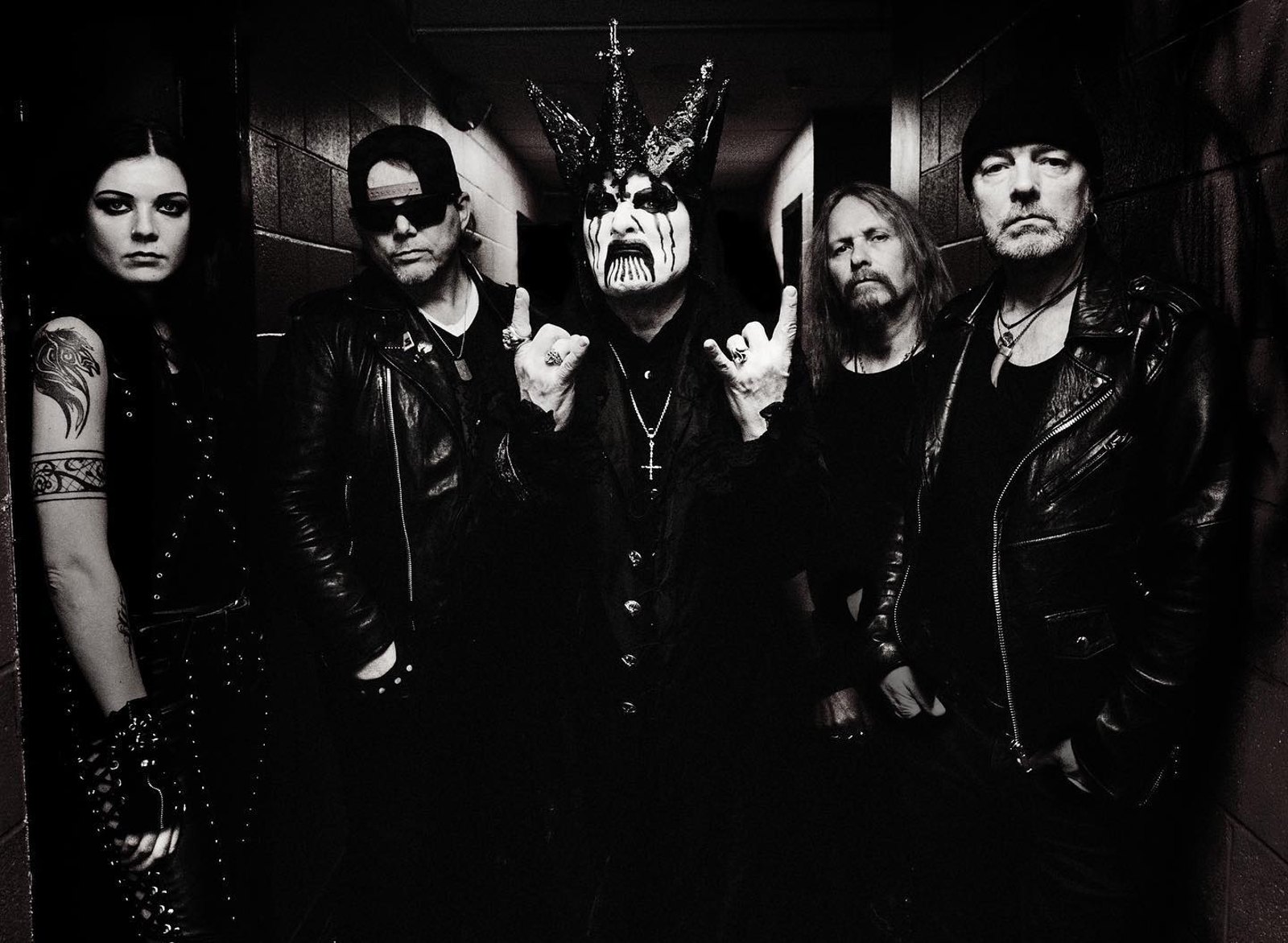
The heaviest single loan came from Copenhagen. The Danish singer who walked onto stages in black and white face paint, and sang over the twin guitars of Hank Shermann and Michael Denner in a falsetto that could reach the back wall of any hall, was King Diamond of Mercyful Fate, and the Norwegian bands of the early nineties took the painted face from him and left the voice exactly where they found it. They kept the mask. They threw away the tenor.
Black metal kept heavy metal's costume and its minor keys and refused everything that made heavy metal a night out: the chorus, the solo, the lights, the band that wants to be seen.
Declan Rourke, KaosMetal
Transilvanian Hunger and the riff that does not stop

Recorded on a four-track cassette machine in the drummer's own bedroom, which the band called Necrohell, and released by Peaceville on 17 February 1994, Transilvanian Hunger takes the removals as far as they go. The Norwegian duo that had made a death metal debut at Sunlight Studio in Stockholm only a few years earlier, and then turned its back on that sound completely, was Darkthrone, and on this record Fenriz played every instrument while Nocturno Culto sang. It is a whole album of desolation built from a handful of riffs per song.
The title track shows the method in barely six minutes: a few riffs, each repeated far longer than any heavy metal arranger would allow, over a steady beat with barely a fill, no solo, no chorus anyone could sing, and a voice set so far back in the mix that the words are a texture rather than a message. Heavy metal builds a song to arrive somewhere. This one is built to keep going.
Tremolo picking is what fills the space the solo left. The guitarist strikes a single note or chord as fast as the wrist allows, down and up, and holds it that way for bars at a time, so that the riff stops arriving as separate blows. Hail on a corrugated iron roof works the same way: every stone is a separate strike, but at the rate they fall the ear stops counting and hears one sheet of roar, while outside the storm strips the leaves off every tree in the yard and flattens the dead stalks in the garden. Heavy metal's riffs hit. Black metal's fall.
The light heavy metal kept
Set against that, heavy metal's priorities stand out like a lighting rig switched on in a dark hall: a singer who wants every word understood, a guitar solo placed at the centre of the song as the moment the band proves what it can do, a chorus built to be shouted back, and a production that lets all five players be heard at once. The heavy metal band plays to be seen. The black metal band of 1994 played from behind a painted face and a pseudonym, and often did not play live at all.
To the young Norwegian musicians of 1993 the stadium show, the power ballad and the music video were anathema, the very machinery that had turned the older music into entertainment. Heavy metal had treated the devil as theatre. Black metal's inner circle treated the theatre itself as heresy.
Heavy metal had treated the devil as theatre. Black metal's inner circle treated the theatre itself as heresy.
The road back to 1981

The strongest proof that the two musics share a skeleton came from the band that had taken away most. From The Cult Is Alive in 2006 onwards Darkthrone let punk, speed metal and the British heavy metal of the early eighties back into its songs, and in 2007 the duo issued an EP whose title spelled the argument out on the sleeve: NWOBHM, expanded to New Wave of Black Heavy Metal.
The drummer who had written almost every riff on Transilvanian Hunger, and who went on to champion forgotten heavy metal on his own Radio Fenriz broadcasts, is Fenriz. On The Underground Resistance, released on 25 February 2013, he trades a high, clean heavy metal register with Nocturno Culto on "Leave No Cross Unturned", a song of nearly fourteen minutes with more Mercyful Fate in it than anything recorded in Norway in 1993.
"The Hardship of the Scots", from Old Star on 31 May 2019, walks rather than shivers: a mid-tempo riff with its feet planted, a vocal from Nocturno Culto that is rough without being buried, and a guitar sound much closer to Celtic Frost and the heavy metal of 1984 than to the band's own records of 1994. The riffs came home. The gloss never did.
Where the border runs
Three questions settle heavy metal vs black metal on any record. Can the bass guitar be heard, does a solo arrive, and does the singer want the words understood? A heavy metal record answers yes to all three, a black metal record of the classic Norwegian kind answers no to all three, and the records in between are where the argument lives. The Swedish band that first pulled black metal back toward heavy metal, slowing its songs and adding choirs on Blood Fire Death in 1988, was Bathory itself.
That border is only one of several drawn around the genre, and the full set of what it gets confused with runs from hard rock and punk to grunge and the cores. Black metal is the case where the family likeness survives almost every cut, because the minor keys, the riff as the unit of the song and the love of darkness as a subject all came through intact.
The opposite experiment took the same starting point and added to it instead, faster double kick drums, brighter keys, bigger choruses, and it is set out under heavy metal vs power metal. Power metal switched on every light in the hall. Black metal went looking for the fuse box.
