
In 1990 Ibanez put a seven string guitar into production for Steve Vai. The instrument the firm built for him, the Universe, hung a low B under the standard six so that a virtuoso could reach further down without giving up anything he could already do higher up, and inside five years the people buying seven strings in numbers were using that bottom string for one job only, a low note struck flat on the beat, and taking no solos on the other six at all. The tool did not change. The work asked of it did.
Beat oil into vinegar hard enough and the bowl holds what looks like a single substance. Beat the same oil into an egg yolk and it is a single substance, because the yolk carries something that ties fat to water and will not let go again, and a cook standing over the two bowls can tell which is which without tasting either. Heavy metal vs nu metal is that distinction, put to records rather than to dressings.
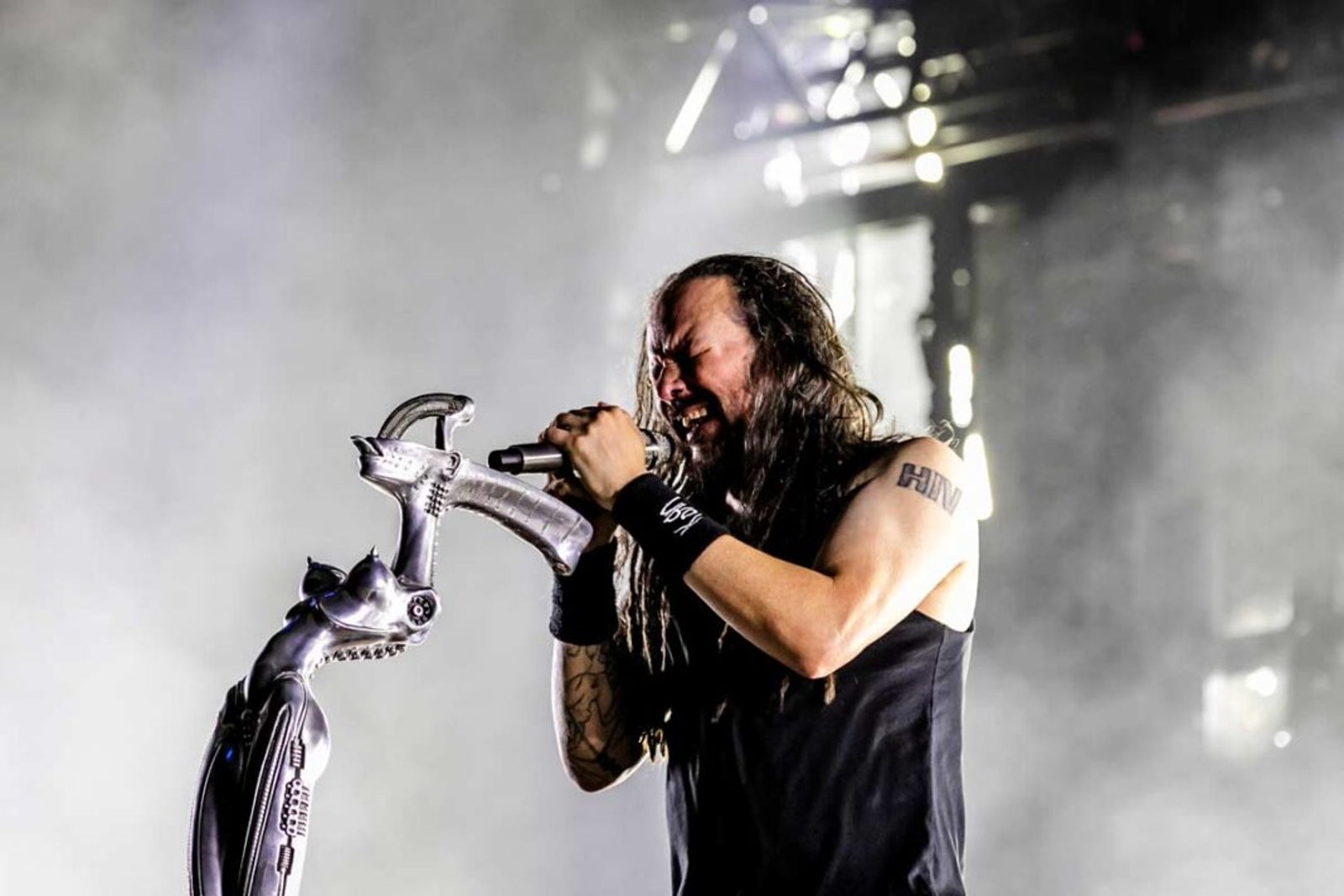
The Bakersfield band that took the virtuoso's instrument off the wall, slackened the bottom string until it slapped against the frets and built its first record on the noise that came back was Korn. Heavy metal had spent twenty five years fusing the blues, the minor modes and the concert hall into one alloy that cannot be separated back out by ear. Nu metal is the other kind of mixture, and its parts can be named one at a time.
Where the wider frontier runs, against hard rock and punk and glam and the extreme cousins, is drawn in the chapter above. This border needs different evidence, because the two musics agree about volume, distortion, black clothing and anger, and disagree about almost everything underneath them.
Heavy metal vs nu metal, heard on the bottom string
A heavy metal riff is a line of pitches that goes somewhere. "Riding on the Wind", the second song on Judas Priest's Screaming for Vengeance in 1982, climbs and falls through a minor shape at speed, hands two guitars a harmony to divide between them, and puts a solo in the middle because the riff has set up a question the solo is there to answer. Take the distortion away and the shape is still a tune. That is the test the older music passes.
A nu metal riff is a rhythm played on a pitch. The bottom string is tuned down until it is barely a note at all, it is struck on an off beat and then muted dead, and the interest of the bar lives in where the hits land rather than in where the hand moves, which is why so many of these records carry two guitarists and credit neither of them as a lead player. Nothing has been forgotten. The job was given to the drummer.
"Freak on a Leash", from Follow the Leader in 1998, shows the whole method inside four minutes. Reginald Arvizu's bass is slapped and popped in the manner of a funk player rather than plucked under the guitars, the middle section abandons words for a stretch of scatted noise from Jonathan Davis, and where a heavy metal band would raise a solo the song instead drops to nearly nothing and then hits the floor again. There is no lead break anywhere in it. Nobody involved considered that a loss.
A heavy metal riff is a line of pitches that goes somewhere. A nu metal riff is a rhythm played on a pitch.
Who the song is talking to
The second body of evidence is on the lyric sheet, and it is the one that decides most arguments. A heavy metal lyric is a report filed from somewhere the listener is not: a trench, a cockpit, a cell, a hall with the roof coming in. A nu metal lyric is a note left on the kitchen table of a house the listener already lives in, weighted down with the sugar bowl so the draught from the hall cannot take it.
Count the pronouns and the pattern is flat and obvious. Heavy metal writes in the third person about someone else, which is why its subjects run to soldiers, kings, machines and the devil, and why a fifteen year old can sing every word without giving anything away. Nu metal writes in the first person about the singer and in the second person at whoever did the damage, on any honest reading the oldest move in the blues rather than anything new. The vocabulary is small. The address is direct.
The names on the sleeve
Third piece of evidence, and the least arguable: read the credits. The Des Moines band that put nine men on a stage, two of them on custom percussion, one on turntables and one behind a bank of samplers, was Slipknot, and no heavy metal band in history has ever needed a member whose instrument is a sampler, because there is nothing in a heavy metal arrangement for that person to do.
"Duality", from Vol. 3: The Subliminal Verses in 2004, is the case at its clearest, because by then the band was plainly capable of the older music and chose the newer one anyway: a screamed verse over a figure that barely moves, a sung chorus built to be shouted back by a field, percussion hits scattered across the bar where a heavy metal band would put nothing at all. The band could play. The arrangement had other priorities.
Turn the sleeves over and heavy metal's personnel are as consistent as a trade guild's. One lead guitarist, or two who trade and harmonise; a bass player audible as a separate voice; a singer with a working upper register and a name for the note he is famous for. The exponent of that model who kept it running longest is Iron Maiden, three guitars and a bass writing counterpoint at each other. Nobody in that band has ever touched a turntable.
The records that refuse to sort

The Sacramento five who were sold with the movement, toured with it and spent twenty years refusing the label in interviews were Deftones, and White Pony, released by Maverick in June 2000, is where the argument gets hard. Chino Moreno sings more than he shouts, Stephen Carpenter's guitar sits under textures borrowed from shoegaze rather than from hip hop, and there is no rapping on the record at all. The tuning says one thing. Everything laid on top of it says another.
Two more resist in the opposite direction. Fear Factory came out of death metal and kept its double kick drums and its machine precision while the press filed the band with the newcomers, and Machine Head, a thrash band by descent, let Ross Robinson produce The Burning Red in August 1999 and then spent the following decade grinding the movement's sound back out of its riffs. A record can wear the clothes without changing its blood.
What each one left behind
The inheritance runs in both directions, which is the surest sign that these were two musics and not one. Tunings that nobody would have touched in 1988 are now standard issue across metal, and the producers who learned their trade on those records went on to make some of the heaviest music of the following twenty years. The bottom string stayed loose. Almost everything else was handed back.
Heavy metal, for its part, never went away and never needed rescuing. The harmony guitar came back through the young bands of the 2000s, the clean high voice came back with them, and both of them are now playing to bigger rooms than the movement that was supposed to have replaced them. A question of the same shape, asked about a band that spent fifty years refusing the word, is settled under is AC/DC heavy metal.
The last piece of evidence is the plainest one. Ask a nu metal record to hand over its parts and it will give them up one at a time, the hip hop cadence here, the funk bass there, the down tuned guitar underneath. Ask a heavy metal record the same thing and nothing comes apart, because the parts stopped being parts somewhere around 1970 and have not been separable since.
