
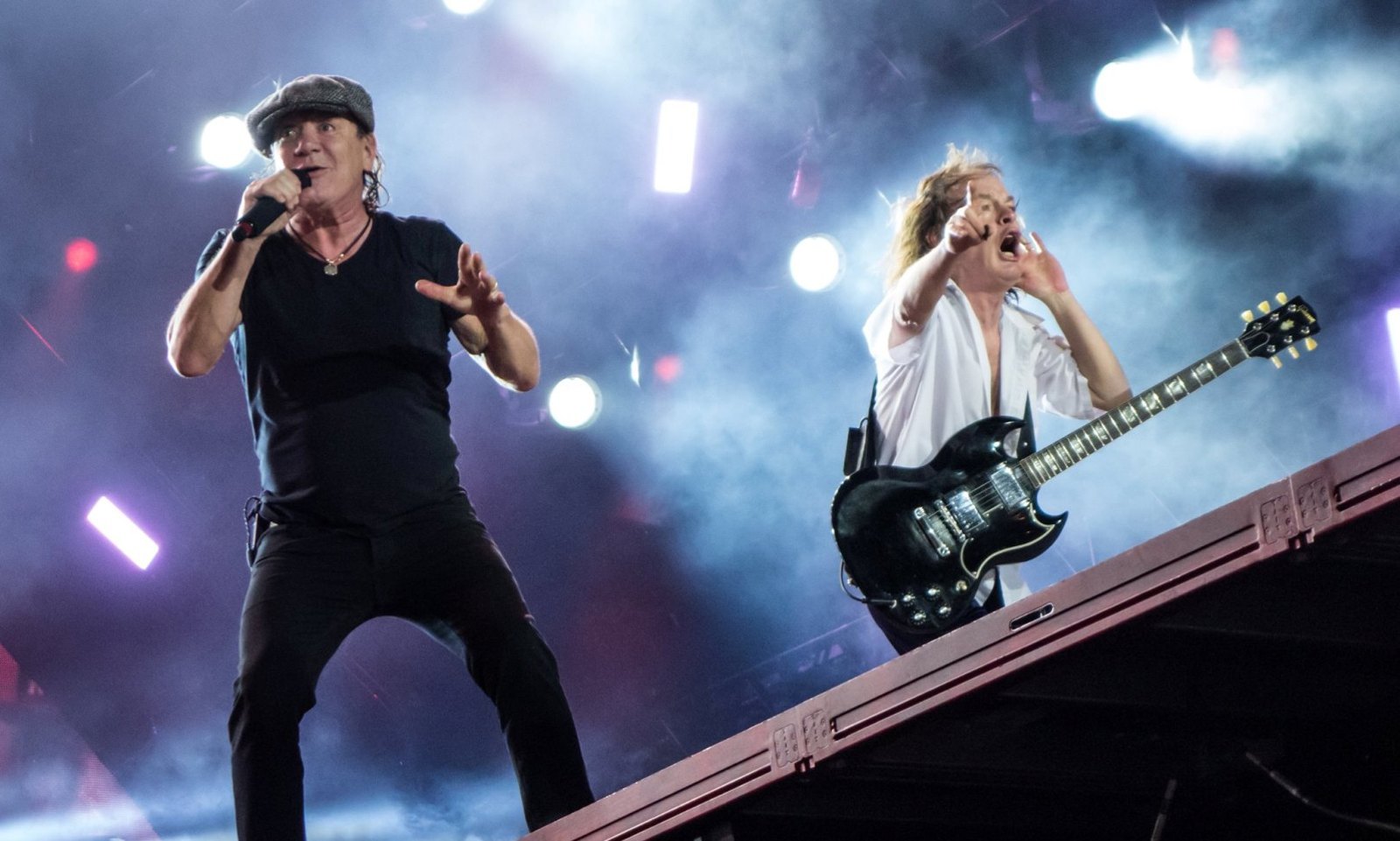
No. AC/DC is a hard rock band, the greatest of them, and it has never once been heavy metal, whatever the patches on the jackets in the front row say. Yet the old pub question, is AC/DC heavy metal, refuses to die, and the reason is that the evidence comes in several kinds and the kinds pull in opposite directions. The band that the heavy metal festival at Castle Donington put at the top of its bill three times, in 1981, 1984 and 1991, more often than any other act in the Monsters of Rock years, was AC/DC, playing Malcolm Young's open chords struck as if to split the pick in half.
On Anzac Day the pubs of Australia bring out the game the diggers carried to the trenches, a penny game from the gold rush years, legal today only at approved venues on this one day: a spinner steps into a ring of shouting drinkers, lays two pennies tails up on a flat wooden kip and flings them spinning above the heads of the crowd. Two heads wins and two tails loses. One of each is odds, which settles nothing, and the pennies go up again. On this question the coins have been coming down odds for fifty years, one head for the volume and the festival bills, one tail for the rhythm and the band's own word, and the ring keeps roaring for another throw.
The way to stop throwing is to count the coins separately.
Is AC/DC heavy metal? Ask the titles
Start with the band's own testimony, and not with the interviews. Across five decades AC/DC has printed its creed on its own record sleeves, and the word on them is always the same one. "Let There Be Rock" in 1977. "Rock 'n' Roll Damnation" in 1978. "Rock and Roll Ain't Noise Pollution" to close Back in Black in 1980, For Those About to Rock We Salute You in 1981, and Rock or Bust in 2014.
Not one title in the catalogue uses the other word. Bands in the heavy metal trade printed it on their sleeves as a boast from 1980 onwards, in song after song and album after album, and a band that spent those same years writing rock and roll into its anthems was answering the question in the only place where its answer could not be misquoted.
| Evidence | Where it points | The case |
|---|---|---|
| Song and album titles | Hard rock | "Let There Be Rock", "Rock or Bust", never the word metal |
| The rhythm section | Hard rock | A backbeat that never straightened, from Powerage to Rock or Bust |
| The songs metal claims | Heavy metal, partly | "Hells Bells", "Thunderstruck", the cannons of "For Those About to Rock" |
| Festival bills | Heavy metal | Monsters of Rock headliner in 1981, 1984 and 1991 |
| The Grammy | Hard rock | Best Hard Rock Performance for "War Machine", 2010 |
| The genre's own register | Hard rock | Left out of Metal Archives, whose own rules require "unambiguously heavy metal" |
The rhythm section never changed its mind
The physical evidence is in the grooves, and it is the kind that settles the case. The rhythm guitarist who wrote most of the riffs, held the band to the backbeat for forty years and treated a guitar solo as something his younger brother could have if he finished it quickly was Malcolm Young, and under him Phil Rudd played the kick and snare the way a Chuck Berry drummer would have, only harder.
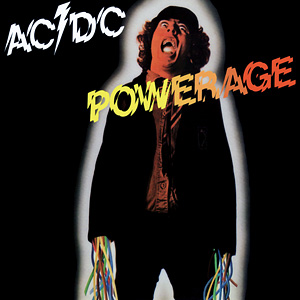
Take Powerage, released in May 1978, and the record the faithful most often hold up as the band's heaviest, and "Riff Raff" in particular, which runs at a tempo close to anything the young British metal bands were playing a year later. The speed is real. The swing never leaves it: the snare still lands on two and four with the lilt of a dance hall, and the chords are the open, bluesy shapes of a bar band turned up past the point of reason.
A racing pigeon let out of a basket at a railway halt five hundred miles from home circles twice, finds its bearing and flies straight back to its own loft, through hail that knocks weaker birds out of the sky and past a thousand finer lofts on the way. AC/DC's records fly home the same way. The self-produced Flick of the Switch in 1983, Rick Rubin's production of Ballbreaker in 1995 and Brendan O'Brien's of Black Ice in 2008 all land on the same backbeat.
That drumbeat is the test that decides hard rock vs heavy metal for every band on the border, and AC/DC answers it the same way on every record it ever made. The volume says metal. The feet say otherwise.
The voice points the same way. The Newcastle singer who took over the microphone in the spring of 1980, weeks after the death of Bon Scott, and pushed his rasp so far up the register that he is taken for a metal screamer by anyone who has never sat through a Judas Priest record, was Brian Johnson, hired that April. The notes are high. They are torn from the throat over a blues phrase rather than sung from the head over a minor riff, and the rasp hides the difference only from a distance.
The songs metal claims
The case for the other side is not nothing, and it rests on a handful of songs. "Hells Bells" opens Back in Black, the record Atlantic released in July 1980 with Johnson's voice on it for the first time, with the sound of a struck bell and a slow minor riff with more menace in it than anything else on the album. It is the darkest thing the band recorded. It still swings.
The producer who took the band into the nineties with The Razors Edge, released by Atco in September 1990, and gave "Thunderstruck" its stadium gloss was Bruce Fairbairn, and the song is the nearest AC/DC came to the other trade: Angus Young hammering a single figure on one string with the left hand alone, a pedal note pounding underneath, a gang chant in place of a verse. Metal fans took it as theirs at once. The drums, when they arrive, still dance.
The festival bills and the paperwork
Then there is the evidence of company, and here the case for metal is at its strongest. Donington in those years was the heavy metal calendar's single largest day, and across those three bills AC/DC headlined over Whitesnake in 1981, Van Halen and Ozzy Osbourne in 1984, and Metallica in 1991, and an AC/DC back patch has sat beside Iron Maiden and Saxon on the denim at every metal gathering since the early eighties, with nobody on the gate ever asked to see its papers.
The 1991 set closed, as AC/DC shows have closed since the tour of 1981 and 1982, on "For Those About to Rock (We Salute You)" and a row of stage cannons firing over the crowd, a salute borrowed from the gladiators of Rome, who greeted the emperor with the same words before a fight to the death, and turned into the loudest full stop in the business. It is pure heavy metal spectacle. The song under it is a mid-tempo rock and roll march.
The institutions go the other way. The body that handed the band its only Grammy, at the ceremony of January 2010, and handed it for Best Hard Rock Performance rather than Best Metal Performance, turned out to be the Recording Academy, and the award, the only Grammy the band has ever won in a career of ten nominations, went to "War Machine" from Black Ice. The encyclopaedia that the metal underground keeps of its own music, and whose own rules ask for a release that is "fully, unambiguously heavy metal", goes by the name Metal Archives, and AC/DC is not in it. That is not an insult. It is housekeeping.
Where the verdict falls
Weigh the kinds of evidence against each other and they are not equal. Festival bills and fans measure who a band plays to, and the heavy metal audience has loved AC/DC for half a century, beyond dispute. Titles, the rhythm section and the paperwork measure what the band is, and all three say hard rock. What a band is outweighs who buys the tickets.
So AC/DC is the hard rock band that heavy metal adopted, with the band's cheerful refusal and without its permission. The same question, asked about a band that crossed the border with a single song and never followed it, has a different shape entirely, and it is answered under is Queen heavy metal.
