
Seventy-five weeks on the Billboard 200, a peak at number 29 and a platinum disc, and not one word sung from the first track to the last. The record was Surfing with the Alien, released by Relativity in October 1987, and it proved that instrumental heavy metal bands could sell to people who had never held a guitar. The singer, it turned out, was optional.
A foil bout runs without a word. Two fencers salute, pull down their masks and go, and the referee does not ask either of them what they meant, because the only witness he trusts is the scoring box, where a lamp flares the instant a point stabs the metallic lamé over an opponent's chest hard enough to bend the whole blade into a bow. No speech wins a point. Only the touch does.
The Long Island guitarist who had taught Steve Vai and Kirk Hammett before anyone paid to hear him play was Joe Satriani, and he built every melody like a locksmith cutting a key blank, one pass at a time, until nothing was left that could not open the next bar, no chorus to hide behind and no verse to rest in. He had given Vai his first lessons at twelve, on Long Island, and taught Hammett through the Exodus years into Metallica. The instrument had to carry the tune, the argument and the hook at once. That is the whole trade.
Raids from records with a singer
The reason it worked at all is older than any of these records. Heavy metal had made the riff the subject of the song from the first Black Sabbath album onward, with the voice riding on it rather than the other way round, so taking the singer away removed the decoration and left the frame of the house standing. In most pop music a song without its singer is a backing track. In heavy metal it is often the song.
The instrumental started life inside ordinary heavy metal albums, as a raid from the ranks rather than a regiment of its own. The East London band that let its two guitarists off the leash for four minutes on its first album, in April 1980, was Iron Maiden, and "Transylvania" gallops at a velocity the vocal songs around it never quite reach. Nobody missed Paul Di'Anno for the duration. The band kept the habit into the Dickinson years, putting on Powerslave in 1984 "Losfer Words (Big 'Orra)", four minutes of twin leads with the microphone switched off.

The bassist who stepped forward alone on Kill 'Em All in July 1983, with a distorted solo the label listed as "(Anesthesia) Pulling Teeth", was Cliff Burton, and a year later Metallica gave nearly nine minutes of Ride the Lightning to "The Call of Ktulu", a slow build borrowed in name from H. P. Lovecraft. The songs with words sold the records. The instrumentals told the players what the band could really do.
Across the border, Rush had already put "YYZ" on Moving Pictures in 1981, a piece built on the Morse code for the Toronto airport's identifier, and it drew a Grammy nomination for rock instrumental performance, losing to the Police. Heavy metal drummers learned it bar by bar. Few of them could play it.
Instrumental heavy metal bands on the charts
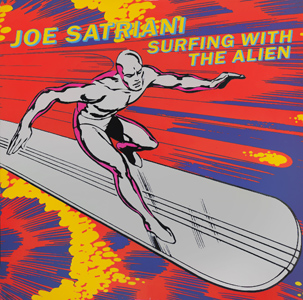
Recorded on a small budget with Satriani playing most of the rhythm parts himself, and sold on a sleeve that borrowed Marvel's Silver Surfer, the title track of Surfing with the Alien runs its melody on the high strings with the whammy bar bending the ends of the phrases the way a singer would bend a vowel, while the rhythm guitar underneath keeps a hard rock shuffle going like a pulse. The whole record cost about thirteen thousand dollars, and the label licensed the Silver Surfer artwork from Marvel for the sleeve. The tune does the singing. The guitar is the voice and the band at once.
The neoclassical shelf that Mike Varney stocked at Shrapnel ran alongside, with Yngwie Malmsteen as its founding exponent and the harmonic minor scale as its rule book, and Jason Becker's Perpetual Burn, released by Shrapnel when Becker was eighteen, pushed the sweep-picked arpeggio about as far as a teenager's hands could take it. Satriani's own pupil went somewhere else. Steve Vai released Passion and Warfare in 1990 and made the instrumental guitar record something closer to a film score, and the pair of them turned a whole generation of guitar students away from the singer's microphone and towards the metronome. Precision became the point of the exercise.
No speech wins a point. Only the touch does.
Bands without a singer, by choice or by contract
The shred records were solo records with hired bands. The groups that came next were bands in the full sense, and they carried their arms the way a family carries a coat of arms with the motto scroll left blank: shield, helm and crest all painted in, and under them a ribbon where every other house writes its words, empty on purpose, the silence itself the device. The listener fills the scroll.
The West Virginia trio that had never wanted a singer and was made to hire one anyway went by the name Karma to Burn. Roadrunner signed the band in 1996 on condition that it recruit a vocalist, and after a brief trial with John Garcia of Kyuss the band brought in a friend, Jason Jarosz, for its 1997 debut. It sold poorly, the singer went, the label went with him, and the trio carried on instrumental from Wild, Wonderful Purgatory in 1999, naming every song by a number and nothing else.
The quartet assembled in 1997 from two members of Dream Theater, the drummer Mike Portnoy and the guitarist John Petrucci, with Tony Levin on bass and Jordan Rudess on keyboards, called itself Liquid Tension Experiment, and its first album, released by Magna Carta in 1998, was written and recorded in five days. Rudess joined Dream Theater not long after. The side project had done the audition.
Post-metal, eight strings and the long crescendo
The twenty-first century changed the shape of the instrumental from the solo to the slow build. The Chicago band that stacked detuned riffs into ten-minute pieces that climb, collapse and climb again was Pelican, and "Autumn Into Summer", from The Fire in Our Throats Will Beckon the Thaw, released by Hydra Head in May 2005, crushes a doom riff under layers of guitar until it gives way to a bright, open chord. Out of the same city came Russian Circles, formed in 2004 by the guitarist Mike Sullivan and the drummer Dave Turncrantz, a trio whose guitarist loops one part over another on stage until a single player sounds like a section, and whose records since Enter in 2006 have kept the singer's chair empty for twenty years.
The trio built around the eight-string guitar of Tosin Abasi answered to Animals as Leaders, and "CAFO", from the self-titled debut released by Prosthetic in 2009, shreds a jazz fusion figure across strings tuned low enough for a bass player, with Abasi slapping and tapping the bottom of the neck while the top carries the melody. The attested lineage runs straight back to Satriani. The tuning runs somewhere he never went.
Behind Abasi came a whole shelf of guitar bands with no microphone on the stage, Scale the Summit from Houston and the Sydney guitarist Plini among them, many selling their records straight to guitar students who wanted the tablature as badly as the music. The audience had changed. It now arrived with a guitar of its own.
A band without a singer has nothing to hide behind and nobody to blame. Every weak bar is the guitarist's, and the audience knows it before he does.
Declan Rourke, KaosMetal
The family has kept growing on both sides, from the tightly composed metal of Ron Jarzombek's Blotted Science to the clean-toned pop shred of Polyphia, formed in Plano, Texas, and every one of them still sits somewhere on the map of the subgenres in order, as a split along the line of technique rather than tempo or weight.
Unarguably, the instrumental has survived longer on its own than anyone at a record label in 1987 expected. It also left a debt in one unexpected place: the riff-first trio from the Appalachians leads straight on to the southern heavy metal bands, where the riff swings and the singer comes back. The singer was never the problem. He was simply never required.
