For the apparel oft proclaims the man.William Shakespeare, Hamlet
Yes, for three years and two albums, and by the photograph and the balance sheet rather than by the sound. The New Jersey quintet that sold more records under the hair metal banner than any band from the Sunset Strip itself went out under its singer's surname, Bon Jovi, and the Bon Jovi hair metal question has been argued ever since by people looking at different evidence. The pictures say yes. The songs mostly say no.
The label fits them the way a customs tag fits a crate of machine parts: tied on at the docks in 1986 by a clerk who read the paperwork and never took a claw hammer to the lid, then left in place for forty years because nobody could be bothered to lever it off and look at the Jersey Shore rock band packed in straw underneath. The contents were never quite what the tag declared. The tag has never come off.
The case turns on what the word is taken to mean. Taken as a sound, a Strip riff with a glam chorus on top, it describes Ratt and Mötley Crüe far better than it describes a band built around a keyboard player. Taken as a moment, the stretch of 80's hair metal between MTV's first broadcast and Nevermind, Bon Jovi stood at its centre, and that much is beyond dispute.
Three tests settle most of it, and they do not agree with each other:
- The sound: keyboards, story songs and a Jersey Shore bar band chassis. Mostly no.
- The look, from 1986 to 1989: teased hair, spandex, scarves. Plainly yes.
- The market: the same label racks, the same manager, the same MTV slots. Yes, and at the very top.
The case for: the photograph and the market
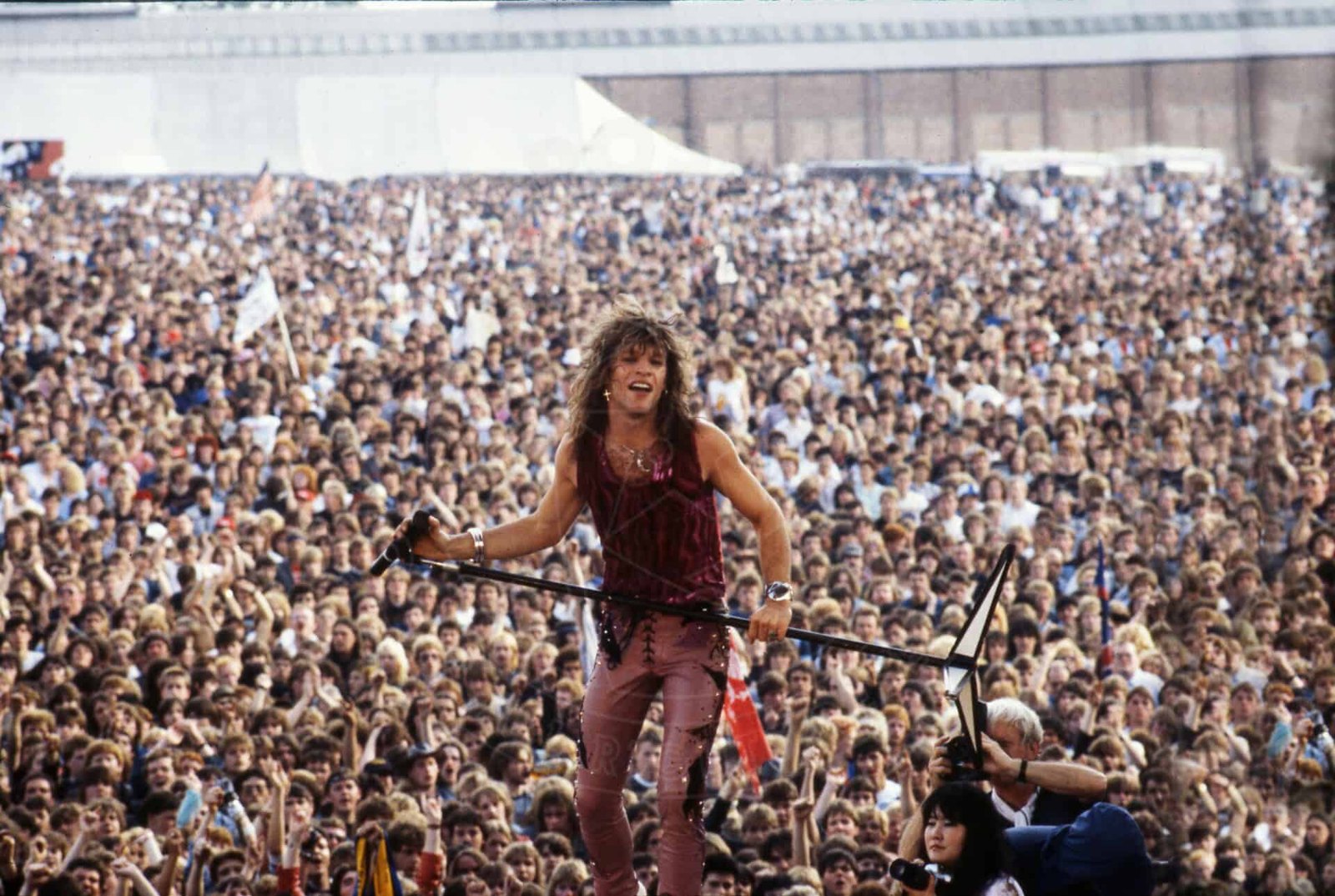
Look at any photograph from the Slippery When Wet tour and the argument is over in a second. The teased and lacquered hair, the torn denim over spandex, the scarves knotted round the wrists and the microphone stand: in 1986 and 1987 the band looked exactly like the bands the label parked beside them in the racks, and the video for "You Give Love a Bad Name", released that July, sat in heavy rotation on daytime MTV before it carried the single to number one on the Hot 100 that November.
The market says the same thing. Slippery When Wet, released by Mercury on 18 August 1986, spent eight weeks at number one on the Billboard 200 and has been certified fifteen times platinum in America. The band shared its manager, Doc McGhee, with Mötley Crüe, Scorpions and Skid Row, and on 12 and 13 August 1989 four of his acts, Bon Jovi and Mötley Crüe among them, played the Moscow Music Peace Festival on the same bill. They sat inside the machine, not beside it.
And they fed it. Jon Bon Jovi saw Cinderella play and helped bring them to Mercury, and Skid Row, whose guitarist Dave Sabo had grown up three streets from the singer and once tried out for his band, opened the Slippery When Wet tour, caught McGhee's ear from that stage, and signed to Atlantic on his say so. A band that sponsors half the second wave of a genre cannot credibly claim to be a visitor to it.
The case against: the sound and the street
Now take the hair away and listen. The first single, "Runaway", was recorded in 1982 with session players at the Power Station in New York, a studio co-owned by the singer's cousin Tony Bongiovi, and it broke on WAPP, a local New Jersey station's compilation of homegrown talent, before the band that played it live even existed in its final form. The riff on it is played by a synthesizer. That is not a detail.
David Bryan's keyboards sit at the front of nearly every record, where a Strip band would have put a second guitar, and the songwriting comes from the Jersey Shore bar circuit of Bruce Springsteen and Southside Johnny rather than from the Troubadour. "Livin' on a Prayer" is a story song about a working couple scraping through a strike and a bad year, sung over a talk box riff from Richie Sambora, which is a long way from the party anthems the Strip was selling. The band never played pay to play on Sunset. It never needed to.
"Wanted Dead or Alive", the third single from the same album, is the clearest exhibit of all, a twelve string acoustic figure and a slide guitar turning the band into outlaws in a western, with not a single bar that owes anything to Judas Priest or the British wave. Sambora could play metal. He mostly chose not to.
The one record that leans toward the Strip is the one nobody remembers. 7800° Fahrenheit, released on 27 March 1985 and named for the melting point of rock, pushed Sambora's guitars louder and the keyboards back, and on "In and Out of Love" and "Only Lonely" the band sounds as close to the Hollywood clubs as it ever would. It sold respectably and no more. The band drew the obvious lesson, handed the next album to outside songwriters and a new producer, and never went back to that volume again.
The pictures say yes. The songs mostly say no.
Bon Jovi hair metal, sorted record by record
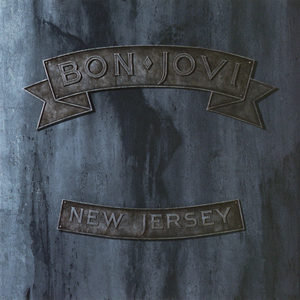
The high tide came on 19 September 1988. New Jersey entered the Billboard 200 at number eight, climbed to the top the following week and stayed there a month, and threw off five top ten singles on the Hot 100, "Bad Medicine" and "I'll Be There for You" both at number one among them, still the only hard rock album to place five singles inside the top ten. It is the most hair metal record the band ever made in look and in timing. In sound it is Slippery When Wet with the guitars pushed up a notch and a Jersey flag nailed to the mast.
| Album | Year | Where it sits |
|---|---|---|
| Bon Jovi | 1984 | Keyboard arena rock |
| 7800° Fahrenheit | 1985 | The loudest guitars of the early records |
| Slippery When Wet | 1986 | Hair metal by look and by market |
| New Jersey | 1988 | The peak of the hair years |
| Keep the Faith | 1992 | The haircut: roots rock for the nineties |
| Crush | 2000 | Pop rock, no argument left |
What the haircut settled
The nineties answered the question more cleanly than any critic did. When grunge routed the Strip bands off the radio, the singer took a pair of barber's shears to his own hair, cutting through the last rope that tied the band to the sinking barge of 1989, and Keep the Faith, released on 3 November 1992, arrived as a roots rock record with hardly a trace of the old lacquer on it. The barge went down. The band did not.
Three years later These Days, released on 27 June 1995, went further still, a dark, slow, almost bluesy record with Sambora's slide guitar running through it, which gave the band its fourth straight number one on the British album chart while an America that had filed the band under the eighties let it stall at No. 9. The American label was still stuck to the band. Europe had stopped reading it.
A hair metal band dies with its haircut. This one got a haircut and went on selling stadiums for thirty years, which tells you what was under it all along.
Declan Rourke, KaosMetal
Then came "It's My Life" in 2000, a talk box riff and a stadium chorus carried straight into the new century, and on 14 April 2018 the Rock and Roll Hall of Fame inducted the band. None of the Strip bands they once stood beside has made that journey intact. Survival on that scale is its own evidence.
So the verdict holds in both directions. As a sound, Bon Jovi is New Jersey arena rock with a keyboard at its centre and metal guitar laid on top for three records. As a moment, a photograph and a business, it is the biggest hair metal band there ever was. The quarrel over which label fits which band is older than Bon Jovi and runs through the rest of the decade, and it gets its hardest test with the band that invented half the look, under the question is Mötley Crüe glam metal. The apparel proclaimed the band for three years. The songs never signed the declaration.