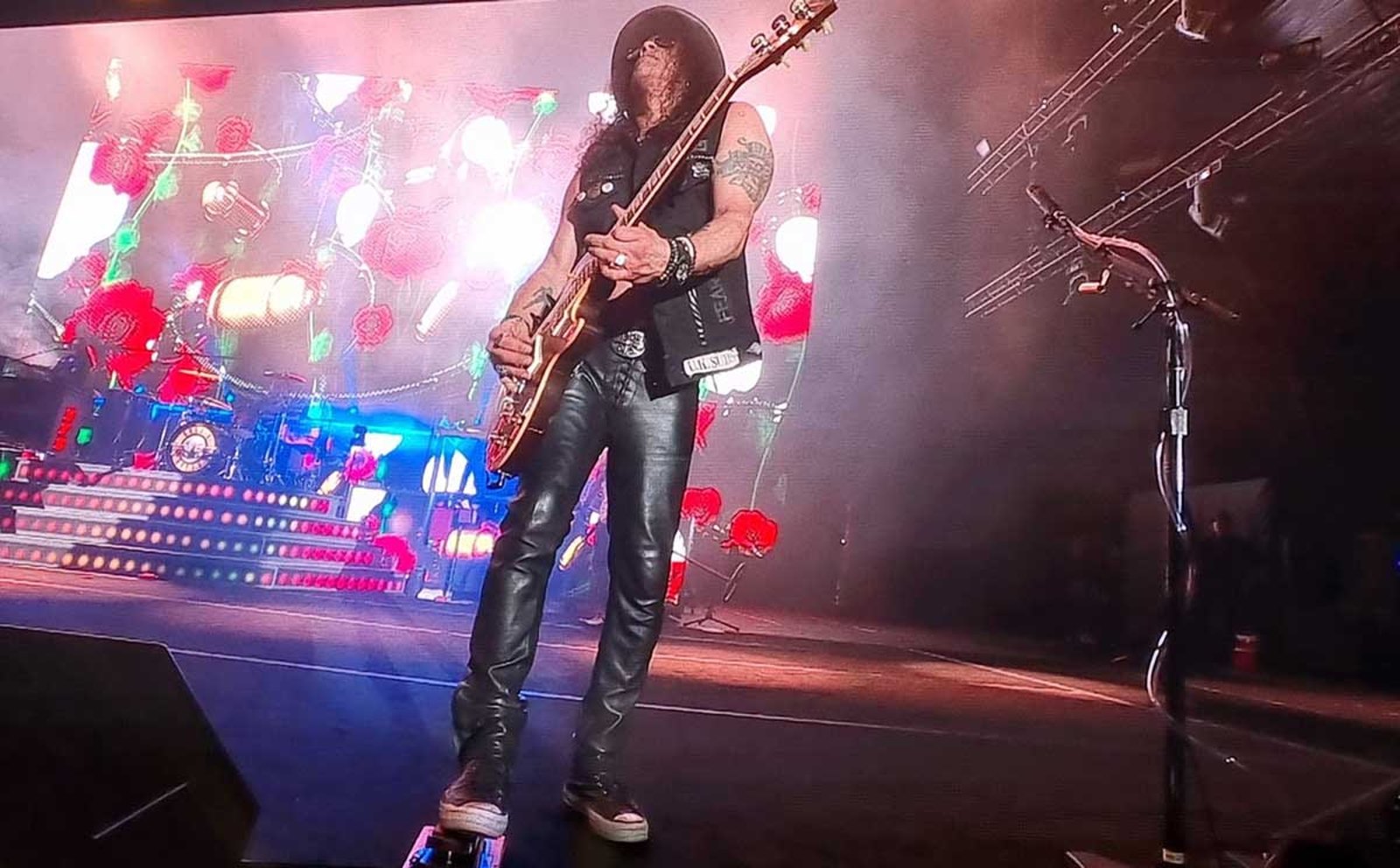
No, and the no has to be won inside the tank, because that is where the band was bought. The five men who came together in the Hollywood clubs in the spring of 1985, took their name from two local bands, played the rooms Poison and Ratt played, signed to the Geffen label that was selling Whitesnake to America and then outsold every one of their neighbours on the Strip were Guns N' Roses. The address is beyond dispute. The animal is not.
A pet shop in a strip mall sells a juvenile piranha, silver and speckled, to a boy who wanted something bigger than goldfish, and for a week it cruises among the fantails under the same blue strip light, snaps up the same flakes and hangs in the same stream of bubbles from the same pump, until one morning it has stripped the fins off every fantail in the tank. Nobody calls it a goldfish after that. It never was one.
Is Guns N' Roses hair metal? The tank says yes: the same street, the same label racks, the same MTV rotation and the same backcombed hair on the first sleeve. The fish says no. How the whole shop was stocked, the clubs, the cameras and the ballads bought on credit, is laid out in the related chapter. The fish itself is known by five things that can be held in the hand: a sleeve, a guitar, a lyric sheet, a ballad and a list of enemies.
The sleeve that says yes
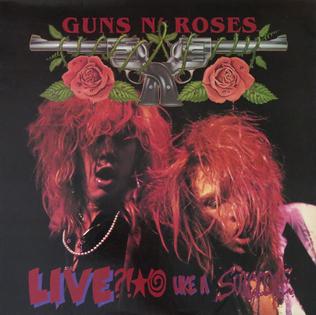
Released in December 1986 on Uzi Suicide, a Geffen-backed imprint wearing an independent's name, Live ?!*@ Like a Suicide put two heads of backcombed, backlit hair across the front of its sleeve, and anyone who pulled it out of a rack that winter beside Poison's first album would have dropped both records into the same bin without a second look. The prosecution leans hardest on that picture. It is right to.
The birth certificate says the same. The two Hollywood bands that were folded into one in March 1985, one fronted by a singer who had come west from Lafayette, Indiana, the other named after its own guitarist, were Hollywood Rose and L.A. Guns. By June the line-up had settled on Axl Rose, Slash, Izzy Stradlin, Duff McKagan and Steven Adler, and the new band was working the same few clubs as everybody else on the street. That is a Strip pedigree. It is also the last exhibit the yes can call.
The guitar that says no
Switch the picture off and the first witness for the defence is a guitar. The instrument carried through the Appetite for Destruction sessions was no pointed Jackson with a locking bar but a copy of a Gibson Les Paul, fitted with Seymour Duncan pickups and plugged into a Marshall, and the player hunched over it, born in England and raised in Los Angeles, was Slash. There is no dive bomb anywhere on the record. There is no tapped run either.
The family behind the playing points away from Pasadena. Most guitarists on the Strip had learned their trade off Eddie Van Halen's right hand, but the band whose 1976 album Rocks made this guitarist want an instrument at all, by his own repeated account, was Aerosmith, and behind Aerosmith stand the Rolling Stones. That is a bar band's ancestry, traced through blues riffs played loose and a little late. It has no Kramer in it.
"It's So Easy", sent out as the band's first single in Britain on 8 June 1987, shows what replaced the Strip's twin leads. The two guitars never harmonise. Izzy Stradlin's chords and Slash's fills fall into each other like the halves of a deck in a card sharp's riffle, bent back under the thumbs until the cards crack and let go, each card of one half dropping between two of the other, while Duff McKagan drives the song at a punk tempo learned in a run of Seattle bands before he ever saw the Strip.
The desk tells the same story. The man the label first lined up to produce the album, and whom the band sent away once he started wanting to rebuild the drummer's kit, was Paul Stanley of Kiss. The record went instead to Mike Clink, who cut it at Rumbo Recorders in Canoga Park and three other Los Angeles rooms between January and June 1987. Tom Werman and Beau Hill, the hands behind half the Strip's hits, never came near it.
The words from the wrong side of the street
Where the Strip wrote the party, this band wrote the morning after it and the bill that came with it: heroin as a houseguest in "Mr. Brownstone", a city chewing up whoever steps off the bus in "Welcome to the Jungle", and a bottle of cheap fortified wine held up like a banner in "Nightrain". The girls are still there. So are the needles, the unpaid rent and the police.
The sleeve made the point before a note was heard. Geffen's first cover was a Robert Williams painting of a robot assailant about to be torn apart by a metal avenger, and when shop chains refused to rack it the label swapped in Billy White Jr.'s cross of five skulls, one for each member, the sleeve on nearly every copy of an album since certified eighteen times platinum. Strip sleeves sold the girl. This one was refused as a heresy.
Strip sleeves sold the girl. This one was refused as a heresy.
The ballad, where the yes is strongest
Here the defence has to give ground. G N' R Lies, released in November 1988, put four acoustic songs beside the reissued EP and climbed to number two on the Billboard 200 while Appetite was still on the chart, and from it came a slow song worked to Top 40 radio exactly the way the Strip worked its own.
"Patience" opens on a whistle over three acoustic guitars and no drums, reached number four on the Hot 100, and by the arithmetic of the market it does precisely what "Every Rose Has Its Thorn" had done for Poison a few months earlier. Add the nine minutes and the orchestra of "November Rain" in 1992 and the charge of trading in power ballads sticks. The ballads were bigger than anyone else's. That is not a defence.
What the ballad cannot do is drag the rest of the catalogue into the same bin. A hair metal album was built around its slow song and sold on it; these slow songs sat at the edge of records that were loud, long and hostile everywhere else.
Is Guns N' Roses hair metal? The enemies decide
The last exhibit is the company the band chose to keep. While the Strip's survivors spent 1993 growing goatees and tuning down, this band made The Spaghetti Incident?, released that November and debuting at number four, a whole album of songs taken from the punk and glam records its members had grown up on, the Stooges and T. Rex and the Misfits among them. Hair metal bands did not keep records like that under the bed. This one had kept them on the turntable.
The enemies it made point the same way. The Seattle singer who turned down the offer of the support slot on the American leg of the Use Your Illusion tour was Kurt Cobain, and the scene that swept the Strip off MTV in a single season went on treating this band as the garrison still holding the fort rather than one more ruin to step over. Nobody mounts a sortie against a ruin. The refusal was meant as an insult, and it reads today as a credential.
Sorted by exhibit, the case splits cleanly. The sleeve, the street and the ballad chart say yes, and they say it loudly. The guitar, the desk, the lyric sheet and the enemies say no, and between them they carry the weight of the music. Guns N' Roses was never hair metal. It was a Strip band that sounded like the Strip's worst news.
The producer the band turned away belonged to a much older quarrel, the one over is Kiss hair metal, which runs the other way round: a band that painted half the costume the Strip later wore, then scrubbed the paint off and walked onto the same street itself.