A Los Angeles studio in late 1984, a Strip band called Keel cutting its first record for a major label, a singer whose earlier band had worked out of Nashville at the microphone, and on the other side of the glass, with the label's money and the final word on every take, sat the man who had spent the previous decade spitting stage blood over the front rows in greasepaint. The producer behind that desk was Gene Simmons. The pupils had hired the teacher.
A champion retired to stud earns more in the breeding shed than he ever earned on the track, and within ten years his foals fill every big field of the season, carrying his stride in their legs. Now and then an owner leads such a horse back out of his box at the stud, clips the grey out of his coat, puts his own sons' racing silks on the jockey and sends him to the post against a field of his get, where he slams two of them into the rail on the far turn and comes home in the first three. He wears their colours. He is not one of them.
Is Kiss hair metal? The silks say yes, for six seasons between 1983 and 1989, and the blood says something older. The street that dressed itself out of this band's wardrobe, and what it made of the costume, is chronicled in the full chapter. Kiss stood to that street in three relations at once, ancestor, trainer and runner, and each is its own kind of evidence.
The ancestor: what the Strip took from the paint
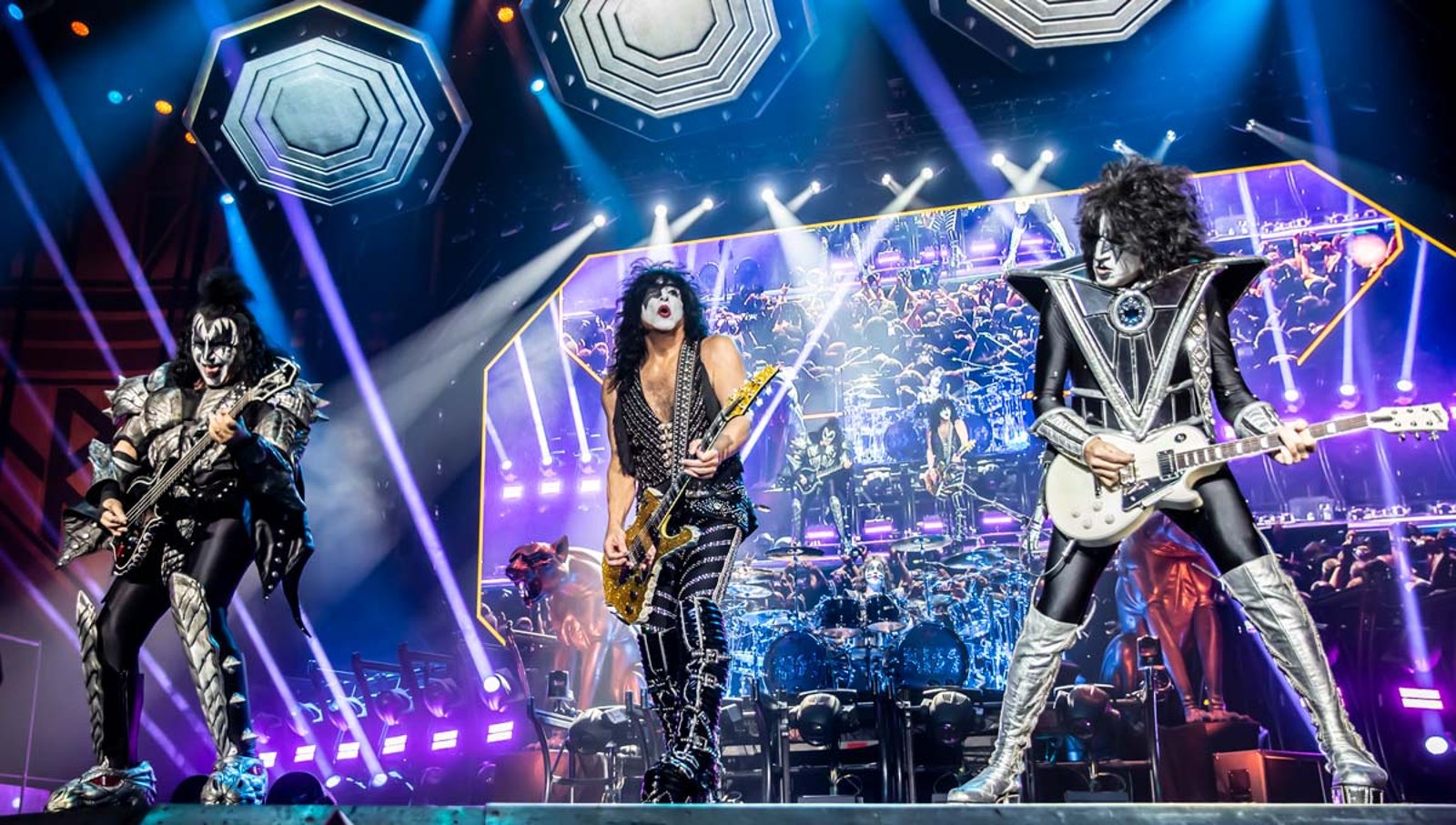
The first relation is the least disputed. The New York quartet that turned a hard rock concert into a spectacle of flash pots, levitating drum risers, fire breathing and a bassist hoisted into the lighting rig on wires from the Dynasty tour of 1979 on, and sold it to teenagers as a club they could join by post, was Kiss, and every headlining act on Sunset in the next decade borrowed some part of that machine. By common consent the Strip's bands learned their stagecraft from those shows. The paint they mostly left alone.
That distinction matters. The Strip took the platform boots, the pyrotechnics and the idea that a band should look like nobody in the audience, and it took the anthem, the chant built for a hall to shout back, straight off Alive! in 1975. It did not take the characters. Nobody on Sunset painted a demon or a starchild on his face; the Hollywood faces were made up as themselves, only prettier. The lineage runs through the stage, not through the mask.
The trainer: a Kiss bassist behind the glass
The second relation is the one most arguments leave out. The Kiss bassist who paid for an unsigned Pasadena quartet's first demo in the summer of 1976, tracked at Village Recorder in Los Angeles and finished with overdubs at Electric Lady Studios in New York, years before any label would touch it, was Gene Simmons, and the quartet was Van Halen. Kiss's manager would not take them on. A year later Warner Bros. did.
In the middle of the decade the same man went into the producing trade in earnest. The Right to Rock, released in January 1985, and The Final Frontier a year later both carried his name as producer, and so did Black 'n Blue's Nasty Nasty in August 1986 and In Heat in 1988. Each record came out of Kiss dough like a waffle pressed in the same iron, the same grid stamped into the batter again and again and the iron shut on the next ladle. The bands were real. The shape was his.
The bands were real. The shape was his.
The runner: six seasons in borrowed silks
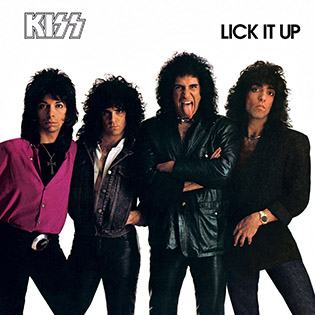
The third relation is where the yes lives. On 18 September 1983 the band showed its faces on MTV for the first time since early 1973, the same day Lick It Up reached the shops, and the sleeve put four men in leather and teased hair against a white wall where the painted characters had stood. It became the band's first gold record in three years. The costume had changed hands, and this time it was the elder wearing the children's.
The guitar chair tells the same story from inside. The players hired, one after another, to fill the lead guitar spot the Spaceman had left were Vinnie Vincent, Mark St. John and, from 1985, Bruce Kulick, all three fast, clean and fluent above all in the tapped and whammy-bar vocabulary the Strip was built on, and Animalize, released on 13 September 1984 with St. John on guitar, became the band's best-selling record of the decade in America, past two million copies. The market did not see a difference. Neither did the charts.
"Heaven's on Fire", the single that carried Animalize, written by Paul Stanley with Desmond Child, is the Strip formula at its most exact: a falsetto hook before the first verse, the chorus inside the first minute, a short solo and a video of the band in spandex working a crowd. Put it on a tape between Ratt and Dokken and no listener would stop the machine. That is the yes, and it is a strong one.
The writing partners confirm it. The songwriter who had finished "I Was Made for Lovin' You" with the band's singer in 1979, and who would hand the Strip's biggest acts some of their biggest singles, was Desmond Child, and his name came back to the credits of the unmasked records, "Reason to Live" in 1987 among them. Outside writers were the Strip's habit. The painted Kiss had mostly written for itself.
"Crazy Crazy Nights", from Crazy Nights in 1987, produced by Ron Nevison, finished the conversion, with keyboards laid across the chorus like a fanfare and a lyric about a whole generation being young and loud, and it climbed to number four in Britain, the band's highest placing there before or since. By then the old characters had been gone four years. The new ones looked like everybody.
The stable that grew up around it
The traffic ran the other way too, and the people carry the proof. The band a former Kiss lead guitarist put together under his own name in 1986, on Chrysalis, was the Vinnie Vincent Invasion. Its singer and its bassist walked out in 1988 and set up as Slaughter, whose Stick It to Ya sold in 1990 to the same audience that had bought Kiss in spandex, on the same kind of high chorus and the same kind of video. The progeny had children of its own.
| Who | Kiss connection | Strip band | Year |
|---|---|---|---|
| Gene Simmons | Paid for and produced a demo | Van Halen | 1976 |
| Gene Simmons | Producer, The Right to Rock | Keel | 1985 |
| Gene Simmons | Producer, Nasty Nasty | Black 'n Blue | 1986 |
| Vinnie Vincent | Kiss guitarist, 1982 to 1984 | Vinnie Vincent Invasion | 1986 |
| Mark Slaughter, Dana Strum | Out of the Vinnie Vincent Invasion | Slaughter | 1988 |
Is Kiss hair metal? The ancestor in borrowed clothes
Laid out by relation, the evidence is not close to a single answer. As ancestor, no: the band was selling its show to sold-out halls in 1975, six years before MTV went on the air, and the thing it sold was a comic book with guitars, not a Hollywood haircut. As trainer, it was inside the machine up to the elbows, paying for demos and producing records. As runner, from Lick It Up to the end of the decade, yes, in look, in writing partners, in guitarists and in chart position.
The paint went back on for a reunion in 1996, and when the Rock and Roll Hall of Fame came for the band in April 2014 it inducted the four original members, the painted line-up, and none of the players from the unmasked years. The institution drew its line where the paint came off. Kiss wore hair metal for six seasons and never belonged to it, because a style cannot be the descendant of itself.
The same decade raised the question from the other side of the country and the other end of the story. A Seattle band whose singer and guitarist had come out of the local glam scene, and whose name was born there, poses it in its sharpest form: was Alice in Chains ever hair metal.