
It's no use going back to yesterday, because I was a different person then.Lewis Carroll, Alice's Adventures in Wonderland (1865)
The Seattle quartet that signed to Columbia in 1989 on the strength of a demo, opened American shows for Poison and Van Halen within two years, sat in the Grammy shortlist beside the hard rock veterans of the decade, and then helped run the whole Sunset Strip off MTV before the ballads had finished charting was Alice in Chains. Every one of those facts pulls the band toward the hairspray. None of them settles it.
A bar of soap is never quite finished. Worn under the hot tap to a wafer too thin to hold, the old bar is mashed wet onto the face of the new one and ground in with the thumb until the two fuse, and most of it lathers away inside a week. Now and then one green stripe outlasts the rest and is still riding on the white bar when the new one is half gone. It is still the old soap. The bar is still the new one.
The question of Alice in Chains hair metal is a question about how much of the old bar was ground into the new one, and how much of it survived the lather. The decade that did the hiring, the clubs, the cameras and the singles bought on credit, is set out in the section that covers it. The answer lies in four things: the bands before the band, the name, the company it kept, and the riff underneath all three.
The bands before the band
The earlier bands were real, and the same people were in them. Layne Staley had sung in the local glam band Sleze, whose name changed in the middle of the decade. The bassist who had already shared a Burien band of the period with the guitarist was Mike Starr, and the pair arrived from Gypsy Rose in the new line-up like the two halves of a snapped wishbone that still fit together at the break. The guitarist who met the singer at a Seattle party around August 1987 and moved into the rehearsal space where he lived was Jerry Cantrell, whose own previous band, Diamond Lie, had worked the same club circuit on the same tough, sleazy rock.
That is a lot of hairspray for four young men from the suburbs of one northern city, and it is attested in photographs as well as in memory: the earliest pictures of the new line-up, taken under the Diamond Lie name in 1987 and 1988, carry the backcombing of the club circuit they had grown up on. The costume was worn in earnest. It was also worn for the last time.
The name that never wore away
One stripe of the old bar never wore away. The man who suggested the name, in a conversation about backstage passes with a member of the singer's earlier group, was Russ Klatt, and it had been spelled Alice N' Chains precisely so that nobody would read bondage into it. The new band kept it, restored the word the old one had been too nervous to print, and carried it onto every sleeve for the rest of its life. The spelling changed. The descent did not.
No other trace of Sleze reached the records. The songs Staley had sung in the glam years were left behind, the party lyrics went with them, and the high clean tenor that every Strip band required of its front man was never the instrument this band built on. A name is the one thing a band can inherit without playing it.
A name is the one thing a band can inherit without playing it.
The company it kept
The bills are the strongest evidence for the yes, and they are not in dispute. Between 1990 and 1991 the band opened for Iggy Pop, for Extreme, for Poison and for Van Halen, which is to say that a Columbia act from Seattle spent a good part of its first two years playing to the audience the Strip had built, night after night, in the same halls and under the same lights. Record companies book support slots by market. This one was booked as hard rock. It was the door into those halls that a label could open for a new band in 1990, and the band walked through it without changing its clothes.
The industry filed it the same way. In 1992 "Man in the Box" was nominated for the Grammy for Best Hard Rock Performance, and the band that took the award in that category, for For Unlawful Carnal Knowledge, was Van Halen. Headliner and support had become competitors inside a single year. The schism with the Strip was not yet visible from the ballroom where the envelopes were opened.
The riff underneath
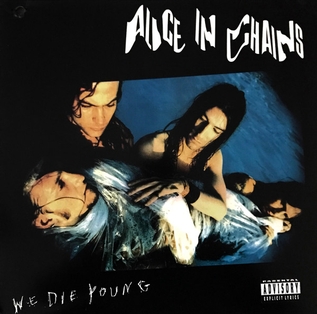
What was growing underneath came out on the first record. We Die Young, the three-song extended play Columbia released in June 1990 and worked to metal radio ahead of the album, carries not one of the Strip's devices: no chorus inside the first minute built for a sing-along, no ballad, no whammy bar, no party.
The desk points the same way. The producer who took the band into London Bridge Studio in Seattle for Facelift was Dave Jerden, and the record that had made his name was Nothing's Shocking by Jane's Addiction, the Los Angeles club band that had come up a few miles from Sunset without ever wearing its clothes. No producer from the Strip's usual circle touched the record. The choice of desk was an argument in itself.
The title track drops through the bar like a lift car whose cable has parted, the counterweight shrieking up the shaft as the car falls, until the safety brake bites into the guide rails and holds it one floor short of the pit, and Cantrell plays that fall and that catch over and over for two and a half minutes. Staley does not sing over it so much as through it. The drop comes from Birmingham, not from Hollywood.
The words hold the same line. By the band's own account the song was written after Cantrell watched nine and ten year olds doing business with pagers on the bus he rode to rehearsal, and nothing on the extended play or the album after it is about a girl, a party or rock itself, the three subjects the Strip returned to on almost every single it released. The Strip wrote postcards from the weekend. This was a report from the street.
"Sea of Sorrow", released as a single from Facelift in 1991, is the other half of the evidence: two voices stacked a close interval apart in a slow minor dirge, the harmony that became the band's signature and that has no model on the Strip at all. Its nearest relative is a Seattle one.
The guest who sang on two of the four songs of Sap, the acoustic extended play of February 1992, and who had spent the second half of the previous decade at the top of the American charts with a band from the same city, was Ann Wilson of Heart. That is the only eighties hard rock ancestry the band ever claimed in public. It ran north up the coast, not south to Hollywood.
Alice in Chains hair metal: the answer by kind
Sorted by kind, the evidence gives one answer at each depth. The members' earlier bands, yes, every one of them, and the early photographs with them. The name, yes by origin and no by use. The bills and the Grammy category, yes by the ledger of the industry that sold the records. The riff, the harmonies and the songs, no, without exception, from the first extended play onward.
So the band was never hair metal, though almost everyone in it had been. The glam years were real and they were short, a few seasons on the Seattle club circuit before the singer and the guitarist found the heavier thing they were built for. The Strip never had a bastion in Seattle to lose. It only had a few young men in borrowed scarves, and by 1991 they were somewhere else.
The costume did not stay buried. The bands that put it back on deliberately, knowing exactly what it cost the first time, are the modern hair metal bands, and they wear it as a choice rather than as the only uniform on offer.