
"Well, same thing there, no." The question had come straight after one about Satanism, in an Impericon interview on 9 February 2020, and the singer who dismissed both in a single breath, a baritone who had by then set a papal bodyguard, a Benedictine abbey smashed to rubble by Allied bombers and a Christmas ceasefire in the trenches of 1914 to music, was Joakim Brodén of Sabaton.
So, is Sabaton a Christian band? It is not. In the same breath Brodén had already put the rest of it plainly, no political or religious message anywhere in the music and nobody in the line-up worshipping the Dark Lord either, which settles the opposite suspicion too.
Faith in these songs is material, not message. The Swedes treat the church the way a medieval scribe treated an old choirbook, taking a knife to the vellum and scraping the prayers off the page until only the ruled staves and the square notes remain, then writing the dates of battles over them, so that the organ, the choir and the Latin keep their full sound while the creed underneath has been shaved clean away.
Is Sabaton a Christian band? What the catalogue says
Set out song by song, the evidence runs through two decades of records and the pattern never breaks. Union (Slopes of St. Benedict), on The Art of War of 30 May 2008, follows the four battles fought between January and May 1944 for the hill beneath Monte Cassino, the abbey Saint Benedict had founded some fourteen centuries earlier, and it sings the soldiers of many nations climbing the slope, never the monks who had prayed there.
The papal bodyguard of The Last Stand, the 2016 title song, dies at St Peter's on 6 May 1527 so that Pope Clement VII can escape the troops sacking Rome, and on Legends, released by Better Noise Music on 17 October 2025, Templars follows the trials that broke a crusading order on the orders of a French king. The church is the setting in every case. It is never the sermon.
| Song | Record | Subject |
|---|---|---|
| In the Name of God | Attero Dominatus (2006) | Terror committed in religion's name, 11 September 2001 |
| Union (Slopes of St. Benedict) | The Art of War (2008) | The battles for Monte Cassino, January to May 1944 |
| The Last Stand | The Last Stand (2016) | The Swiss Guard in the Sack of Rome, 1527 |
| Christmas Truce | The War to End All Wars (2022) | The Western Front, December 1914 |
| Templars | Legends (2025) | The trials and dissolution of the Knights Templar |
The one song that reads like a statement is In the Name of God, from Attero Dominatus in 2006, and its target is the reverse of a creed. The band's own note ties it to the attacks of 11 September 2001, and it condemns killing done under religion's cover, a judgement on violence rather than a position on God. Anyone still asking is Sabaton Christian because a monk, a crucifix or a chapel turns up in a video is reading the scenery as a confession.

The War to End All Wars, released by Nuclear Blast on 4 March 2022, holds the clearest case, because its first single took for a subject the one day of the First World War remembered for carols rather than for a battle. The religious calendar in that song does a historian's job, dating the event and setting its mood, which is how faith sits across the genre's lyric sheets generally, as the wider story of dragons, battles and stars makes plain.
Christmas Truce, issued as a single with its video on 29 October 2021, sets down 24 and 25 December 1914, when British and German soldiers climbed out of their trenches on the Western Front, swapped gifts, posed for photographs and in places kicked a football across the frozen mud between the lines. The carols in that story were real. They mark the hour, not the faith of the men now singing about them.
The church is the setting in every case. It is never the sermon.
Is Powerwolf a Christian band? The Mass as theatre
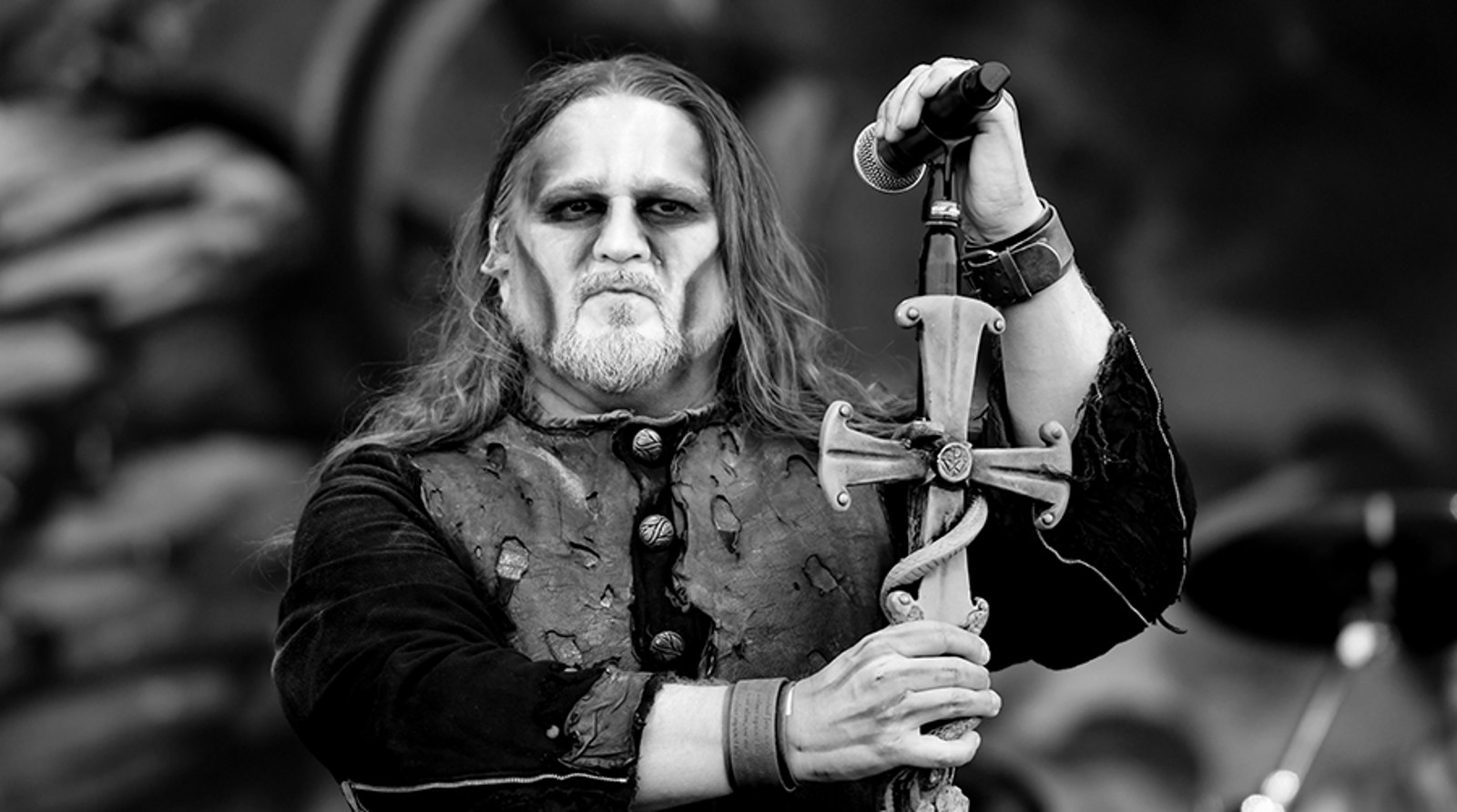
Dressed in corpse paint and vestments, singing in Latin over church organ and calling every concert a heavy metal mass, the five-man congregation of werewolves that the same searches reach next is Powerwolf, and the question draws the same answer by a different road. The liturgy is the costume. The band has said so.

Lupus Dei, issued by Metal Blade in 2007, is a concept record about a wolf's journey from bloodlust to enlightenment, a conversion narrative dressed in liturgy, and the method has not changed since: Latin titles, church organ from Falk Maria Schlegel, choirs worked into the studio recordings and a vocabulary of saints, sacraments and preachers running from Blood of the Saints in 2011 to The Sacrament of Sin in 2018.
The heresy is the joke, and the joke is the proof. A catalogue that contains Resurrection by Erection and Sanctified with Dynamite was not written by men asking anyone to kneel, and Matthew Greywolf, the band's main songwriter, has kept his own views private.
Talking to Ghost Cult Magazine in June 2015, ahead of Blessed and Possessed, Greywolf explained: the band are entertainers, not preachers, with no message to sell.
Amen & Attack, the single released on 28 June 2013 ahead of Preachers of the Night, which Napalm Records issued on 19 July and which entered the German album chart at number one, is the method at its most concentrated: the word that seals every benediction turned into a stadium chant and hurled back by the hall. Its chorus swings like a thurible let out to the full length of its chain and cracked against the altar rail on every downbeat, flinging smoke over the front rows at the exact instant the kick drum lands, which is the one thing a censer and a hook have always had in common.
So is Powerwolf Christian? As a band, no more than a theatre company staging a Passion play is a parish. What the five men believe in private is their own business, and they have kept it there.
Christian power metal bands, where the creed is real
Where the creed is real, it arrives with the same major keys, the same double kick and the same stacked choirs, which is the strongest argument that faith has never been a sound in this music. Founded in 1996 by the guitarist Carl Johan Grimmark and the singer Christian Liljegren, the Swedish band that wrote its belief into every lyric sheet is Narnia, and the label Liljegren set up in 1997, later known as Rivel Records, became a house for Scandinavian Christian metal.
Out of that house came Majestic Vanguard, whose Beyond the Moon, released by Rivel Records in 2005, was melodic power metal built around Christ from the first track to the last. Formed in 1989 around Herbie Langhans, the German quartet Seventh Avenue played the same hybrid of speed and power metal and closed with Terium on Massacre Records in 2008, likened at the time to the heavier side of Stratovarius.
That debut became a band in time for Mirror of Souls, released by Ulterium Records in November 2008, and Theocracy has carried its faith openly through to Mosaic in 2023, with long progressive suites and choruses of the full European kind. Stryper, whose yellow and black stripes sold Christian metal to the American mainstream in the eighties, belongs to heavy metal and hard rock rather than here.
Christian power metal keeps its creed the way Bach kept his, inked as S.D.G., Soli Deo Gloria, at the foot of the last page of the score, where no player's part ever carried it. The fiddlers who sawed through a cantata played exactly the notes they would have played without the dedication. Strip the lyric sheet away and not one bar of Narnia or Theocracy announces a creed, which is why a Christian band and one merely wearing the vestments can share a bill without anyone noticing.
Choirs, organ and liturgy: why church music suits power metal
The reason the church keeps turning up has nothing to do with belief and everything to do with arrangement. Built over centuries to bind a whole congregation into a single voice, the liturgy already contains the devices a power metal chorus needs: antiphony, two halves of a choir answering each other across the chancel, and the four-part hymn, every voice moving together toward a cadence the ear can see coming.
That last device is the one that matters most. A hymn in four parts is homophony, voices locked in rhythm and stacked in chords, and a multitracked power metal choir does precisely the same thing at a hundred times the volume, which is why it reads as church to ears that have never opened a hymnal. The organ holds its chords under a moving line exactly as the keyboard pads do in half the genre's catalogue.
The church entered power metal early and through the arrangement rather than the altar, as anyone tracing how the genre grew will find, long before Powerwolf put on vestments. Avantasia set The Metal Opera in 2001 around Gabriel Laymann, a young Dominican novice drawn into his mentor's forbidden reading, in the year 1602, and by common consent it gave the genre's choirs a story to sing through. Beyond dispute, the choir came first and the doctrine, where it came at all, came later.
Faith, in the end, sits in the same drawer as the dragon: a source of grandeur the arrangement can use and the listener can take or leave. The same logic explains why power metal sings about dragons, because in both cases the subject is chosen for the size of the sound it permits. Sabaton reads the archive. Powerwolf performs the Mass. Narnia and Theocracy mean it. The music cannot tell the difference.
