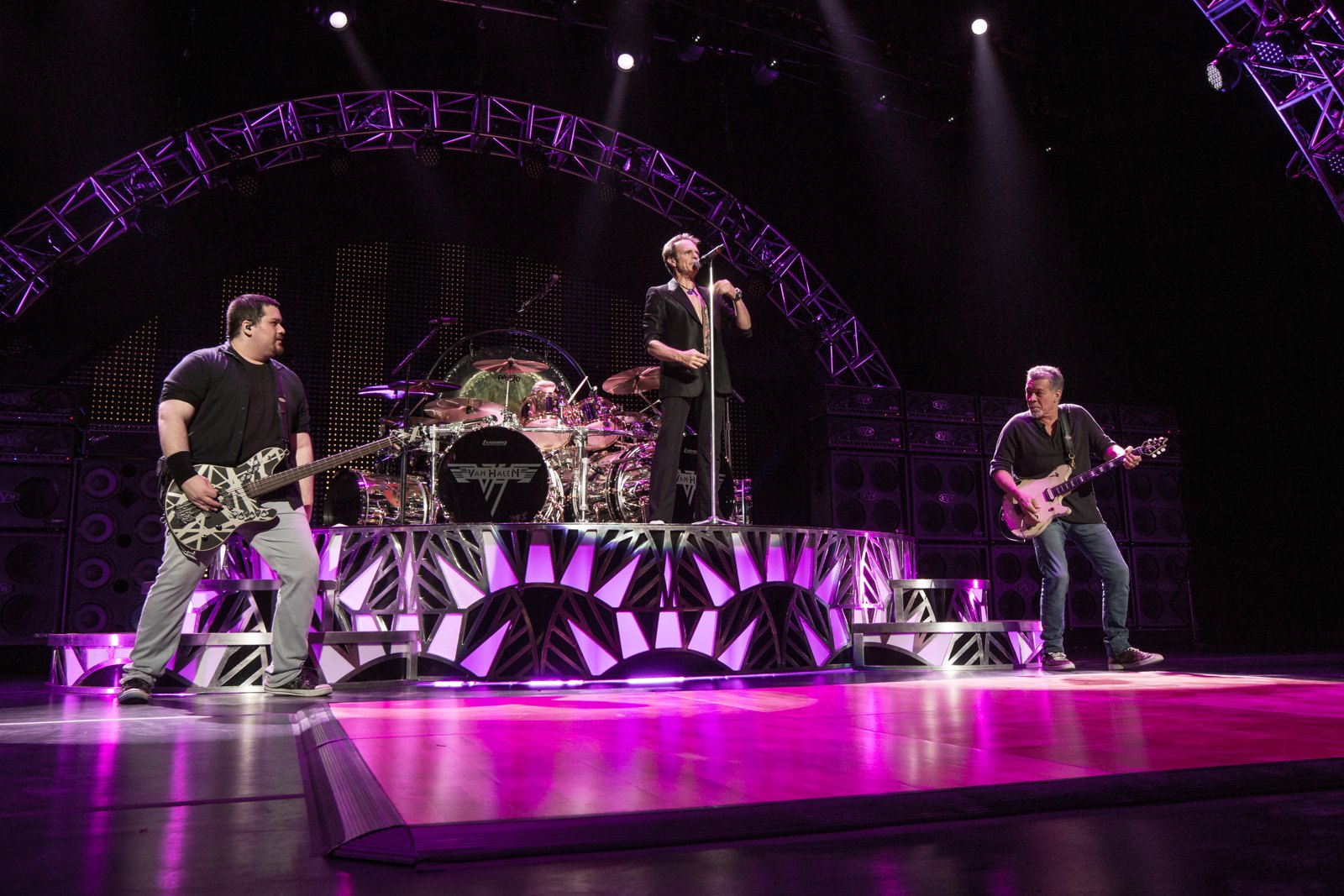
On 10 February 1978 Warner Bros. put a first album into American shops. MTV was three and a half years from its opening broadcast. Mötley Crüe did not exist, Ratt had not made a record under that name, and the clubs on Sunset Boulevard were still booking bands to play other people's songs on a Tuesday night.
The four young men who had spent the middle of the seventies hauling a PA into backyards around Pasadena and playing covers for whatever the party would pay, and who came off that circuit with a major label contract and a guitarist nobody in California could follow, were Van Halen. Everything the next decade did with hairspray, spandex and a locking tremolo was built on drawings they left lying around.
Is Van Halen hair metal? A drawing office answers it better than a wardrobe does. A prototype is taken up in 1978 and flown past the speeds the rest of the fleet will ever be rated for, then bolted into a rig on the ground and hauled on until the main beam of the wing splits, and the numbers that come out of that wreck go to every workshop with a pencil and a drawing board. Ten years later the machines built to those drawings are grounded in one bad season. The prototype is towed into the same field, under the same tarpaulin, by men who never learned the difference.
Nineteen seventy eight, and what was not yet on the calendar
Dates are the least glamorous evidence in the case and the hardest to argue with. Cut quickly at Sunset Sound Recorders in about three weeks, with Ted Templeman producing and Donn Landee engineering, the debut carried "Runnin' with the Devil", a Kinks cover taken at a gallop and ninety seconds of unaccompanied guitar that every player in Los Angeles spent the next five years failing to reproduce. Three years of that went by before the four young men who would set the look for a mile and a half of Sunset Boulevard put a band together in January 1981 and called it Mötley Crüe. Ratt got Out of the Cellar onto Atlantic in February 1984, six years behind the record every guitarist on that street had been working off since school, and Poison, who came west from Pennsylvania in 1983, took until 1986 to get Look What the Cat Dragged In into the racks.
That arithmetic settles direction rather than membership, and the two are worth keeping apart. A band can predate the word that later covers it and still belong under it, which is how the argument for including them usually opens, and the longer account of the decade shows how fast the Strip converted whatever it admired into a uniform. Direction still matters. The traffic between Pasadena and the Strip ran one way for ten years, and it is not in dispute which end of the road was copying the other.
What the Strip lifted, and what it left on the bench
What the boulevard took was the hardware and the hand: the tapped run, the bar hauled down until the note growls and released, the pointed body, the striped finish, the tone every advertisement of the period tried to describe. What it left on the bench was the writing. A bootmaker keeps a wooden foot on his bench and builds every boot around it. Lend that block to the street and a dozen workshops turn out the same shape by Friday, all of them correct at the toe, none of them any better at cutting leather than they were on Monday.
The evidence for that sits in the catalogue rather than in anybody's opinion. The band that put five of the twelve songs on Diver Down in 1982 through someone else's pen, Roy Orbison's "(Oh) Pretty Woman" among them, was a bar band by pedigree and never pretended otherwise. Hair metal bands did not make records like that, because a covers habit is what a group picks up playing four sets a night to people who have not come to look at anyone.
The drummer who opens "Hot for Teacher" with a figure that runs for fifteen seconds before a guitar is heard at all, and who plays it on two bass drums without ever letting it turn into a march, was Alex Van Halen. No band on the Sunset Strip had a rhythm section that could have followed him into it. On "Unchained", cut for Fair Warning in 1981, the same pair hold a riff at half that speed and twice the weight, and the bass player singing the high harmony over its chorus, unarguably the loudest backing voice in American hard rock, was Michael Anthony, whose voice is the one thing on these records that a hundred imitators tried to hire rather than learn.
Where the yes is real: the camera, the spandex and the synthesiser
The case on the other side is not weak and it is not about the music. By January 1984 the singer was working in spandex and a leather waistcoat under a hall of lights, the videos were running comedy sketches around the songs, and the band was in the same MTV rotation, on the same bills and in front of the same audience as the bands the Strip was turning out by the month. Anyone sorting the decade by photographs puts them in the same box. The photographs are real evidence. They are simply not evidence about a riff.
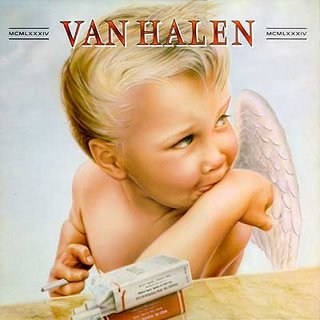
"Jump" is where the yes gets its best day in court. Built on a synthesiser figure rather than a guitar one, it went out as the lead single in December 1983, a month ahead of the album 1984, climbed to the top of the Hot 100 and stayed the band's only number one there for the rest of its history. The style the Strip was selling lived on exactly that trade, a keyboard hook and a chorus inside the first minute, and here was the band the whole street had copied doing it better than any of them.
"Panama" is the reply. It is a guitar record with no keyboard anywhere in it, cut for the same album and sent out as a single from the same campaign, and the spectacle in its video, the leaps and the grin and the scaffolding, sits on top of a riff that would work in an empty room with one amplifier. That combination is the whole difficulty. The look belongs to the style. The song does not need it.
Anyone sorting the decade by photographs puts them in the same box. The photographs are real evidence. They are simply not evidence about a riff.
The ledger after 1985, and the year that settled it
Opinion runs out at this point and the charts take over. The Californian singer who came in after David Lee Roth left in 1985, already established on his own account, was Sammy Hagar, and the four studio albums the band made with him went to number one on the Billboard 200 one after another: 5150 in 1986, OU812 in 1988, For Unlawful Carnal Knowledge in 1991 and Balance in 1995, eleven years that never once broke stride. Those records carried the genre's commercial devices openly, a ballad as a single and a keyboard where a guitar had been.
A style is not a queue you join by standing in it. The bands that built hair metal were working from a set of drawings, and somebody drew them.
Declan Rourke, KaosMetal
Then comes the evidence nobody has been able to argue away. The whole apparatus of the Strip collapsed between 1991 and 1993, contracts cancelled, tours pulled, bands dropped inside a year, and Balance, in the shops that same January, went straight in at number one regardless. A market that had just finished executing a style did not touch this band. What was dropped in that purge was a look and a formula, and neither of them was ever the thing being bought here.
Is Van Halen hair metal? The answer the evidence gives
Sorted by kind, the evidence is not close. The calendar says no, and says it by five years. The songs say no, because a bar band's habits and a rhythm section like that one were not reproducible by anybody on the boulevard. The photographs of 1984 say yes, and the concert bills of the same period say yes with them, which is why the question keeps coming back and why it deserves an answer rather than a sneer. The band was the source the style drank from, then stood in the queue with everyone else for one decade and got filed accordingly.
The verdict is no, with the photograph conceded. The same method, sorted the same way, is what decides is Def Leppard hair metal, and the answers do not have to match, because two bands can stand in the same photograph for entirely different reasons. Van Halen was the drawing office. The rest of the decade was the production line.