
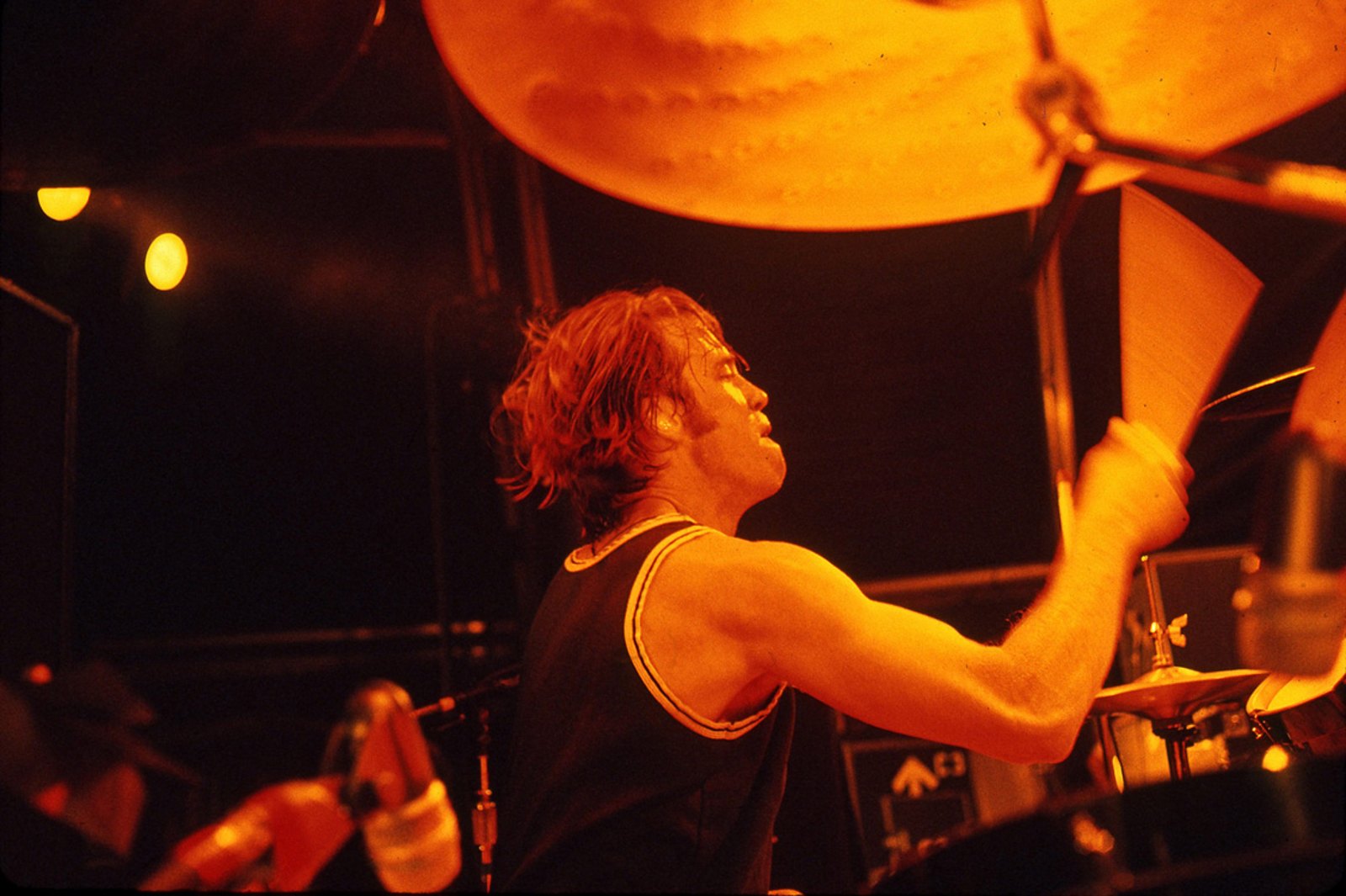
Fifteen eighth notes. That is the full span of the riff under "The Ocean", the song that closes Led Zeppelin's Houses of the Holy, released by Atlantic in March 1973, a bar of four followed by a bar of seven eighths, so that every second bar arrives one eighth note short and the band's whole tonnage lands on the next downbeat a fraction before the listener's foot has come down to meet it.
The guitarist who built a riff that long and then asked a rock drummer to hit it square on every pass was Jimmy Page. The drummer who counted the band in on the tape itself, and then drove his snare straight through the hole where the missing eighth note should have been, was John Bonham. Nobody in that room was reading a chart. The count came off the riff.
A good changeup leaves the pitcher's hand with the same windup, the same whip of the elbow and the same arm speed as his fastball, and reaches the plate at a different instant from the one the arm promised. The batter who read the arm has already thrown his hips, his wrists and the bat at a ball that is not there, and he swings through empty air and wrenches himself round until one knee hits the dirt of the box. Odd time signatures in metal do the same to a listener. The arm says four. The ball keeps its own time.
Odd time signatures: metal counts in twos and threes
A time signature is two numbers stacked like a fraction. The lower one names the note that counts as the beat, 4 for a quarter note and 8 for an eighth, and the upper one says how many of them fill a bar, which is why nearly every rock song ever pressed sits in four quarter notes with the snare on two and four. An odd time signature is one whose top number will not divide into equal groups of two or of three: five, seven, eleven, thirteen, fifteen.
The ear never counts to seven. It hears twos and threes, and a bar of seven eighths arrives as two plus two plus three, or three plus two plus two, a bar of four with a limp at one end. Where the limp falls is the composer's choice, and it decides the whole feel: put the three at the front and the bar staggers before it walks, put it at the back and the bar walks and then stumbles. Five is a two and a three. Eleven is a five and a six bolted end to end.
The chord, the interval and the gallop that ride on top of these bars are taken apart one by one in the full chapter. The floor under them is time itself: how long a bar lasts, and what happens to a hall full of bodies when it lasts an eighth note less than every one of them expects.
Led Zeppelin and the bar with a piece cut out
"The Ocean" is the plainest lesson in the catalogue. Page's riff runs through a full bar of four and then a bar of seven eighths, Bonham plays the pair as one phrase without visible strain, and the song later drops into a loose, swinging four for its closing section. The seven reads less as a time signature than as a riff too impatient to wait for the drummer. Heard loud, it does not sound clever. It sounds hungry.
Every bar of seven eighths is a bar of eight with something cut out of it, and the cleanest cut in European history was made on paper. The pope who ordered ten days torn out of October 1582, so that Thursday the fourth was followed directly by Friday the fifteenth and Easter was dragged back into step with the spring equinox, was Gregory XIII. The tale of London crowds rioting for their eleven lost days when Britain made its own cut in 1752 is a legend nobody has ever documented, traced by historians to a satirical Hogarth print rather than to any actual riot. The calendar kept its shape around the hole. So does a riff.
"Four Sticks", from the untitled fourth album released on 8 November 1971, goes further. Its riff lurches between bars of five eighths and bars of six, the recording ate far more takes than the band usually spent on a song, and the track owes its name to Bonham taking two sticks in each hand and battering the toms into submission until the pattern held. The odd meter was not a plan drawn up in advance. It was the thing the drummer had to beat flat before the take would stand.
| Song | Band, year | The count |
|---|---|---|
| "Four Sticks" | Led Zeppelin, 1971 | Bars of 5/8 and 6/8 in turn |
| "The Ocean" | Led Zeppelin, 1973 | One bar of 4/4, one of 7/8, fifteen eighths per phrase |
| "Kashmir" | Led Zeppelin, 1975 | A riff in threes over drums in four |
| "Outshined" | Soundgarden, 1991 | Verses in 7/4 |
| "Spoonman" | Soundgarden, 1994 | Main riff in 7/4, chorus in 4/4 |
| "Schism" | Tool, 2001 | A verse of twelve eighths phrased as 5/8 plus 7/8 |
| "Bleed" | Meshuggah, 2008 | A figure in threes of sixteenths over a hi-hat in four |
Three against four, and the riff that drifts
Stacking an odd length against an even one is the other road, and a different device, though the two are forever confused. Recorded for Physical Graffiti, released on Swan Song on 24 February 1975, "Kashmir" sets a guitar figure that turns over every three beats against a drum part that stays in plain four, so the riff and the kit drift apart bar by bar and meet on the same downbeat only once every twelve beats, three bars of drums against four turns of the riff. Nobody's bar is odd. The whole thing still limps.
The drummer holding that four under the riff when the band played it at the O2 Arena in London on 10 December 2007, at the concert in memory of Atlantic's founder Ahmet Ertegun, was Jason Bonham, the son of the man who had cut it in 1974. Watch his right foot and the snare, square as a ruler, while the guitars wheel over the top. That is the device laid bare.
The Swedish quintet that pushed the idea to its limit a generation later is Meshuggah. On "Bleed", from obZen in 2008, the hi-hat keeps a steady four while the guitars and the kick drum hammer out a figure grouped in threes of sixteenth notes, so the accent crawls across the bar line, bar after bar, until the cycle comes round and the whole barrage lands on one together. The count never changes. The ground moves under it.
Holding a stream of sixteenth notes on the kick drums against a hi-hat that never budges is a job for both feet, and the hardware that made it possible has a history of its own, traced in where double bass drumming came from. Heavy music needed that machinery before it could afford this arithmetic.
Riffs that nobody counted
Most odd bars in heavy music were never planned. The Seattle guitarist who has said his band only worked out a song's metre after writing it, and called its odd meters an accident, is Kim Thayil of Soundgarden, whose "Outshined", from Badmotorfinger in 1991, runs its verses in seven quarter notes, and whose "Spoonman" of 1994 hangs its main riff on the same seven before the chorus falls back into four.
Most odd bars in heavy music are riffs that ended where they ended.
That is the heart of it. A riff is written with the hands, by ear, and it lasts exactly as long as the idea lasts, so a phrase that happens to come to rest after seven beats instead of eight is simply played as seven, and the drummer is left to decide where the snare goes. On any honest reading, the time signature is a description written down afterwards by whoever has to teach the song to somebody else.
A conservatory teaches you to count a bar of seven before you play it. A riff lets you play it for a year before anybody thinks to count it.
Julien Vasseur, KaosMetal
The Los Angeles quartet that carried the device into the metal mainstream at the turn of the century was Tool. Its "Schism", from Lateralus in 2001, carries a verse usually written as twelve eighth notes that the band phrases as a five followed by a seven, and the song changes metre dozens of times before the end, which did not stop it winning the Grammy for Best Metal Performance in 2002. Progressive metal later made a whole creed of that habit, and it has its own history.
The heavy tradition's claim on odd time is smaller and more physical. It rarely counts to eleven for the sake of it. It keeps the four on the hi-hat, lets the riff run as long as the riff wants, and trusts the faithful at the barrier to find the downbeat when it finally comes. They always do. That is what the volume is for.

