
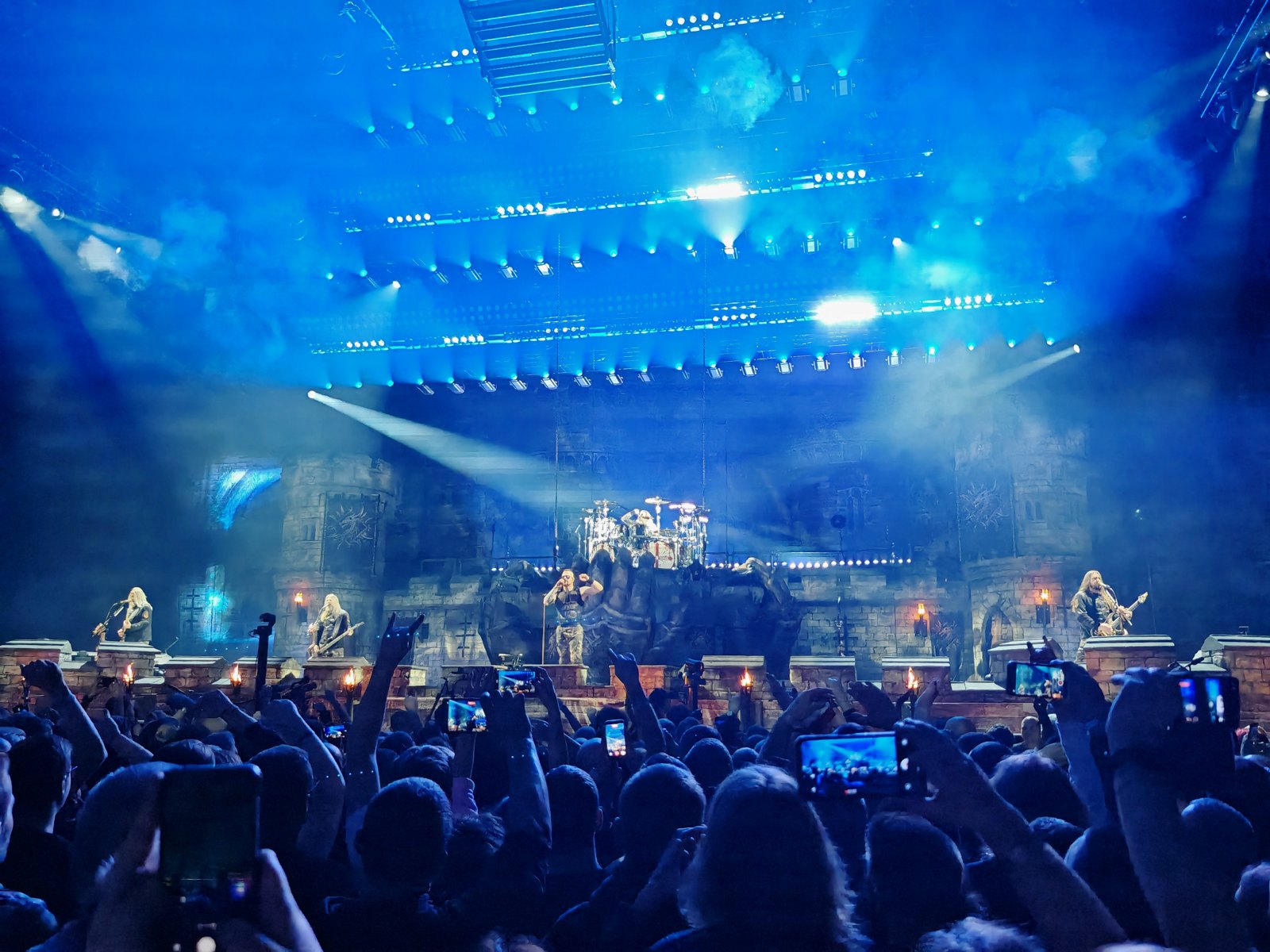
Thirty six minutes and fifty six seconds, eleven tracks, and exactly one of them past four minutes.
The Swedish band that had let four songs on its first album run beyond five minutes was Sabaton, and the record it finished at The Abyss with Peter Tägtgren eleven years later holds its longest song to four minutes and twenty four seconds. Nothing went missing in the mastering. The songs were built to that measure, and the same arithmetic runs through most of the power metal that moved into bigger rooms.
A film composer does not write a piece and then measure it. The timing sheet comes first, with the clock running down the margin, and the music is written to land on seconds that somebody else chose: holes punched clean through the print so the downbeat flashes in the conductor's face, a streamer scratched diagonally across three feet of picture so the entry cannot be missed. Bars get dragged out of the middle of a cue when an editor takes four seconds off a scene, and the strongest bars in it move forward to where the audience is already looking. The clock is not a limit imposed on that music. It is one of its authors.
Power metal acquired a clock of that kind when its rooms changed. What happened to the halls, the charts and the record companies on either side of the 1990s is the wider story. What happened inside the songs is narrower and attested on the back of every sleeve, in running times, running orders and writing credits.
What modern power metal cut, measured in minutes

Out on Nuclear Blast on 19 August 2016, The Last Stand set a spoken interlude of fifty one seconds in fourth place and packed the ten songs around it so tightly that they average three minutes thirty six, none of them more than fifty seconds off that line. Three years later The Great War kept the same measure, nine of its eleven tracks inside four minutes.
Set that beside Primo Victoria from 2005, where nine songs filled forty one minutes and four of them ran past five. No album in between is a cliff, and on any honest reading the line is not straight either: the average song on Carolus Rex in 2012 runs four minutes six against three minutes fifty nine on Coat of Arms two years earlier, and The Great War averages three minutes thirty against three minutes twenty one across all eleven tracks of The Last Stand. The average wobbles, and the ceiling is what moved: the longest song on Primo Victoria runs five minutes fifty five, against four minutes twenty four on The Last Stand and four minutes forty five on The Great War.
Ninth on that 2016 record sits Shiroyama at three minutes thirty six and its proportions are exact: a figure that lasts half a minute, a verse that has the chorus in by one minute six, the chorus, and out. A chorus a shade under a third of the way into one song is not by itself a trend, but the song runs the length the record averages, which makes it the measure and not the exception.
| Year | Band and album | Tracks | Longest | Album |
|---|---|---|---|---|
| 2005 | Sabaton, Primo Victoria | 9 | 5:55 | 41:05 |
| 2007 | Powerwolf, Lupus Dei | 11 | 6:08 | 43:31 |
| 2008 | DragonForce, Ultra Beatdown | 8 | 8:12 | 58:11 |
| 2012 | DragonForce, The Power Within | 10 | 7:20 | 50:11 |
| 2013 | Powerwolf, Preachers of the Night | 11 | 7:42 | 45:32 |
| 2016 | Sabaton, The Last Stand | 11 | 4:24 | 36:56 |
| 2018 | Powerwolf, The Sacrament of Sin | 11 | 4:30 | 42:42 |
| 2019 | Sabaton, The Great War | 11 | 4:45 | 38:27 |
| 2021 | Powerwolf, Call of the Wild | 11 | 4:23 | 40:28 |
Two dated changes in one running order
The German five who had opened three albums in a row with a short instrumental and closed five in a row with a song past six minutes were Powerwolf, and each habit stops on a record with a date on it. The openings run one minute seventeen on Lupus Dei in 2007, one minute thirteen on Bible of the Beast in 2009 and forty eight seconds on Blood of the Saints in 2011. From Preachers of the Night in 2013 the first thing on the record is the single.
The long closers went five years later. They run six minutes eight, six minutes five, six minutes twenty five, seven minutes forty two and seven minutes twenty, in that order, up to Blessed & Possessed in 2015, all of them made with Fredrik Nordström. Then they stop. On The Sacrament of Sin in 2018 the longest of the eleven tracks is four minutes thirty, and the whole record sits inside a band of sixty four seconds from shortest song to longest.

Call of the Wild, produced by Jens Bogren at Fascination Street and out on Napalm on 16 July 2021, brings the ceiling down again, to four minutes twenty three, with the shortest song at two minutes fifty four. Dancing with the Dead, third on it at four minutes five, strides at mid-pace under a chorus made for a hall to shout back.
The edit, and what comes out of it
The British band whose eight songs on a 2008 album ran between five minutes twenty and eight minutes twelve, seven of the eight past six minutes, was DragonForce, and Ultra Beatdown is fifty eight minutes and eleven seconds of a method at full stretch. Four years later the average song on The Power Within had lost over two minutes. Nobody had slowed down. The instrumental acreage between the choruses had simply gone.
Cry Thunder, the single off that 2012 record, runs five minutes sixteen in a catalogue that had been averaging seven. The riffs are the same riffs and the guitarists are the same guitarists. What came off was instrumental.
The plainest proof of how much room these songs carry is the edit itself. The album version of Through the Fire and Flames runs seven minutes twenty two; the truncated radio and video edit of the same song runs five minutes flat. Two minutes and twenty two seconds came out of a seven minute song. Just under a third of it was expendable, and nobody had to write a new song to get the record on the radio.
The German band that made a single out of a song fourteen minutes and six seconds long was Blind Guardian, and that single reached the shops in November 2001 with a three minute forty B side behind it. Fifteen years later a headline act's whole album was shorter than four of those songs laid end to end.
What the second guitar does now
Distance does much of the thinning. Sound crosses a festival field slowly enough that the people at the back clap the snare they can hear rather than the one being hit, so a tempo that holds a club together pulls a field apart until it comes down. Two hundred metres of air pulls a cymbal to pieces and knocks the edges off a double kick, and what reaches the fence whole is the lowest, slowest and loudest thing on the stage. A chorus that has to reach the back of a field is written out of fewer parts, and the parts that go are the ones only headphones ever heard.
A chorus that has to reach the back of a field is written out of fewer parts, and the parts that go are the ones only headphones ever heard.
The credits say the rest. On The Last Stand every lyric but one is credited to Brodén and Pär Sundström and every piece of music to Brodén, with a guitarist added on four of the eleven, Ken Kängström on the first two, Chris Rörland on the title track, Thobbe Englund on Shiroyama. Brodén sings and plays the keyboards. He has set out the division himself, that he does not write the guitar solos but writes the main guitars and how the main parts of the drums are going to go, which leaves everything the two guitars play outside a solo coming from one pen. Nothing in an arrangement built that way has to ask the second guitar for an answering line. Two players on one line make no harmony at all. Put them a hair apart and the line beats against itself, a slow throb between two nearly identical pitches that a field reads as weight and a pair of headphones reads as a fault, and that is what a doubling guitar is for.
The keyboard sits inside the same arrangement and under the same writer, a part whose descent runs through synths, Eurodance and the modern power metal keyboard.
The bands that kept the long songs
None of this is a law of the genre, and the exceptions are loud. Blind Guardian's A Night at the Opera of 2002 refuses every cut across ten songs and sixty seven minutes, the shortest of them five minutes eighteen, and Beyond the Red Mirror, thirteen years later, still averages six and a half minutes a song and runs one of them to nine minutes twenty eight. Stratovarius closed Elysium in January 2011 with a title track of eighteen minutes and seven seconds. Sonata Arctica went the other way, and its albums average longer songs now than its 1999 debut did, five minutes five a song on Clear Cold Beyond against four minutes forty four on Ecliptica.
The split is hard to miss. The records that shortened belong to the bands now playing arenas and headlining fields; the records that kept their suites belong mostly to bands whose rooms stayed the size they were, and to crowds who will stand still for nine minutes. Which way the causation runs is not provable from a tracklist. That the two go together is beyond dispute.
So the arena sound is a trade and not an improvement. It buys a chorus ten thousand people can hold without a lyric sheet, a set with nothing in it to wait through, and a record that can be played front to back on a coach. It costs the four part suite, the instrumental middle and the ending that takes three minutes to arrive. Both kinds of record are in the catalogue. Only one of them was built with the back of the field in the room.
