
Three questions settle it, and most songs answer all three before the second chorus arrives.
Sorted by ear rather than by the sticker on the sleeve, taken one at a time and in the order of how much each one actually proves, the power metal characteristics worth testing come down to a voice, a chorus and a pair of kick drums, while the keyboards, the speed, the cape and the dragon settle nothing whatever.
A genre test works like a voice trial in a choir school. The organist strikes one chord, the boy is told to sing the note at the top of it, and when nothing comes back the lid comes down on the keys hard enough to split the music desk, the candidate sent back down the aisle before anybody has asked whether he reads Latin, holds a line against three others or owns a clean surplice. Thirty seconds decide. The paperwork follows.
Filed by its own label as melodic death metal while carrying a double kick, a keyboard and guitar duel and a hook in a major key inside the same three minutes, the Finnish band whose lead guitarist wrote the riffs and the keyboard lines both is Children of Bodom, and "Hate Me!", the single taken from Follow the Reaper in 2000, fails on the first question alone.
Nothing on it sings. Everything else is in place, which is what makes it useful here: it is the solo line of a concerto left on the stand after somebody has prised the fingerboard off the instrument meant to play it, every note still written out and nothing left in the room that can carry a tune. Where each of these parts came from, and in whose hands they were bolted together, is the wider story. The sorting is a smaller job, and it goes in order.
The voice decides first
The first question is not whether the singer is a tenor. It is whether a voice carries the tune in pitches you could write down, without distortion, loud enough that the words arrive whole. A growl or a scream on the hook ends the examination there, whatever the drummer is doing underneath.
Register is habit and nothing more. The high clean tenor became the house sound after one hiring in the mid eighties and has been the audition standard ever since, but Joakim Brodén in Sabaton sings from the chest and Attila Dorn in Powerwolf sings out of the opera house, and both belong to the family: the test is cleanness and legibility, not altitude.
Guest voices do not move the answer either. Kamelot put a harsh voice into "March of Mephisto" on The Black Halo in 2005 as a character inside a story, with Roy Khan carrying every chorus clean. A borrowed voice in one role is costume. A growl where the tune should be is a different descent altogether.
Then count the kick drum
Put a hand over the guitars and listen to what is left. In power metal the kick drums do not punctuate the riff, they run underneath it, sixteen strokes to the bar beneath a riff moving in eighths, unbroken through the verse and so even that the ear stops counting blows and starts hearing a surface. When the pattern starts and stops with the riff, the song is heavy metal. When it arrives in short bursts, it belongs elsewhere.
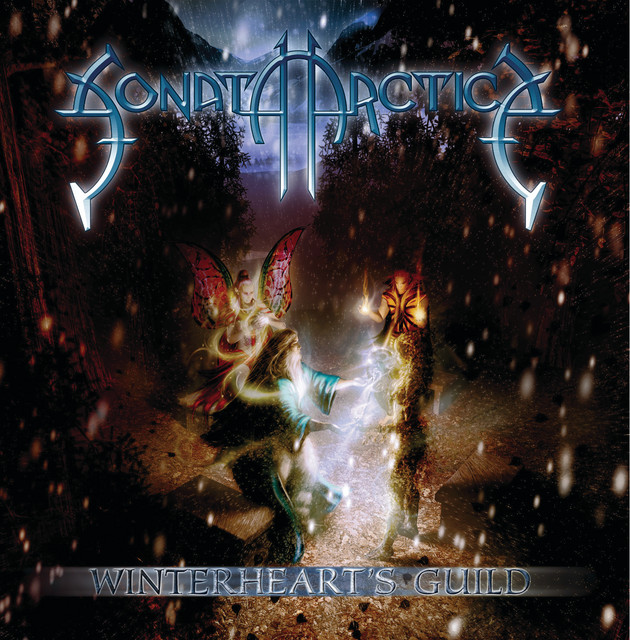
Released by Spinefarm on 21 February 2003 and cut almost entirely at the tempo the style gets caricatured for, the band that had spent two albums learning to set a tenor and a keyboard player on top of that pattern was Sonata Arctica, and on Winterheart's Guild the track "Victoria's Secret" gives you thirty seconds of the plainest evidence on the record.
What the answer is worth is where most arguments go wrong. An unbroken double kick is the strongest single confirmation the style offers and it holds no veto. Ballads have none of it. A song that fails this one and passes the other two is still power metal; a song that passes this one alone almost never is.
The chorus has to be given away
The last question is the one nobody thinks to ask. Find the highest note in the song. In power metal it lands on the title words, in the chorus, inside a range an untrained crowd can reach, and it comes round again before you can forget it.
A power metal chorus is written to be surrendered. In a parish church the tune goes down to the nave and the choir keeps the parts around it, the melody cut out of the stall copies with a blade so that the only place it survives is five hundred untrained throats, and every device stacked above a chorus here exists to hand the tune over.
Released on AFM in 1998, mixed by a guitarist out of Stratovarius and sung on by a guest whose own stacked choirs had set the standard, the German band that had been rehearsing together since school and cut Vain Glory Opera was Edguy. Its title song states the chorus, repeats it, and puts Hansi Kürsch on top of the repeat. That is the method in one gesture.
Underneath the chorus the harmony is doing its own work, climbing to a landing that sounds like daylight at the end of a dark verse, and why that landing reads as arrival rather than as relief is worked out in the theory chapter. For sorting, the ear is enough. If the phrase resolves upward and bright where the verse was heavy, the box is ticked.
The power metal characteristics that decide nothing
Speed is the first of them and the most stubborn. The tempo in ordinary use runs from about 90 beats a minute to about 200, which is not a border but a country.
"Nightfall", the song Blind Guardian built on an orchestral arrangement and a slow chorus for Nightfall in Middle-Earth in 1998, walks where the caricature sprints, and its place in the genre is beyond dispute. Speed is a dialect, not the language.
Keyboards are the second, and the case against them is geographical. The American practitioners worked without any from the start, Manilla Road, Jag Panzer and Vicious Rumors putting a second rhythm guitar where Europe would later put a string patch, and losing nothing for it.

Founded in October 1997 by a singer just passed over for the most public vacancy in British heavy metal and by the bass player Mat Sinner, the German band that builds everything it does on a top register and two guitars is Primal Fear, and Nuclear Fire, released by Nuclear Blast in 2001, carries hardly a synthesiser on it.
"Angel in Black" is the demonstration. Ralf Scheepers stacks his own voice five deep on the chorus, a chorus one critic ranked as power metal at its highest pitch, and nothing in the arrangement waits on a keyboard player. Take the keyboards out of a Stratovarius song and it thins. Take them out of this one and nothing has gone. The keyboard is a coat. It tells you the weather, not the animal.
The keyboard is a coat. It tells you the weather, not the animal.
Lyrics decide least of all. Dragons, battles, the sea or nothing in particular: the subject has never sorted a record in this music, and the guitar solo is just as optional. A fast song with a growl is not power metal. A slow song about a tax dispute, sung clean, with a chorus a hall can take off the singer, very well might be.
Running the checklist on songs that argue back
| What to listen for | A pass sounds like | How much it decides |
|---|---|---|
| The voice | Clean, pitched, words legible, no distortion on the hook | Decides. A growl on the hook ends it |
| The chorus | Highest note on the title, early, repeated, inside a crowd's range | Decides |
| The kick drum | Unbroken sixteenths under the riff, a surface and not punctuation | Strong confirmation, no veto |
| Where the phrase lands | A bright resolution at the end of a dark verse | Strong confirmation |
| Keyboards | Pads, doubled leads, a harpsichord in the intro | Nothing. A whole school has none |
| Tempo | Anything between roughly 90 and 200 beats a minute | Nothing on its own |
| Lyrics | Dragons, real battles, the sea, nothing at all | Nothing |
Iron Maiden's "Aces High", from Powerslave in 1984, passes the first and third questions outright, a clean voice at the top of its range and a chorus a stadium takes off the singer, and it fails the second, because the kick drums punctuate the gallop instead of laying a floor under it. The verdict is heavy metal, and the song sits in the ground the genre grew out of, which is the whole meaning of proto-power metal.
Blind Guardian's "The Bard's Song (In the Forest)", three minutes of acoustic guitar and one voice on Somewhere Far Beyond in 1992, is the opposite case. There is no distortion on it, no kick drum, no chorus in the shape the style uses, and it is sung back at more festivals than almost anything else the genre owns. Two questions are not even attempted. The third is passed more completely than by any other song in the style.
That is the creed the whole checklist rests on: a genre lives in songs and not in bands. The ballad on a power metal album is a ballad, the acoustic song is a folk song, the band is still a power metal band. Anybody sorting by the name on the sleeve will be wrong about a third of any tracklist.
So the order stands and it is short. Voice, then chorus, then kick drum, everything else held as evidence rather than as a rule. Anything a record still refuses to answer after those three has stopped being a question about power metal characteristics and turned into a question about taste.
