
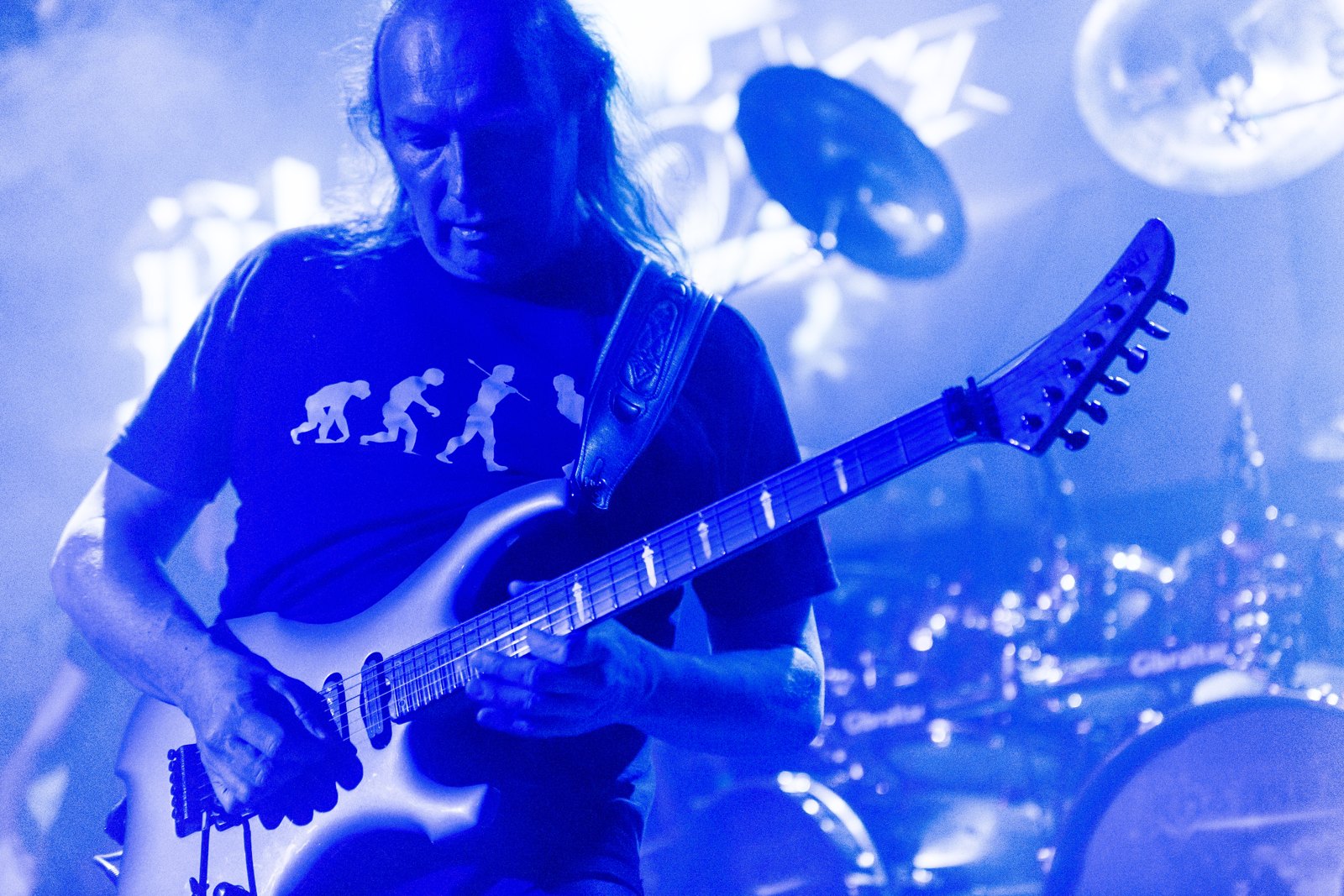
Five strings crossed in one movement of the right hand, five notes out through the speaker, and not one of them with an edge on it.
The founding guitarist an Italian band credited on record after record until 2011, a player whose leads run on swept arpeggios, tremolo picking and the harmonic minor scale, is Luca Turilli of Rhapsody of Fire, and that short list holds the mechanism almost all power metal guitarists reach for once a lead outruns the hand that strikes it. The plectrum never leaves the strings. It is dragged across them in one long downstroke.
A violinist before 1750 held a stick curved away from its hair, and the stroke it gave him thinned at both ends of its own accord, shaping a phrase whether the arm shaped it or not. The stick that replaced it curves the other way, inward, under a ribbon of hair held flat and screwed to a tension that would have snapped the slender head off the old one, and one even sound can be held the whole length of it with nothing asked of the arm. The long line came free. The bounce that used to arrive free had to be manufactured after that, stroke by stroke.
A technique is not an ornament laid over music. It is the list of sentences a pair of hands can say cheaply, the list it says at ruinous cost, and the list it cannot say at all. The harmony these hands move through is laid out in the history it belongs to. The hands come down to six habits, and each gives a listener something the other five withhold.
Sweep picking, and the chord that arrives as a line
Sweeping carries one pick stroke through three, five or six strings without a pause in one unbroken direction while the fretting hand lifts off each note the instant the next one speaks the instant the next one speaks, and the whole discipline serves silence: no two notes may overlap, or the arpeggio turns into a strummed chord. Five notes leave the speaker as one gesture.
A swept arpeggio delivers a whole harmony inside the time a singer needs for one syllable, which is what a band wants in the bars before a chorus comes round again, and it does it without the pick striking anything hard enough to be counted. Nothing inside a sweep can be leaned on. A player who wants a line an audience will hum goes elsewhere.
A technique is the list of sentences a pair of hands can say cheaply, and the list it cannot say at all.
The shape the technique loves best is the diminished seventh arpeggio, four notes stacked a minor third apart, so that one fingering shifted up the neck in threes covers the fretboard with nothing new to learn. Timo Tolkki drove that vocabulary at Finnish tempos for two decades, and his Stratovarius leads lean on swept shapes and runs picked note for note.
What power metal guitarists ask of alternate picking
Alternate picking takes the opposite bargain and charges for it in the forearm. Down, up, down, up, one attack on every note and no exceptions, unsparing on a wrist that pays for every bar the pick stays in motion. What the labour buys is articulation: a run whose notes a listener can count, each with its own consonant. The calluses are the cheapest part of the bill.
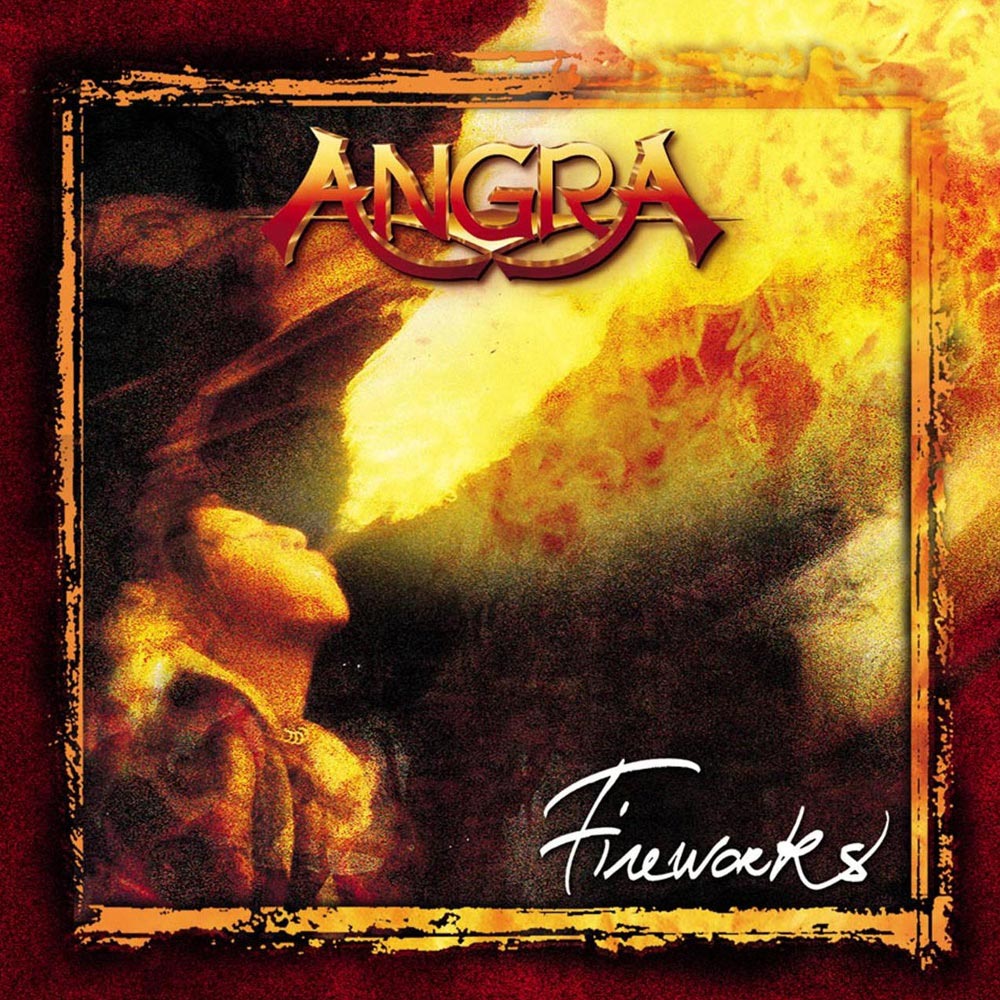
Kiko Loureiro, one of the two guitar chairs on Fireworks, where "Wings of Reality" opens the album, builds his own advice for the picking hand on string changes, not speed: one note to a string, then two, three and four, then strings skipped, all of it slow under a metronome, because a hand that can pick four notes to a string and cannot cross cleanly between strings comes apart at the first fast bar.
Legato, the skipped string and the note with no consonant on it
Under every key of a Mellotron lies a strip of tape carrying about eight seconds of a player recorded years earlier, dragged across the head while the key is held and sprung back the moment it lifts. Strike the key harder and nothing whatever happens. The attack is on the tape, cut by somebody else's hands, and no force at the keyboard will put a consonant on the front of a note, while the strips wear through where the roller drags them until a worn one drops out under the finger and gives back less than was recorded onto it.
A legato run is the same transaction. Hammer-ons and pull-offs sound the note with the fretting hand alone, the plectrum silent for whole bars, so little in the run has an edge on it and little of it can be accented. What it buys is speed the forearm never has to pay for. What it gives up is the inside of the line.
The pair of hands that writes every solo out in full, bar by bar, rather than finding one in the room, and then sits down with the other guitarist once the songs are done to divide them up, belongs to Sam Totman of DragonForce, who writes most of what the band plays. Herman Li holds the other chair, improvises his solos standing up, and imitates old arcade machines in them on purpose.

Out on Noise and Sanctuary in the spring of 2004, Sonic Firestorm is where that written-out, divided-up writing becomes the arrangement itself, and "Fury of the Storm" sits second on it at six minutes forty six, words and music by Totman, its guitars a relay between two men rather than a statement from one, each run handed on before the one in front has finished cooling.
String skipping belongs to that kind of writing too, the plectrum crossing a string left silent in order to reach a wider interval. Tapping buys reach and pays for it in tone. A valveless horn gives its player the notes of its own harmonic series for nothing, and the ones between are had by driving a hand up into the bell until the pitch bends down a semitone, so what comes out is smaller and duller than the note beside it. A string fretted by the hand that should be holding the pick has that problem exactly, which is why tapped runs are propped up with gain and a compressor.
The harmonic minor, the raised seventh and the note that will not move
All six habits are ways of crossing one scale. The harmonic minor lifts the seventh degree of the natural minor by a semitone, which plants a leading note a half step under the tonic and leans on it so hard that a phrase left hanging on it sounds unfinished. It also rips a step and a half open between the sixth degree and the seventh, a gap neither the major nor the natural minor contains, which the hand has to jump and the ear hears as the genre's baroque colour.
| Technique | What the picking hand does | What the listener is given |
|---|---|---|
| Sweep picking | One unbroken stroke across several strings, the fretting hand muting behind it | A chord delivered as a line, with no accent inside it |
| Alternate picking | Down and up without exception, one attack per note | A run whose notes can be counted |
| Legato | Nothing for bars at a time; the fretting hand hammers and pulls | A run with no consonants in it, heard as one sound |
| String skipping | Crosses a string without sounding it | Wide intervals inside a fast line |
| Tapping | Leaves the pick and frets with the fingers | Reach beyond the hand, at a smaller tone |
| Tremolo picking | Repeats one note as fast as the wrist allows | A held note with a grain in it |
Pedal point is the cheapest device the genre has. One note is held or struck again and again underneath, usually an open bottom string, while the harmony above it moves, so every chord arriving over it is measured against something that refuses to budge. Two guitars moving together in parallel thirds or sixths is a separate matter, the twin guitar harmony, used here to carry a lead as readily as to thicken a chorus.
The shred tradition, and the hands that divided it
The vocabulary arrived in one decade and mostly by one route, through Yngwie Malmsteen's guitar-first records from 1984 onward and the magazines and specialist labels that sold what he had done to his epigones by the thousand. Where the scales and the arpeggios came from before that is Vivaldi, Paganini and the neoclassical guitar. Power metal took the vocabulary and left the format on the shelf, because the chair at the front of these bands was already held by a tenor.
Kai Hansen leans on bends, vibrato and picked runs, nearer to hard rock phrasing than to a caprice, which is why Gamma Ray solos stay singable at tempos where the Italian school turns into weather. Andre Olbrich of Blind Guardian favours staccato, and his lines keep shadowing his own singer's phrasing.
Edguy's lead chair has never changed hands. Jens Ludwig has played nearly every lead part and solo the band has recorded since it started, and "Tears of a Mandrake", a little over seven minutes at the head of the album AFM put out on 24 September 2001, gives him several stretches rather than one. A band that leaves the same man there for a quarter of a century is not buying decoration.
Refusal is a position too. The man who had a song finished before he had a band to play it was Oscar Dronjak, and the Swedish house style he set in HammerFall keeps the tune in the rhythm guitar and his own solos tied to the riff, patterned on Accept's Wolf Hoffmann, with little of the arpeggio vocabulary the Italian and Finnish bands built their leads out of. The notes sit close under the hand. The hook sits nowhere near it.
None of it is display for its own sake. A swept arpeggio, a legato flight and a run picked note for note are three routes into the same chorus, and the choice is settled before the song is written. What separates the good players here from the fast ones is knowing which of the six will still be audible once the choir comes in.
