

Almost no heavy metal vocal was ever sung the way it is heard. Recorded last, after the drums, the bass and the walls of guitar are finished and the band has gone home, the lead voice on a heavy record is a verdict reached afterwards, by an engineer who once sliced two-inch tape into strips with a razor and now does it with a mouse, picking phrase after phrase out of a dozen full takes and joining them into one performance nobody ever gave.
The producer who drove heavy metal vocal recording toward its far end, grinding a Sheffield band's fourth album out take upon take across sessions that ran from February 1984 to January 1987, was Robert John Lange, and the singer at the microphone, who said afterwards that you do a lot of takes when you work with Lange, was Joe Elliott. Hysteria came out on 3 August 1987, three and a half years after the first session.
Francis Galton stacked portrait after portrait onto a single photographic plate, each given only its fraction of the exposure, and out of the fog rose one face that belonged to none of the sitters, every scar and quirk of any single sitter bleached out of it and only what they shared left standing. A comped vocal is that plate. Nobody in the control room, and the singer least of all, can say afterwards which night any syllable on the master came from, and no night's cracked note survives to be blamed on anyone.
Heavy metal vocal recording is a fight for three kilohertz
The voice arrives last in a room that is already full. Two, four or six rhythm guitars have spent weeks claiming the ground between roughly one and four kilohertz, where the ear is sharpest and where a distorted guitar puts most of its bite, and the voice needs exactly that ground to be understood. The bass lost the same argument earlier in the mix. The singer cannot afford to.
An engineer has three ways to clear the ground, and most heavy records use all of them. He can gouge a narrow notch out of every guitar track at the frequency where the vowels live, he can ride the vocal fader up and down word by word through the song, or he can compress the voice so hard that it never once drops below the guitars. None of the three sounds natural. All of them sound like a record.
| Stage | Typical tool | What it is there to do |
|---|---|---|
| Microphone | Large condenser or moving coil dynamic | Catch the voice without the circuit clipping first |
| Preamplifier | Console channel or outboard unit | Raise the level with headroom left for the scream |
| Fast compressor | Universal Audio 1176 | Pin the peaks of every shout |
| Slow compressor | Teletronix LA-2A | Level the body of the phrase |
| De-esser | Frequency-selective compressor | Tame the sibilants the compression brought up |
| Equaliser | Console or plug-in | Put the voice in the gap cut from the guitars |
A microphone that can take a scream
Studios keep two kinds of microphone and heavy singers wear out both. A large diaphragm condenser such as Neumann's U87, sold since 1967, hears every breath and lip click, and its own circuit is rated clean only to 117 decibels until its pad is switched in. A moving coil dynamic such as Shure's SM7, on the market since 1973, hears less and minds nothing.
That is why so many harsh vocals are cut on a dynamic clamped close or held in the fist, and why an engineer who sets a condenser for a whispered verse will often swap it before the chorus arrives. The choice is not about fidelity. It is about which part of the chain gives out first, the throat or the circuit.
A grip behind the head
The engineer who built the 1176, a limiting amplifier with field effect transistors doing the work the valves of his earlier 176 had done, able to react in twenty millionths of a second, and who put it on sale through his own company, Universal Audio, in 1967, was Bill Putnam. Half a century on it sits on a great many heavy vocal chains.
A grey heron standing in the shallows strikes faster than the eye can follow and has an eel by the head before it can bite, and leaves the rest of it free to thrash and coil round the bill. The 1176 does that to a scream. It catches the opening salvo of every shout and clamps it, and everything behind the head, the grit, the vibrato, the air at the end of the phrase, keeps moving.
Practitioners chain a second, slower compressor after it, often the optical LA-2A, one catching the peaks and the other levelling the body, until a whisper and a scream leave the speakers within a few decibels of each other. Nobody hears it happening. That is the craft.
It is about which part of the chain gives out first, the throat or the circuit.
A voice that sings with itself
The singer from Aston whose signature sound, in Dave Grohl's hearing, is a doubled lead, the same line sung twice and matched so closely that the pair shimmer like a flanger, was Ozzy Osbourne. Two passes never land on exactly the same pitch, and the ear hears the pair as one wider note. The double thickens a thin voice and hides the wobble in a strained one. It costs closeness.
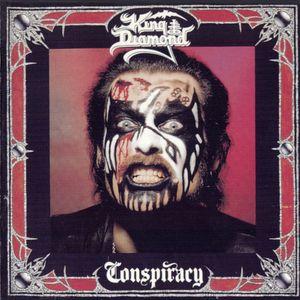
The Danish singer who turned the multitrack into a stage for one man, voicing every character of a story himself and ranging from a low speaking voice to a falsetto of glass so that one throat could play a whole cast, was King Diamond. On Conspiracy, released by Roadrunner on 21 August 1989, all the voices are his again, and "Sleepless Nights" hangs its chorus up in the falsetto. In the studio he needed nobody else.
Punch-in, comp and the machine that tunes
On two-inch tape a bad line was fixed by punching in. The engineer dropped the vocal track into record for one phrase while the singer sang along with his own earlier take, then dropped it out before the next word, and a punch that came out a fraction late wiped the first syllable of the good line after it for good. Engineers kept their fingers off the coffee.
"Armageddon It", among the last songs finished, in late January 1987, and driven to number three in America after its release there in November 1988, carries the Def Leppard method at full stretch, an anthem hammered out at the very end of three years of takes. That is what three years buys.
Pro Tools turned the punch into the comp. Every take now lands on its own playlist, the engineer marks the best phrase in each, and the software stitches the winners together with crossfades too short for the ear to catch. The engineer who had spent years at Exxon turning seismic echoes into maps of the rock underground, and then turned the same mathematics on the human voice, was Andy Hildebrand, and the plug-in his company Antares released in 1997 was Auto-Tune.
Pop made the machine audible. Heavy metal buried it, nudging a flat note up a few cents and leaving the grit untouched, and Melodyne, launched by Celemony in 2001, let an engineer slide the pitch of a single syllable like a bead along a wire. A large share of modern heavy vocals are tuned. The tuning is set where nobody can hear the machine.
The studio can also teach. The singer who walked into sessions running from October 1990 to June 1991 saying he had never really sung, only yelled, was James Hetfield of Metallica. Bob Rock's answer, on "The Unforgiven" and "Nothing Else Matters", the two songs Hetfield wanted to sing, was a vocal sound so big it would not need doubling, and a singer who got better every day.
That kind of change needs a room with nobody in it but the engineer. A voice that did not yet trust its own clean middle could try a line thirty times, keep the one that held and go home, and the next record would start from there. How that room behaved before hard disks, when every take cost tape and a punch could not be undone, belongs to the analog tape era.
The studio is only one half of a singer's working life, and the other half is a stage with no second take, no comp and no tuning, which is where the singers and the show meet the hall that answers them.
The voice is one part of a longer account of rooms, tape machines and producers that runs from Regent Sound onward, and where it sits in the story is set out in full. The throat never changed. What changed is how much of any one night the listener actually hears.

