
In October 1998 Limb Music released a power metal record whose booklet credits a chamber choir, a Russian choir, a baroque oboe, a set of recorders, a string group of eleven and a woman singing in the baroque manner, and names no orchestra anywhere.
Recorded at Gate Studio with Sascha Paeth and Miro at the desk, and released less than a year after the debut that had first drawn up the plan, Symphony of Enchanted Lands carried brass and timpani that existed nowhere outside the keyboards of Alex Staropoli, and the Italian quintet that hung the whole arrangement on those keyboards was Rhapsody, the band later renamed Rhapsody of Fire.
That is the record where symphonic power metal stops being an ambition and becomes a sound. The orchestra was still a machine.
The arrangement has an ancestor nearly two centuries older than the genre. In 1813 Johann Nepomuk Maelzel, the inventor whose name still stands behind the letters MM on a metronome marking, talked Beethoven into writing a piece for his panharmonicon, a cabinet that played the instruments of a military band with air pressure for lungs, and Beethoven wrote straight through the walls of the box, piling up parts its mechanism could never hold until the music had to be torn out of the cabinet and handed to a full orchestra.
They gave it on 8 December 1813, at a benefit concert in Vienna with the Seventh Symphony and Maelzel's mechanical trumpeter on the same programme. The parts outlived the cabinet. Everything the machine could not do, the players did that first night: they breathed, they swelled into a chord instead of slamming it, and they landed a hair apart on every downbeat.
Symphonic power metal ran the same campaign in about six years. Between 1998 and 2004 the genre wrote its arrangements inside a keyboard, and then booked rooms full of players who showed, bar by bar, which of those parts had been composed for a box.
Symphonic power metal before anyone hired an orchestra
The years from the Hamburg clubs to the first orchestral record are the introduction, a decade in which the genre learned its tempo and its tenor with two guitars, a double kick and, where a band had one at all, a keyboard player who mostly kept out of the way of the riff.
Released on Virgin in April 1998, a few months ahead of the Rhapsody record, and built between July 1997 and January 1998 in five different studios, Nightfall in Middle-Earth ran to twenty-two tracks with spoken scenes and short vignettes threaded between the songs, and the Tolkien-reading quartet that stacked its singer's voice into a choir and filled the gaps with orchestral effects off Mathias Wiesner's keyboards was Blind Guardian.
The credit says it in plain words: keyboards, orchestral effects. The strings on that record swell into the bars the guitars leave empty and fall away when the riff comes back. That was the orchestra's first job in the genre. Colour poured into the gaps.
Four years later the same band spent all of 2001 between the Twilight Hall studio in Grefrath and a second room in Hamburg making A Night at the Opera, released in March 2002, and Wiesner's credit had changed to keyboards and orchestral arrangements. The second word marks the moment the orchestra stopped decorating the gaps and started fighting the guitars for the same bars.
The fourteen minutes of "And Then There Was Silence" are the longest stretch of that fight, guitars, stacked voices and strings sharing one block of bars, and the record has so much going on in every song that the riff gives up ground to the voices, the choirs and the orchestral keys.
The orchestra stopped decorating the gaps and started fighting the guitars for the same bars.
One control room and an orchestra in a keyboard
The production pair that taught the genre to sound like a film score was Sascha Paeth and Miro, the two men behind the desk at Gate Studio, who produced Rhapsody's first records and went on to produce Epica, released by Noise in 2003 and recorded partly at Gate and partly in Florida, for the American band Kamelot.
The booklet of Epica credits its orchestrations to the Rodenberg Symphony Orchestra. Rodenberg is Miro's surname. The orchestra is Miro, ninety chairs set out across an empty stage and a single man sprinting between them, kicking each section into sound as he passes and dragging the next one awake before the last has finished its bar.
It is the most honest credit in the genre. A sampled orchestra cost one player's time and some studio hours, it never tired, it never needed a conductor, and it never breathed.
Of all the additions made across every branch of the genre, the orchestra is the dearest, the one that sends an invoice by the hour, and the sampled version was the cheaper answer. The tonnage of the sound was real. The players were not.
The real voices came first, because a choir is cheaper than an orchestra. On Symphony of Enchanted Lands the Helmstedter Kammerchor under Andreas Lamken sings the sacred parts and a group of Don Cossack singers the Russian ones, and beside them any choir patch, one vowel frozen in a chip for ever, would sound like what it is.
A row of men changes vowel on every syllable, and the frozen vowel would crack beside them like a painted saint set down in a living congregation. Rhapsody went on hiring choirs. The full orchestra stayed garrisoned in the keyboard a while longer.
When the players arrived
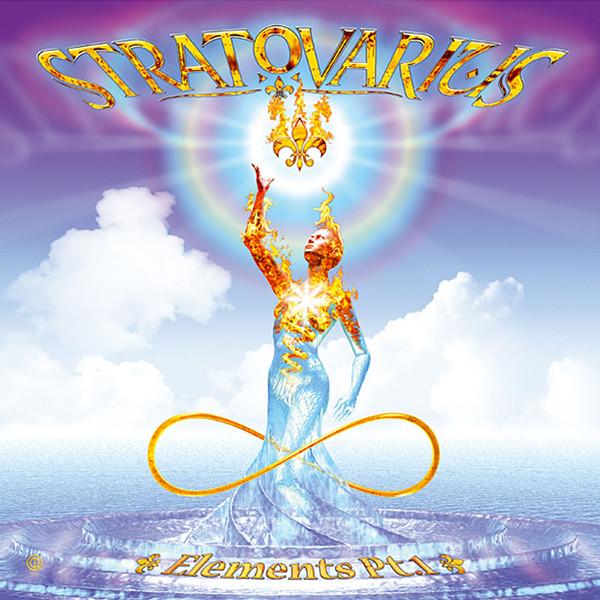
The Finnish conductor who stood in front of two of the genre's earliest real-orchestra records was Riku Niemi, and the Joensuu City Orchestra he led played on Century Child by Nightwish, released in May 2002, that band's first record with an orchestra, and then, with Niemi also credited for the orchestral percussion, on Elements Pt. 1, released by Nuclear Blast on 27 January 2003 by Stratovarius.
One provincial orchestra, two of the biggest bands of the Finnish wave, eight months apart. What changes when a section of real players takes over from a sampler is the attack: a whole row of bows lands a fraction apart, the chord opens from inside instead of arriving whole, and any guitar in the room has to give up the top of the register to let it through.
That last point is the cost nobody prints on the sleeve. A distorted guitar and a violin section want the same octaves, and when a record hires real players something in the band has to give ground.
Released by SPV on 27 September 2004, Symphony of Enchanted Lands II: The Dark Secret moved Rhapsody from the keyboard and a handful of strings to the concert platform, the Bohuslav Martinů Philharmonic under Petr Pololáník and the Brno Academy Choir booked for parts that Staropoli now wrote as orchestral arrangements, and "The Magic of the Wizard's Dream", the record's second single, is the song to hear it by.
Two years later Triumph or Agony, the first record under the name Rhapsody of Fire, went further, with a live orchestra and the same choir, and Christopher Lee back as the Wizard King.
| Record | Released | The orchestra on the credits |
|---|---|---|
| Blind Guardian, Nightfall in Middle-Earth | April 1998 | Keyboards and orchestral effects |
| Rhapsody, Symphony of Enchanted Lands | October 1998 | No orchestra; two choirs, a string group of eleven, baroque oboe and recorders |
| Blind Guardian, A Night at the Opera | March 2002 | Keyboards and orchestral arrangements |
| Nightwish, Century Child | May 2002 | Joensuu City Orchestra, Riku Niemi |
| Kamelot, Epica | 2003 | "Rodenberg Symphony Orchestra", orchestrations by Miro |
| Stratovarius, Elements Pt. 1 | January 2003 | Joensuu City Orchestra, Riku Niemi |
| Rhapsody, Symphony of Enchanted Lands II | September 2004 | Bohuslav Martinů Philharmonic, Brno Academy Choir |
| Rhapsody of Fire, Triumph or Agony | September 2006 | Bohuslav Martinů Philharmonic, Brno Academy Choir |
| Blind Guardian Twilight Orchestra, Legacy of the Dark Lands | November 2019 | Prague Philharmonic Orchestra |
Where the orchestra stops being an addition
The symphonic power metal bands who arrived after 2004 inherited both routes at once, the keyboard orchestra for the records a label would fund modestly and the hired section for the ones it would fund in full.

The far end of the road is a record released by Nuclear Blast on 8 November 2019 under the name Blind Guardian Twilight Orchestra, Legacy of the Dark Lands, which Hansi Kürsch and André Olbrich had been planning since the middle nineties, a companion to a novel by Markus Heitz, with the Prague Philharmonic Orchestra and Kürsch's voice, and the guitars and double kick of the band left out.
"Dark Cloud's Rising", the fifth track on it, keeps Kürsch's melody and his voice, and everything that made Blind Guardian a power metal band on Nightfall has been taken out from under them. It is a fine record and it is not power metal. The orchestra consecrated a whole album to itself and the genre stayed outside the hall.
That is the line the arrangement draws, and it can be heard without a booklet. Where the double kick, the riff and a chorus built to climb are still carrying the song, the strings and the choir are an addition, recorded or sampled, and the record stays on the power metal shelf. Where the orchestra carries the song and the band could leave the room, the music has become something else.
Whether the strings came from a keyboard or from a full orchestra in a Prague concert hall changes the budget, the credits and the sound of the attack. It does not change which shelf a record belongs on. The roll call of the symphonic power metal bands is drawn up on exactly that test, and Rhapsody's two records called Symphony sit on it side by side, one made with an orchestra and one made without.
