
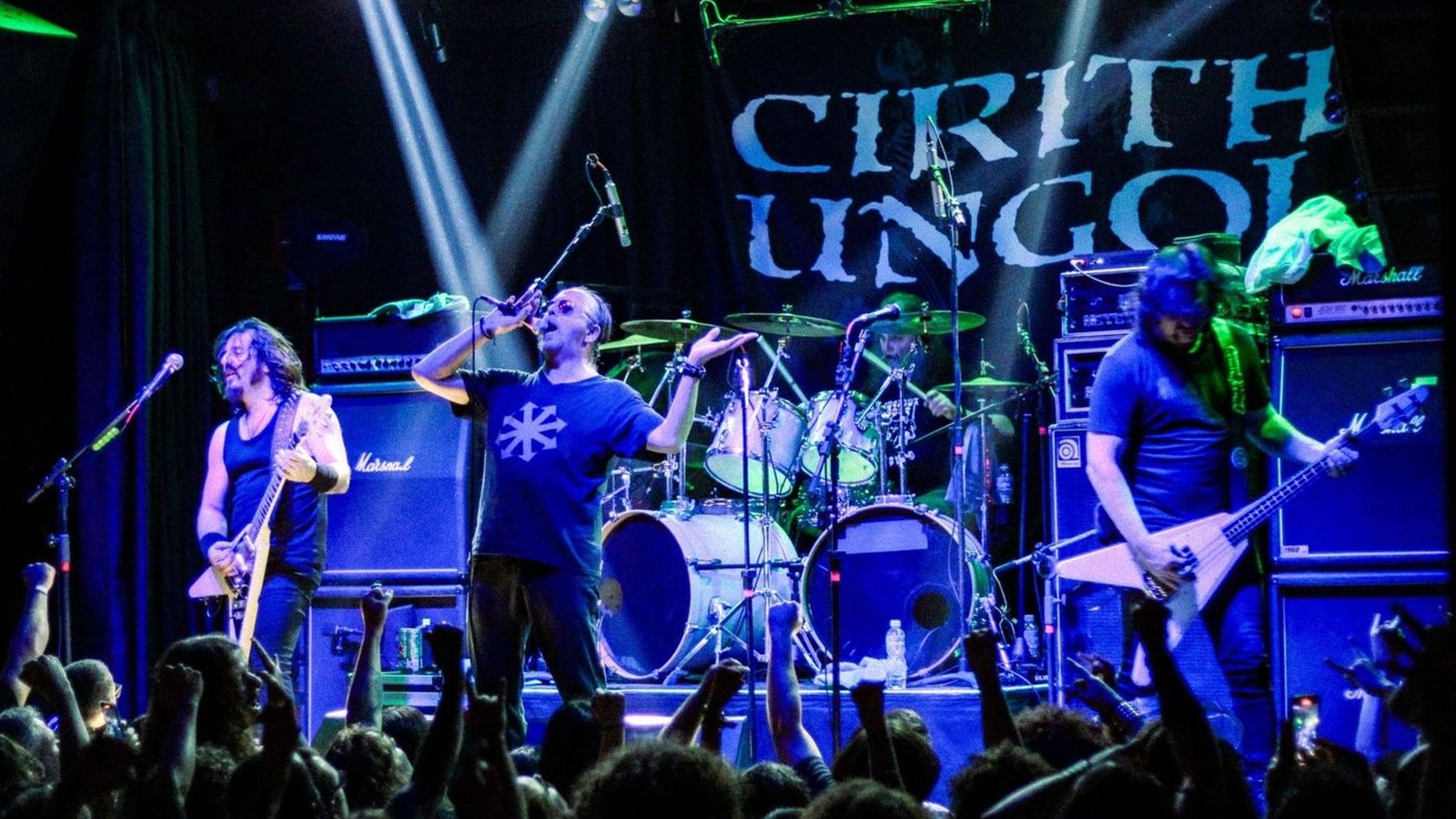
Eleven. That is the position Forever Black reached on the German album chart after Metal Blade released it on 24 April 2020, the first studio album in almost twenty-nine years by Cirith Ungol, the Californian quintet that had formed in Ventura in late 1971, played its last show on 13 December 1991 and broken up the following year with four records behind it. The number does not measure fashion. It measures a form that nobody had rebuilt while the band was away, so that what people bought in 2020 was made of the same materials as what they had declined to buy in the eighties.
Traditional doom metal is the name the chroniclers gave, after the fact, to the bands that took the template Black Sabbath laid down in 1970 and kept every part of it: a singer who sings rather than growls, riffs descended from the blues rather than from hardcore or death metal, tempos held between a slow walk and a weighted mid-paced march, a template first gathered into a genre by a handful of American bands during the decade that named it. Nothing is added to the Sabbath model. Nothing is taken away.
Cirith Ungol never slowed down to join doom. Doom slowed down far enough to find them already standing in the road.
Declan Rourke
The Sabbath template, kept whole
Picture a millstone in a mill house on a river, turning at exactly the speed of the water that drives it and at no other, grinding the same grain into the same flour season after season whoever the miller happens to be, because a miller can feed the hopper, dress the stone, but he cannot make the river run faster, and the one who tries, sluicing more water onto the wheel than it was built for, gets a stone that races, flour that scorches and a mill that stops being a mill. That is traditional doom metal. The river is the first Black Sabbath album, released in February 1970, and its title track set the current at which the whole form still turns.
Traditional doom bands tune higher than most of the doom that came after them, play at slow to mid tempo rather than at the funereal crawl of funeral doom, let the bass follow the melody line of the guitar, and keep the vocals clean, a high wail learned from Ozzy Osbourne and Bobby Liebling rather than a bark. The form leaves the growl to death-doom, the amplifier ringing for twenty minutes to drone and the fuzz haze pushed in front of the song to stoner metal. Each of those is a second river joined to the first. Traditional doom is the water before any of them came in.
Four founders at the wheel
Formed in Los Angeles in 1978 under the name Tyrant, recorded over two days in August 1982 at Total Access in Redondo Beach and then held back by SST Records, the Californian punk label, until early 1984, the debut of Saint Vitus dragged Dave Chandler's leaden riffs through a hardcore scene that wanted speed and got a dirge instead. When Scott Reagers left in 1986 the band recruited Scott Weinrich, known as Wino, who had come west from Maryland after the collapse of The Obsessed, the band he had led out of Potomac, Maryland, since 1976, first under the name Warhorse, and whose debut album, recorded in 1985 for a Metal Blade release that never came, sat on the shelf until Hellhound Records, by then the label of Saint Vitus as well, released it in 1990.

Born Too Late, released by SST in 1986, was the first record Wino sang for Saint Vitus, and its title is the closest thing traditional doom has to a manifesto: a band out of step with the thrash and hardcore of its own year, refusing to change step. Further east, two other mills had been turning with nobody watching. Pentagram, whose singer Bobby Liebling had carried the name since a Virginia rehearsal room in 1971, waited until 1985 for a first album on its own Pentagram Records, and Trouble, formed in Chicago in 1978 by the guitarist Rick Wartell, released its debut through Metal Blade in 1984, the record later reissued as Psalm 9, with Eric Wagner setting lines from the King James Bible over its riffs. Four bands, one current.
| Band | Country | Formed | The record that keeps the template |
|---|---|---|---|
| Pentagram | United States | 1971 | Pentagram, 1985 |
| Saint Vitus | United States | 1978 | Born Too Late, 1986 |
| Trouble | United States | 1978 | Psalm 9, 1984 |
| The Obsessed | United States | 1976 | The Obsessed, 1990 |
| Count Raven | Sweden | 1987 | Storm Warning, 1990 |
| Reverend Bizarre | Finland | 1994 | In the Rectory of the Bizarre Reverend, 2002 |
Cirith Ungol, a heavy metal band at the same river
Named after the mountain pass into Mordor in Tolkien's The Lord of the Rings, the band that Greg Lindstrom, Robert Garven and Jerry Fogle put together in Ventura played its first show on 1 January 1972, recorded in April 1980 at Gold Mine Studios in its home town and released Frost and Fire in 1981 on its own Liquid Flames label, thirty-one minutes of sword and sorcery heavy metal paid for with the band's own money.

King of the Dead, produced by the band itself at Goldmine and released by Enigma on 2 July 1984, is where the argument over the filing starts. The long songs, the seven minutes of "Master of the Pit" and the eight and a half of "Finger of Scorn", are why the reference works file the album under doom as well as power metal, while "Atom Smasher", the four minutes that open it, goes back by Greg Lindstrom's account to songs the band had written together in the mid seventies. Metal Hammer placed the same record fourteenth among the greatest power metal albums in 2019. Both filings are honest. Neither is complete.
The clauses of the template that Cirith Ungol breaks are the voice and the pace. Reviewing Forever Black for Blabbermouth, Jay H. Gorania heard Tim Baker's "commanding barks and wild jackal-like howls" and called "Legions Arise", the first full song after the intro, a speed metal track, and neither a bark nor a howl is the wail the doom singers took from Ozzy Osbourne. Elliot Leaver of Distorted Sound, writing on 23 April 2020, heard the band running a couple of notches slower than it once had, which is as near to the doom tempo as the comeback came. Our verdict is that Cirith Ungol is a heavy metal band that drew water from the same river as the doom founders, which is why it belongs in any account of where it all began and why it does not stand at the centre of the traditional doom canon. A band can drink from the same river without living in the mill.
One Foot in Hell followed on Metal Blade in 1986 and Paradise Lost on Restless in August 1991. Jerry Fogle died on 20 August 1998. The reunion was announced in 2015, and the first show in twenty-five years took place on 8 October 2016 at the Frost and Fire festival in Ventura. Forever Black came out in April 2020 with "Legions Arise" and "Stormbringer" among its songs and charted at eleven in Germany and twenty-five in Switzerland; Dark Parade followed on 20 October 2023, the month the band announced it would stop playing live at the end of 2024.
A band can drink from the same river without living in the mill.
The keepers after 1990
Formed in Stockholm in 1987 as Stormvarning and renamed in 1989, the Swedish quartet Count Raven released Storm Warning on Hellhound in 1990 and lost its singer Christian Linderson to Saint Vitus in 1992, after which guitarist Dan Fondelius took the microphone and has kept it through a split in 1998, a return in 2003 and The Sixth Storm in 2021. In Pittsburgh, drummer Mike Smail and guitarist Terry Weston of Dream Death founded Penance in 1990 on the same template.
Formed in Lohja in 1994 and recording under the names Albert Witchfinder, Peter Vicar and Earl of Void, the Finnish trio Reverend Bizarre released In the Rectory of the Bizarre Reverend on Sinister Figure in 2002, moved to Spinefarm for II: Crush the Insects in 2005 and closed its account with III: So Long Suckers in 2007, the year it broke up, after a last run of concerts through the autumn and winter of 2006 that ended in Turku. From the wreck Peter Vicar built Lord Vicar, whose records run from Fear No Pain in 2008 to The Black Powder in 2019.
Orodruin, formed in Rochester, New York, in 1998, released Epicurean Mass on PsycheDOOMelic in 2003 and Ruins of Eternity on Cruz Del Sur in 2019. Apostle of Solitude, formed in Indianapolis in 2004, went from Sincerest Misery on Eyes Like Snow in 2008 to Until the Darkness Goes on Cruz Del Sur in 2021, and Nate Garrett began Spirit Adrift alone in Arizona in 2015, writing its first EP over a few weeks that May and recording it in three days, before Chained to Oblivion came out on Prosthetic in August 2016 and Curse of Conception on 20 Buck Spin in October 2017. The millers change every decade. The stone keeps its speed.
Where traditional ends
The border is crossed the moment a band adds something the Sabbath model did not carry. When Candlemass released Epicus Doomicus Metallicus in 1986 and then put Messiah Marcolin's operatic voice on Nightfall in November 1987, it built a tower over the millrace, and epic doom is the name for what stands there. When bands pushed the fuzz and the psychedelic haze of the early seventies to the front of the mix, stoner doom began, and Wino's later work stands on that bank as often as on this one. When the voice drops to a growl, as it does for the Finnish band Hooded Menace, the record has left for death-doom, however faithful its riffs remain to the founders.
What stays inside the line is modest to describe and hard to do: a riff that could have been played in 1970, a singer who can be understood, a tempo nobody hurries and a band that does not think it has improved on the model. The scripture Wagner set over Trouble's riffs in 1984 runs from that same current into the Christian Doom Metal Bands, whose faith sat in the lyric while the music kept the old speed. Fifty-six years after the first Black Sabbath album, the river runs at the pace it always did, and the stone turns with it.
