
What's past is prologue.William Shakespeare, The Tempest, Act II, Scene 1
When did heavy metal music start? Four dates have serious partisans, 1968, 1969, February 1970 and 1971, and each can bring a record, a review or a chart position to court in its own defence. Only one survives cross-examination. It is the third.
Avalanche forecasters never date a slide by the first snowfall. The weight builds on a steep slope for weeks, a fracture line opens across the snowpack one night with a crack that carries for miles, and then the slab lets go and comes down the mountain, snapping pine trunks at the root and burying the valley road under forty feet of ice and rubble, and only after that does anybody in the village give it a name. The release is the date. Everything before it is load.
What the music is, and which parts of the blues it tore out to become itself, belongs to chapter one. The question here is narrower and harder: on which day could a listener first walk into a shop and carry the thing home?
Nineteen sixty-eight, the year of the loud singles
The case for 1968 rests on a pile of records released inside twelve months. The San Francisco trio that opened the year with Vincebus Eruptum on 16 January was Blue Cheer. By the summer Steppenwolf had taken "Born to Be Wild" to number two on the Billboard Hot 100, the American singles chart, Iron Butterfly had given a whole album side to "In-A-Gadda-Da-Vida" in June and the Jeff Beck Group had released Truth that July, and in November The Beatles put "Helter Skelter" on the White Album.
The case against is that every one of those records was a sortie rather than a campaign. Blue Cheer's noise sat on top of loose electric jams, Steppenwolf meant a motorcycle and nothing more, Iron Butterfly's seventeen minutes belonged to the organ and the drum solo, the Jeff Beck Group played Chicago blues with the amplifiers raised, and the Beatles had moved on by the next track, which on the White Album could be anything from a music hall number to a lullaby. Not one of those bands built a whole album on the riff. Not one was still doing it two years later.
Not one of those bands built a whole album on the riff. Not one was still doing it two years later.
Nineteen sixty-nine, the weight goes on tape
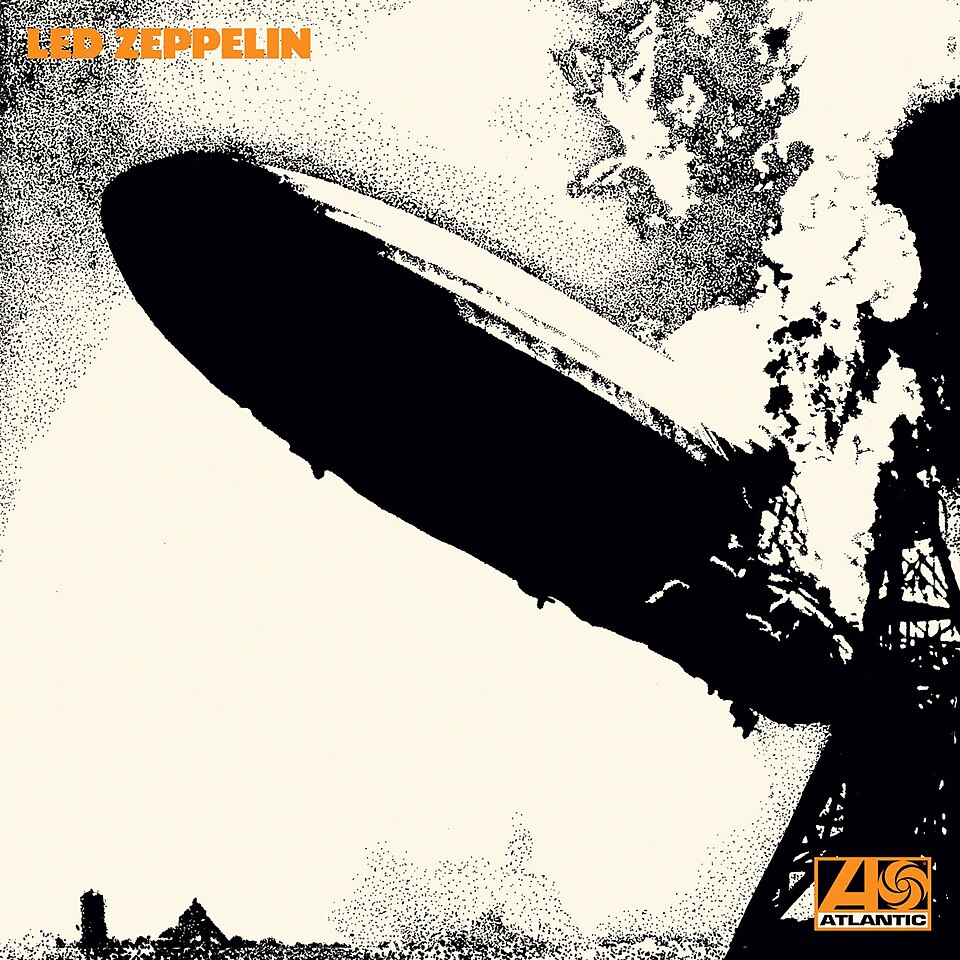
Recorded at Olympic Studios in Barnes in September and October 1968, in around thirty six hours of studio time, and released in America by Atlantic on 12 January 1969, the debut of the London quartet assembled that summer put more weight on tape than any band before it, and the four who opened it with "Good Times Bad Times" were Led Zeppelin. The case for 1969 starts on its first side.
John Bonham's bass drum fires its triplets under "Good Times Bad Times" like a cooper driving iron hoops down onto a barrel, blow after blow, until the oak staves groan and hold, and no drummer in rock had played a kick drum that way on a record before. Jimmy Page's guitar sits on top of it. The song lasts under three minutes.
The rest of the year piles evidence on top. The Flint trio that took long, loud, blunt blues rock to Capitol with On Time in August was Grand Funk Railroad, Led Zeppelin II arrived on 22 October and sat at number one in America by the end of December, and in November a Birmingham quartet taped its debut album at Regent Sound in about a day of studio time. That last fact is the strongest card in the 1969 hand. It is also the weakest.
A tape in a box that nobody has heard is not a beginning, and the Zeppelin albums, by the band's own repeated account, were blues played louder by men who refused the heavy metal label for the rest of their careers. The year of the weight is attested beyond argument. The year of the style is not.
February 1970, and the case for a single month
Released by Vertigo on Friday 13 February 1970, climbing to number eight on the British album chart while most reviews went against it, and putting in the shops the first album that opened on the riff and built most of its songs on it, the debut came from the Aston quartet that named itself and the record after the same song, Black Sabbath. The same weeks give the rival claim its paper trail. Reviewing an unrelated record, the Guess Who's Canned Wheat, Lester Bangs used the words heavy metal in Rolling Stone on 7 February 1970, dismissing other bands as "heavy metal robots of the year past." The record and the phrase reached print in the same month, a coincidence rather than a review of the record itself.
The American calendar runs a few months behind. Warner Bros. did not issue the debut in the United States until June 1970, so a listener in Detroit or Los Angeles who dates the music by the day he could buy it arrives at the summer, and that is a fair reading of the same evidence. It moves the date by a season. It does not move the year.
One record in February could still be a fluke. What turns the month into a date is what followed it inside the same year, three British bands making the same decision independently, and a date that nobody repeats is only an anniversary.
The London quintet that had played a concerto with the Royal Philharmonic in September 1969 and then turned its back on the orchestra, opening Deep Purple in Rock in June 1970 with "Speed King", its guitar and a distorted Hammond organ going off together like a gas main under a high street, lifting the paving and blowing out every shop front along it, was Deep Purple. Uriah Heep released a debut on Vertigo that same June. In September came Paranoid, which went to number one in Britain.
That is the bridgehead. Three bands, four albums, one calendar year, and the second of them from the band that had made the first.
A genre is not born on the day somebody plays it. It is born on the day somebody can buy it, and proved on the day somebody else plays it back.
Declan Rourke, KaosMetal
When did heavy metal music start, then
The case for 1971 is the case for recognition. Paranoid reached American shops only in January 1971, Mike Saunders applied the phrase to a band's whole style in Creem in May 1971, reviewing Sir Lord Baltimore, and Master of Reality arrived in July with its strings tuned down, a method the whole later lineage of doom and sludge would copy. By 1971 heavy metal had a name that fitted, an American audience and its first imitators. All of that is true.
The same rule that removes 1969 removes 1971. A start date cannot be the day a record was taped, or the Birmingham session of November 1969 would win on a technicality nobody outside the studio could have heard; nor can it be the day a critic found the right word, or the music would owe its birth to a magazine deadline. It has to be the day of release.
It is also the wrong question answered well. A name is a verdict on something that already exists, and a town is not founded on the day the mapmaker prints it. The imitators of 1971 were imitating records of 1970, which is the most useful evidence the 1971 party has, and it points straight back at the year before.
So the verdict is February 1970, with the months either side in their proper places: 1968 as the loud singles that proved the appetite, 1969 as the weight put on tape and the debut recorded, 1971 as the name and the first copies. Every definition of the style, including the one behind the types of heavy metal music, mapped, is measured from a record that went on sale that month.
The date has a place attached to it as well, and the place is less obvious than the date. The quarrel over where did heavy metal originate runs across two countries and four cities, and it has more than one right answer. The date does not. It was Friday the thirteenth.
