
In April 1982, in a garage in Downey, California, four young men put four songs onto a cassette and wrote two words across the label.
Printed weeks earlier on a stack of business cards by a bass player who wanted neither hard rock nor heavy metal on them, carried onto the tape because the cards already existed, and refused on sight by a drummer who told him plainly that he had ruined them, that phrase was power metal, and the Los Angeles quartet holding the cassette was Metallica.
So the words have a documented origin, and the origin explains nothing whatever about the music now filed under them. Nothing on that power metal demo resembles power metal. Four songs of fast minor-key riffing played with a hammering right hand, it is a document of American metal a year before it split in two, and the phrase on the label was a boast about loudness rather than a description of anything.
A name behaves like a dynamic marking rather than like a score. Someone inks a fortissimo at the head of an empty stave, the part goes out onto a stand, and it waits there until players in another country write the notes in underneath it and take the marking literally enough to split their double reeds and dent the bell of the trombone. The marking says how hard. It never says what.
A power metal demo with no power metal on it
The tape ran to four songs: "Hit the Lights", "Jump in the Fire", "The Mechanix" and "Motorbreath", cut in April 1982 on a four track recorder in McGovney's own garage. It was taped for club bookers, never sold, and has circulated ever since under the title on the label because nobody involved gave it another one.
Ron McGovney has told the story more than once, among others to Pat O'Connor of Shockwaves Magazine. He had cards printed for the band, he did not want hard rock on them and he did not want heavy metal either, and as far as he knew nobody had used the other phrase. Lars Ulrich, by the same account, was furious and said the cards could not be used. They were used. So was the name.
"Jump in the Fire" survived from that cassette onto Kill 'Em All fifteen months later, and what it does is the whole point: a mid-paced minor riff, a shouted verse, damnation in the chorus, and not one bar of the bright resolution, the operatic top line or the unbroken double bass floor the two words would later guarantee. On any honest reading the label names a music that did not yet exist.
Within two years the American press had a better word for what those four played, and the better word was thrash. The pair on the cassette were left lying about with no owner, which is the condition a phrase has to be in before a genre can pick it up. How the music that eventually took them was assembled, out of which parts and in whose hands, is set out in the account that frames it.
What the word power was already doing in metal
Power was not an empty noun in 1982. It had been in the guitar vocabulary for years as the name of a chord, in the rock press since the sixties as the name of a line-up and of a kind of song, and on the back panel of every amplifier as a measurement in watts. What it had never once been was a genre.
Start with the chord, because the joke lives there. A power chord holds the root and the fifth and nothing else, and the degree it leaves out is the third, the single note that decides whether a chord is glad or in mourning. Take a pen to the alto line of a four-part chorale and score it through, and what is left ringing is that same hollow interval, a sound that refuses to commit either way. The genre named after it is the one branch of metal that will not stop insisting on the major third.
The rest of the family arrived before metal did. A power trio named a line-up with one guitar, one bass, one drum kit and nobody to hide behind. Power pop named a kind of song, and Pete Townshend used the phrase himself in a May 1967 interview with the NME's Keith Altham. The power ballad turned up in the eighties as a label for the slow one on side two. Every one of those compounds points at force and volume. Not one of them points at harmony, at tempo or at a voice.
Metal used the word as decoration long before it used it as a category. Iron Maiden called an album Powerslave in 1984, and Pantera put the two words themselves on a sleeve as late as 1988, at a point when they were still loose enough in America to mean nothing in particular. The vocabulary was lying open. Somebody was going to close it.
How two American words became a German genre

In America the phrase settled loosely on a school of riff-first bands with fantasy in the lyric sheet, and the Kansas trio whose guitarist wrote the words, sang them and played every lead had already shown how few of them the underground needed by calling its second album Metal in 1982. That band was Manilla Road, and the pressing carried the band's own Roadster imprint. One noun. The qualifiers had not been handed out.
Europe had the opposite trouble, because its fast melodic bands already had a name and were about to lose it. The German groups Noise Records signed across 1984 and 1985, Helloween's own debut EP and Walls of Jericho among them, were catalogued as speed metal on release, and then thrash walked off with speed metal entirely. By the end of the decade the word meant the Bay Area and the Teutonic four, and a bright, fast, tenor-led German record had no shelf left to stand on.
What follows is what always follows when a section walks out of a pit and takes the stands with it. The players left behind are holding parts with nothing written at the head, and they will use whatever title is lying on the boards, which is how a set of words printed for a Californian business card ended up at the top of a German score.
A phrase has to be lying about with no owner before a genre can pick it up.
Two records shut the argument. Helloween put Keeper of the Seven Keys Part I out on Noise in May 1987 with a trained tenor sitting on top of the apparatus for the first time, and the succession ran from there through every German, Finnish, Italian and Swedish band that copied the arrangement. Ten years after that the revival made the usage commercial: HammerFall, Rhapsody of Fire and Stratovarius were sold under the two words by their labels and billed under them at festivals, and by 2000 nobody in Europe meant anything else by them.
The clearest evidence of who won the word is what the losers were left doing. American bands playing the older, heavier, keyboard-free version now need a qualifier, and their own listeners supply one, filing them under USPM, an abbreviation no other regional scene in metal has ever needed. A hymn tune carries a name printed above the stave that has nothing to do with the words sung underneath it, and when a new text is bound in, the old one comes out of the hymnal under a blade while the tune keeps the name of a place nobody in the pews has seen. That is the inheritance the American school got.
What the name promises a listener now
The two words now work as a catechism, and beyond dispute it is not the one Ron McGovney had printed. Anyone who picks up a record labelled power metal expects a voice living at the top of its range, a kick drum pattern that does not stop, harmony that resolves bright, and a chorus scaled for a field of strangers. The promise is so exact that a band breaking a single clause of it has its membership argued in public for twenty years. Which clauses actually bind and which are only habit is the business of what makes a song power metal.
| Name | What the word points at |
|---|---|
| Thrash metal | A movement of the picking hand |
| Death metal | A subject |
| Black metal | A subject |
| Doom metal | A tempo and a mood at once |
| Speed metal | A tempo |
| Grindcore | A texture |
| Power metal | An effect claimed, with no instruction attached |
Set the names beside one another and the odd one is obvious. The rest all tell a player something. Power names an effect and gives no instruction of any kind, which is exactly why it could be prised off one music and bolted onto another without anyone noticing the theft.
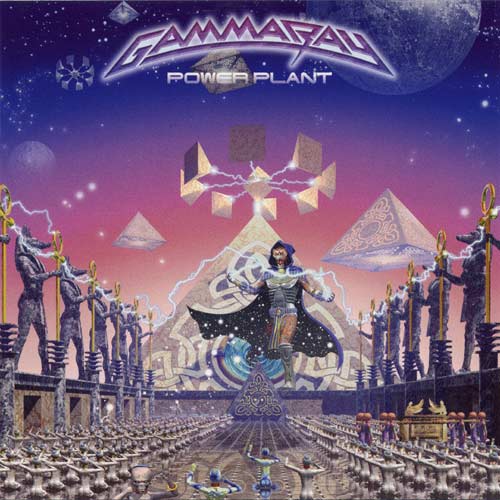
The circle closed in 1999, when the Hamburg band Kai Hansen fronted through the nineties released a record called Power Plant and gave the noun back to the electricity supply. That band is Gamma Ray, and Noise Records put the record out on 23 March 1999. By then the two words had travelled from an amplifier panel to a business card to a cassette label to a genre, and the title reads as a joke only if you know the route.
"Send Me a Sign", the third track and Henjo Richter's composition rather than Kai Hansen's, carries the promise whole. Two independent reviewers of the record converge on it above everything else on the tracklist: one names it outright as the singalong on the record, the other calls it the most accomplished thing Richter wrote for the band, built on the same plan as Helloween's own festival chorus "I Want Out". Nothing in it is a claim about amplifier wattage.
So the answer is smaller and stranger than the music deserves: a bass player's improvisation on a business card, discarded by the band that printed it, ignored for five years, then taken up by people on another continent who needed a title for something nobody had named. The genre did not choose what it is called. It took the name off a tape that was never sold, and the whole road from that tape to festival fields on five continents is the power metal history in full.

