
Six open strings, and not one of them outside E minor. Tune a guitar the standard way, E, A, D, G, B and E from the bottom string up, and every note you strike without touching the neck belongs to the E minor pentatonic scale, the five notes E, G, A, B and D, so that a player who drags a pick across all six has let the instrument choose the key before the fretting hand has made a single decision. That is the first answer to why metal uses minor keys. It is not the romantic one.
Every old university has a lawn crossed by gravel paths the architect drew at right angles, and every one of them has the brown diagonal the students cut across it instead. Heels tear the turf out in clods from the library steps to the bar, the gardeners reseed it each spring and the boots rip it open again by the second week of term, until somebody in the estates office gives up and paves the line the feet already chose. Planners call it a desire line. Nobody designed it. Heavy metal walked into E minor the same way.
The Venetian theorist who set down in print, in the Istitutioni harmoniche of 1558, that a harmony built on the minor third sounds sad was Gioseffo Zarlino, and four and a half centuries of listeners have treated his verdict as a law of nature. Heavy metal kept his key and threw out his verdict. What it heard in the minor third was never grief. It was weight.
Why metal uses minor keys: the hand before the heart
Standard tuning runs in fourths with a single major third between the G and B strings, and it leaves the lowest and loudest note on a distorted guitar on the open E. Any riff that wants that string ringing underneath it as a drone has to treat E as home, and the first-position box of the minor pentatonic sits exactly where a beginner's fingers fall. A teenager with a borrowed guitar and a songbook finds the key of the whole genre in his first week, by accident. The key followed the string.
The chord does not overrule it. A root and a fifth with no third between them commit to neither major nor minor, as music theory in heavy metal sets out at length, so the colour of a riff lives in the single notes that run between the chords and in the line the singer lays over the top. Those notes came from the blues. A blues guitarist bends the minor third a shade sharp and leaves it hanging between the two modes, and the heavy bands of 1970 stopped bending and let it sit flat, held there by the amplifier. The lineage of heavy metal was written in E minor before anybody argued about what E minor meant.
What it heard in the minor third was never grief. It was weight.
Sad was a verdict, not a law
The association of minor with mourning is attested in print from 1558, and it took Europe the better part of two centuries to agree with Zarlino, while the old church modes gave way to the major and minor system that every conservatory now teaches as if it had always been there, a shift that took roughly from 1400 to 1700 to settle. A convention that needs two hundred years to take hold is not physics. It is schooling.
The researchers who carried pairs of major and minor cadences up the Uruwa river valley in Papua New Guinea, played them to 170 people in seven villages and asked which one made them happier were Eline Smit and her colleagues at the MARCS Institute of Western Sydney University, and PLOS ONE published the answer in June 2022. Every community heard major as the happier of the two except one. The village with the least exposure to Western music barely told them apart.
So the sadness is taught. You learned it from hymns, from film scores and from every piano teacher who called the minor key the sad one, and a genre is perfectly free to teach the same three semitones something else. Heavy metal taught them menace.
The minor key is not a mood. It is a room, and heavy metal never found a reason to leave it, because everything it wanted to say could be said without opening a window.
Julien Vasseur, KaosMetal
The concert hall's thunder
In the wings of an eighteenth-century London theatre hung a sheet of iron taller than a man, and a stagehand gripping its lower edge could shake it until the chandeliers rattled and the front stalls felt the roll in their ribs, a storm made of scrap metal and one strong arm, set off on cue before the witches came on. The critic who devised a new way of making stage thunder for his tragedy Appius and Virginia at Drury Lane in 1709, watched the play close, and then heard his own thunder rolling through somebody else's Macbeth, was John Dennis. The phrase about stolen thunder is his.
The classical minor key did the same job. When Haydn wanted a storm in his symphonies around 1770 he reached for minor keys, the Farewell in F sharp minor among them, when Mozart sent the statue of the murdered Commendatore to drag Don Giovanni down to hell in Prague in October 1787 he did it in D minor, and when Beethoven knocked on the opening of his Fifth Symphony in 1808 he knocked in C minor. None of that is sad. All of it frightens. The minor key's pedigree in the concert hall is storm, not sorrow, and heavy metal stole the thunder whole.
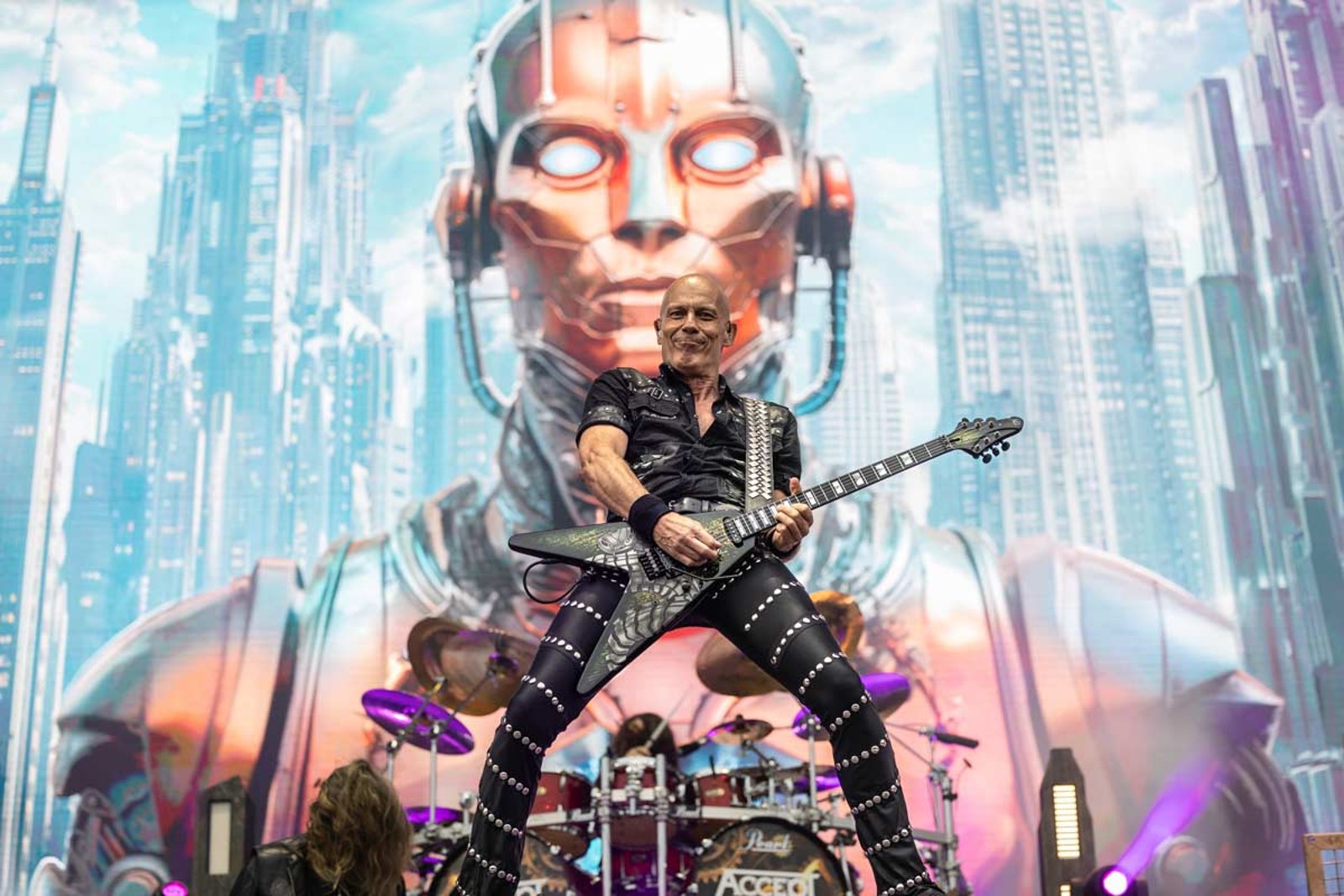
The Solingen guitarist who took the opening of Mozart's Symphony No. 40 in G minor, finished in the summer of 1788, and set its restless strings over a double kick drum for his solo album Headbangers Symphony, released by Nuclear Blast on 1 July 2016, was Wolf Hoffmann of Accept. The band carried the piece onto Wacken's main stage in August 2017, the Czech National Symphony Orchestra at their backs, and released the show the following year as Symphonic Terror. The key did not need changing. The distortion only made it heavier.
It was not Accept's first raid on the repertoire. The title track of Metal Heart, in 1985, had already pulled Beethoven's Für Elise, a piece in A minor, into its riff and its solo, and Tchaikovsky's Marche slave into its opening, which makes the band the most devoted exponent of the classical minor key that German heavy metal produced. Nobody in the audience heard a piano lesson. They heard a storm with two guitars.
Threat at walking pace and at full gallop
Tempo decides what a minor key means. Slow and quiet, three semitones above the root read as dread. Fast and loud, the same interval reads as pursuit, and a band that wants both moods in one song does not have to change key at all, only speed.
The bassist who closed the 1992 album Fear of the Dark, released by EMI that May, with a title track that opens on a lone guitar melody in D minor and then, a minute and a half in, drives the same key into a gallop that stamps the melody flat under two guitars and a bass played with two fingers, was Steve Harris of Iron Maiden. The mood turns over and the key never moves. Crowds have sung that guitar melody back at the band for three decades.
On any honest reading this is where heavy metal parted company with the conservatory. In a sonata the minor third is a shading, something to be answered by a brighter key in the second subject. Here it is the floor of the building. Nobody is waiting for the major key to arrive.
Where heavy metal goes major
Even the loudest declaration of independence in the catalogue stayed in the minor room. The Hamburg guitarist who wrote "I Want Out" for Keeper of the Seven Keys Part II, released by Noise in 1988, kept the song about breaking loose in D minor even as its chorus turned euphoric, and within months he had left Helloween himself. Its chorus was built to be shouted back from a festival field. It went onto the radio as well.
The rule does break, at least once, further back. "Living After Midnight", on Judas Priest's British Steel in 1980, runs on major chords in E and is a song about a night on the town. When heavy metal goes major it is usually heading for a party or for the charts, and often both. Everything else, Hamburg's own festival anthem included, stayed in the minor room.
Key is only the first question a riff answers. The second is how its bars are counted, and a genre that settled so early on one key spent the next half century pulling the metre apart instead, which is where odd time signatures in metal take over. Few riffs keep four beats forever. Almost all of them keep the minor third.

