
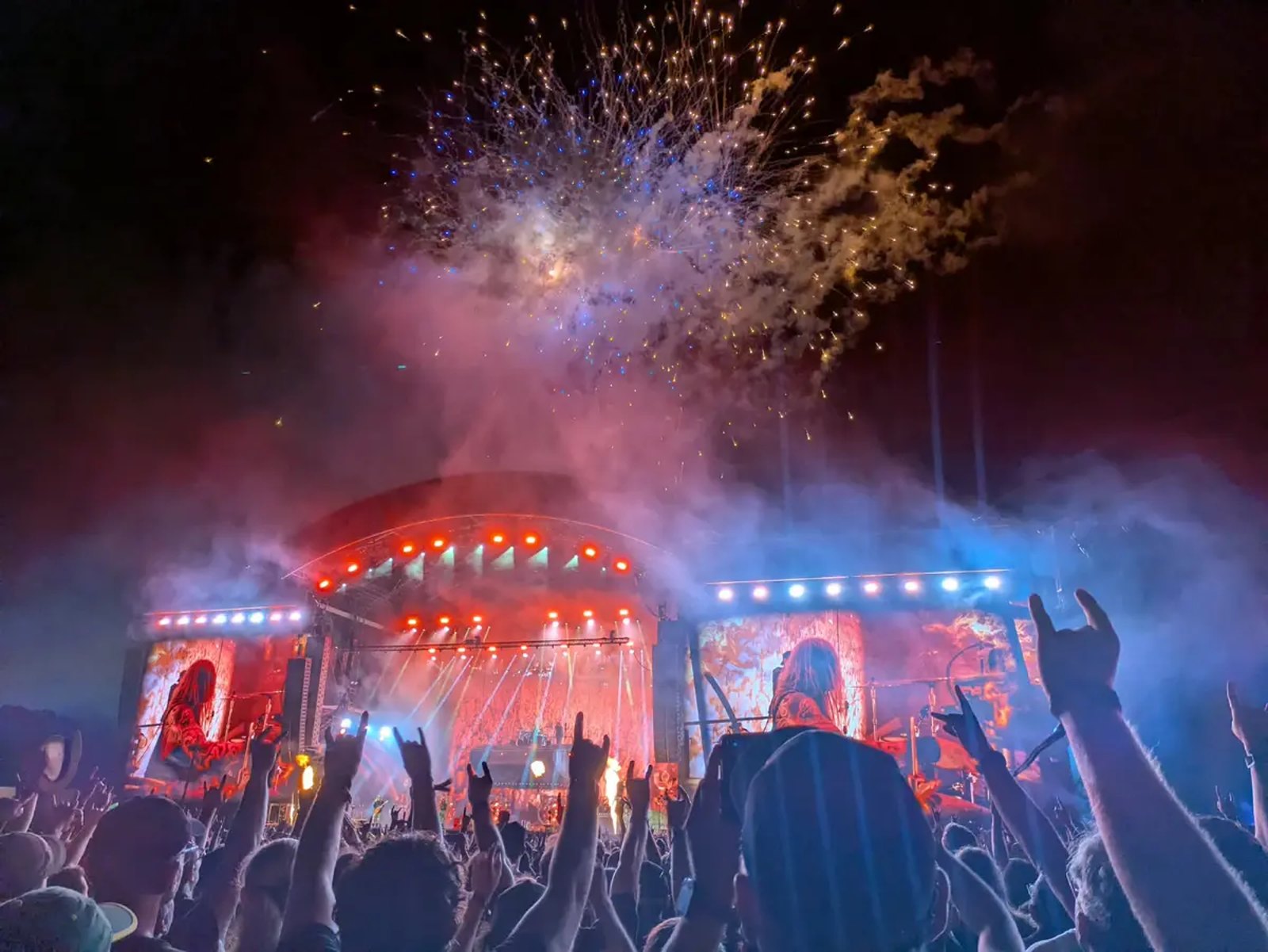
Eighty five thousand tickets to a field in Schleswig-Holstein, gone in four and a half hours.
The question where is power metal popular has an answer nobody has to argue about, because it can be read off a ticketing page, a chart archive and the back of a sleeve, and those three sources say the same thing in three different hands.
The band from Falun whose four studio albums between 2014 and 2022 each reached number one on the Swedish chart, three of them entering there, is Sabaton, and those same four records reached 99, 63, 42 and 87 on the Billboard 200, the American album chart, which is the geography of this music written out in eight numbers.
A singing festival was a hall of green timber thrown up in a field for one week in July, with benches for twelve thousand men who had worked the same part books all winter in rooms over a hundred different bars without once hearing each other sing them. The stamping tore the nails out of the platform boards. What carried the hall was never the soloist's line but the one four thousand second tenors already had by heart, and the whole building came down on the Monday and went up a year later in another county, on a date fixed before anybody had left.
The records and the dates that made the European strain belong to the account that frames it. Forty years on, that chronology has hardened into something flatter and easier to check: a map drawn in tickets, chart peaks and postal addresses.
Where is power metal popular, counted at the gate
Wacken Open Air sold its entire 2024 capacity of 85,000 in four and a half hours, cutting through the six hours the year before had taken, and it does that to a village in Schleswig-Holstein every summer. Masters of Rock, at Vizovice in the Czech Republic, gathers around 25,000 across four days with power, speed and heavy metal named as its core. Neither is a niche weekend the faithful keep alive out of loyalty. Both are ordinary industry.
Behind those two runs a circuit that never has to stop at a border, Graspop at Dessel in Belgium, Sweden Rock at Sölvesborg, Tuska in Helsinki, Leyendas del Rock at Villena in Alicante, and a dozen smaller grounds between them, most of them working through the same forty or fifty bands in a rotation that lets a group cross the continent every other summer without playing the same town twice. All four ran in 2024 with power metal on the bill, HammerFall at Sweden Rock and Graspop, Stratovarius and Sonata Arctica at Tuska, Blind Guardian and Alestorm at Leyendas del Rock. One circuit, and no passport stamped twice.
Against that stands the American weekend that has carried the European strain since 2001, which fits inside one Atlanta theatre and has hosted the United States debut of more than seventy bands, Blind Guardian, Gamma Ray, Nightwish and Stratovarius among them. That theatre, Center Stage, seats 1,050 by its own count. A full choir's anthem sung by four people round one music stand has every note of it present and does not move the building. The bills overlap. The rooms do not.
The bills overlap. The rooms do not.
The charts under the field
Ticket sales can be explained away as a summer habit. The record shows the same split in the one place where a habit turns into money, and it shows it in every decade since 1988.
| Album | Year | Peak at home | Germany | Finland | US Billboard 200 |
|---|---|---|---|---|---|
| Sabaton, The War to End All Wars | 2022 | 1 (Sweden) | 1 | 1 | 87 |
| Helloween, Helloween | 2021 | 1 (Germany) | 1 | 2 | 35 |
| Powerwolf, Call of the Wild | 2021 | 2 (Germany) | 2 | 11 | not placed |
| Stratovarius, Survive | 2022 | 1 (Finland) | 30 | 1 | not placed |
Four countries putting one record at the top of the same week, and a fifth filing it at 87, is what a hymn tune sounds like in a parish that has never sung it: the notes are all on the page, the pews stay shut, and the organist beats the keys until the tracker action rattles in the case. Neither Call of the Wild nor Survive appears on any United States chart at all, main or Heatseekers: the American column is not a low number but a blank one.
The Helloween row is the sharpest of the four. Thirty six years after its first album the band took a German number one for the first time, with 2 in Finland, 3 in Sweden and 6 in Japan behind it, and 35 in the United States, the only one of its records ever to reach the upper half of that chart. Thirty five is a respectable American week. It is also the ceiling.

"Fields of Verdun" went out as the first single on 3 May 2019, ten weeks ahead of The Great War, and the album behind it took number one in Sweden and Germany, three in Finland and Poland and 42 in the United States, which remains the band's best American placing.
The German band that has driven five releases to the top of its own national chart and has yet to trouble an American one is Powerwolf, whose "Beast of Gevaudan" arrived on 20 May 2021 as the first thing heard from Call of the Wild, an album that then went to 2 in Germany, 5 in Austria, 5 in Switzerland and 11 in Finland. The band's five German number ones are the studio albums Preachers of the Night (2013), The Sacrament of Sin (2018) and Wake Up the Wicked (2024), plus the live recordings The Monumental Mass (2022) and Wildlive (2026). Five markets, one continent, no crossing.
The addresses on the back of the sleeve
Money leaves a better trail than memory does. The houses that have paid for this music since the nineties sit in a small Swabian town, an Austrian mining town in Styria, a city on the bay of Naples and a northern German port, a guild with four doors and no fifth, and whoever knocked anywhere else was left on the step until the rain took the ink off his parts.
The Italians who wanted a career had to take a Hamburg label to get a debut pressed at all, which is how Rhapsody of Fire started; the Styrians issue Powerwolf; the Swabian house carries HammerFall and Blind Guardian. None of it is patriotism. It is where the cheques were signed, and a band from anywhere on earth that wanted a record made posted its tape into that square of the map.
What those houses were buying was a template somebody else had already proved, and the record that proved it gets taken apart in Keeper of the Seven Keys and the birth of a genre. Everything after that is distribution.
Two outposts that never handed it back
Japan did not adopt this music. Japan outbid its home market for it. Through the nineties the Japanese chart placed Helloween above the German one on record after record, 8 against 35 for Chameleon in 1993, 6 against 23 for Master of the Rings a year later, 9 against 19 for Better Than Raw in 1998. That was the decade the German trade had written the style off entirely.
The Finnish band that has put an album on the Japanese chart with almost everything it has released since 1992 and has never once appeared on an American one is Stratovarius. Survive, from 2022, took number one at home, 32 in Japan and 30 in Germany. Nothing in America. The asymmetry is attested across sixteen studio albums and three decades, which makes it a market rather than an accident.
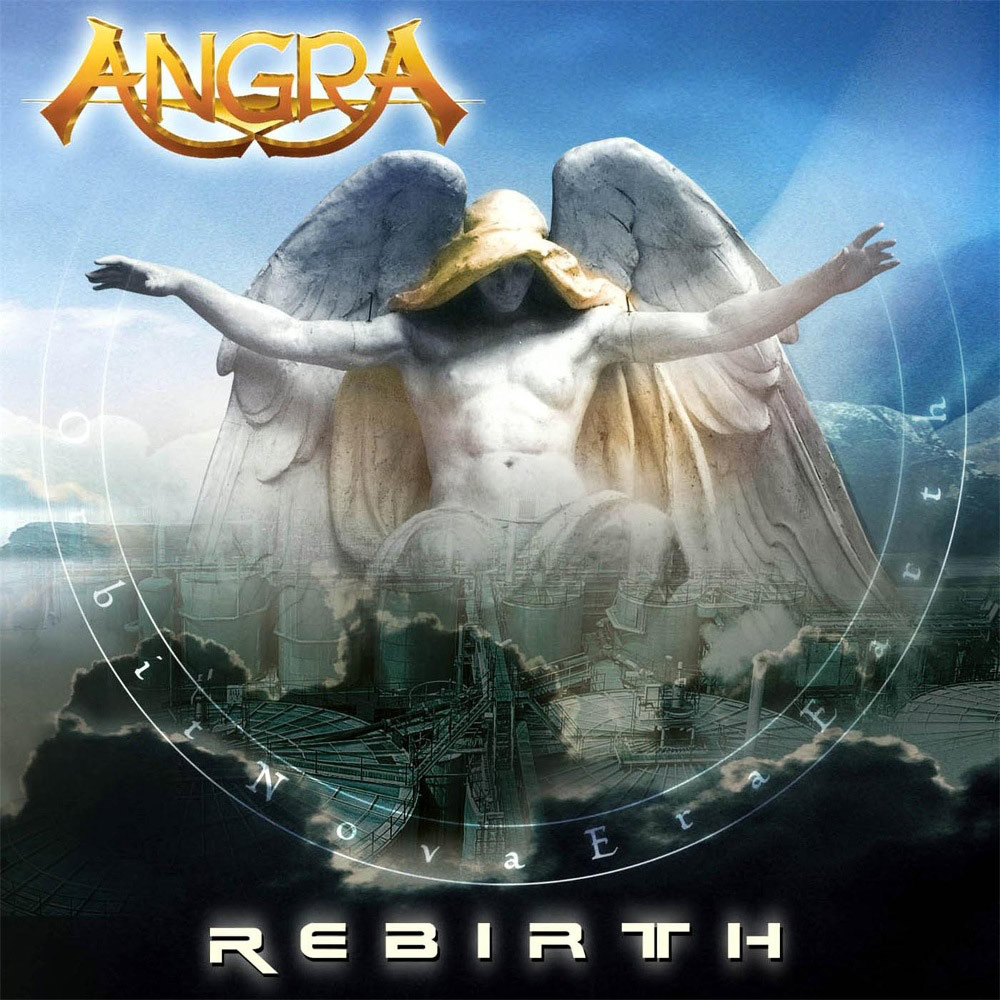
The Brazilian band whose debut was cut at Kai Hansen's studio in Hamburg, with Hansen playing on it, is Angra, and everything about how that band reached an audience runs through the same map: a German room, a European label, a Japanese pressing. Rebirth, released on 13 November 2001, reached 18 on the Oricon chart in Japan and sold roughly 26,330 copies there, against more than 100,000 worldwide. Its gold certification came from Brazil; the Japanese gold record on the band's shelf belongs to Holy Land, five years earlier.
What the continent actually supplies
Strip the banners off and the answer is dull and entirely material. Four or five houses within a day's drive of one another will pay for a record that sells forty thousand copies. A dozen promoters will book the band that made it the following July at a fee large enough to pay for the next one. Between all of them lie short distances and a rail map, so five men in a hired van can play eleven countries in three weeks.
The audience supplies the rest, and it is the part no promoter can buy. Festival reviews describe the same trade year after year: a crowd that takes the top line off the singer by the second chorus turns the most expensive thing on the record, the stacked choir, into something delivered free by fifty thousand throats. Where that trade does not happen, the band pays for the choir itself and carries it on tape.
None of this sits in anybody's blood. It sits in the money, the distances, the four or five postcodes where the money lives, and the willingness of fifty thousand people to stand in the rain in northern Germany for four days in August. Take those away and the records are unchanged. They simply have nowhere to go.
