
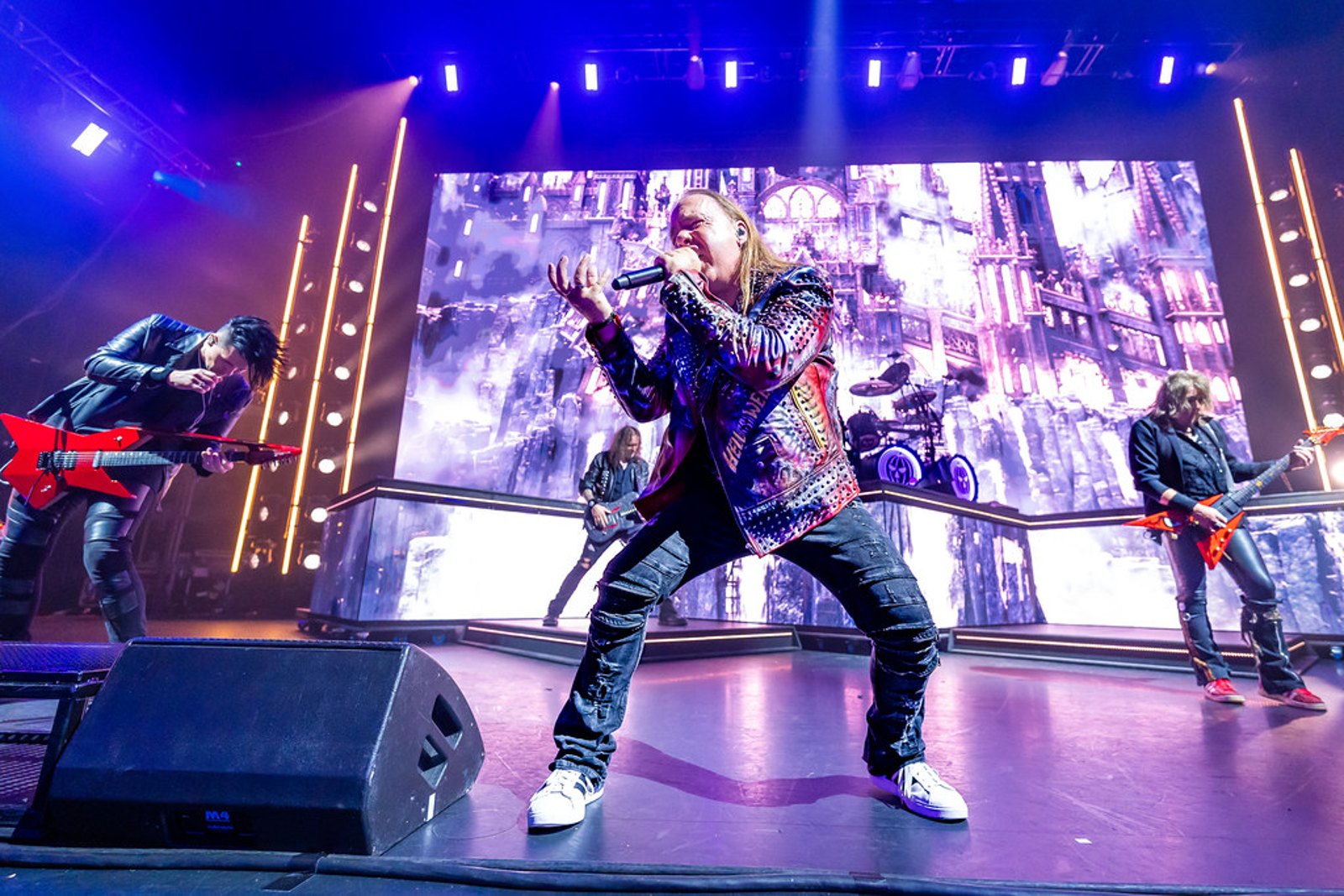
Thirteen minutes and eighteen seconds long, stitched together from a galloping verse, a slow spoken middle and a return to full speed, the song that closes the first half of the story is Halloween, and the young quintet that recorded it for Noise Records in 1987 was Helloween, which on Keeper of the Seven Keys Part I ripped the studded leather off speed metal and dressed it in major keys.
Nobody had tried it at that speed.
Spread across two albums, the first in May 1987 and the second in August 1988, Keeper of the Seven Keys is the founding document of European power metal, the text every later band in the style learned by heart, and it gutted the speed metal chorus of its growl and rebuilt the hollow body as a hymn a whole hall could carry. The records did not invent the parts. They fixed the order in which the parts go together.
A tenor, and two composers at one desk
Before the Keeper records, the band sang through its lead guitarist. Kai Hansen had handled the microphone on Walls of Jericho in 1985 while playing the riffs, and the arrangement suffered for it, since a man carrying both jobs cannot push either one to the limit. The solution arrived in 1986 in the form of Michael Kiske, a singer just eighteen, and the effect on the writing was immediate. The songs could now climb.
Kiske's tenor was pitched above everything and sat over the guitars the way a piccolo sits over a full brass section, needle thin, impossible to bury, audible at the back of the gallery when the whole orchestra is playing fortissimo beneath it. Every composer in the band promptly wrote higher. That single change of personnel is the hinge on which the German beginning turns from speed metal into something that needed a new name.
The other hinge is the writing split. Hansen and Michael Weikath wrote apart and delivered finished songs, and the two records read like the work of two composers sharing one desk in a conservatory, each marking up his own half of the score in a different coloured ink. Hansen brought the velocity and the epic scale, I'm Alive, Future World and Halloween on the first part. Weikath brought the melodic instinct and the jokes, A Tale That Wasn't Right on the first, Eagle Fly Free and Dr. Stein on the second, while Kiske contributed A Little Time and later You Always Walk Alone.

Keeper of the Seven Keys Part I, the thirteen-minute gamble
Produced by Tommy Hansen and Tommy Newton at Horus Sound Studio in Hanover, the first part is a short record, around thirty-seven minutes, and its brevity is part of its design: a keyboard overture called Initiation, then I'm Alive at full speed, a ballad in the middle, the single near the end, then the long piece and a short coda, with no filler anywhere between. The template begins with the running order. Hundreds of later records open on an instrumental intro that hands straight over to the fastest song on the album, and almost none of them know where the habit comes from.
Future World was the single, a mid-paced march in a bright major key with a chorus you can sing after one hearing, and it is the proof that the band understood the difference between speed and energy. Nothing about it is fast. Everything about it lifts.
Then comes Halloween, built like an overture torn out of an opera score and rebound at double speed, the pages restitched in the wrong order on purpose so that the listener hears the main theme, loses it in a quiet middle section, and is thrown back into it for a finale that detonates the orchestra pit. Suites of this kind existed in progressive rock and in the longer songs of Iron Maiden, but nobody had pushed them this far at this tempo, and the gamble paid off with interest. The long epic, placed last or near the end, became a fixed chapter of the European catechism from that record onward.
An overture torn out of an opera score and rebound at double speed, the pages restitched in the wrong order on purpose.
Keeper of the Seven Keys Part 2, and the year of the singles
The two parts were planned as one double album, and Noise refused the risk, which is why the story arrives in two instalments fifteen months apart. The second half is longer, more confident and far more commercial, and it is the record on which the formula stops sounding like an experiment. You can hear the band knowing exactly what it is doing.

Opening on another short instrumental, Invitation, and handing straight over to Weikath's Eagle Fly Free, Keeper of the Seven Keys Part II repeats the architecture of the first part so exactly that the two records lock together like the halves of a hinged music stand, then fills the middle with Dr. Stein, Rise and Fall, March of Time and I Want Out, and closes on the title track, a second long epic of about thirteen and a half minutes that Weikath wrote.
Eagle Fly Free is the song later bands copied most directly. Two guitars in harmony run at a tempo that would strip the horsehair from a violinist's bow in a single passage, the drums hold an unbroken double-bass pulse underneath, and over the top Kiske sings a melody so wide and so bright that it seems to belong to a different, slower song, which is precisely the trick: the rhythm section sprints while the tune floats. A good share of the Finnish records of the next decade is built on that split.
The singles did the public work. Dr. Stein and I Want Out were both released as singles in 1988, and Hansen's I Want Out, with a promotional video directed by Storm Thorgerson, became the most recognisable song the band ever recorded, an anthem of refusal that still closes festival sets today. Part II also reached the album charts outside Germany: 24 in the UK, 108 on the US Billboard 200. A German speed metal band on an independent label had no business doing that in 1988.
What the template actually was
Strip away the pumpkins and the fantasy covers and the Keeper records leave behind five working rules, and every later band in the style has followed at least four of them. Twin guitars play harmonised melodies in thirds at speed. The harmony underneath stays in major keys or in bright modes, with choruses that resolve where the ear expects them to. The singer is a high, clean tenor. Each album carries one long epic in several sections. And somewhere on the record, there is a joke.
| Song | Part | Writer | What it fixed |
|---|---|---|---|
| Initiation / I'm Alive | I | Hansen | Short intro handing over to the fastest song |
| Future World | I | Hansen | The mid-paced major-key single |
| Halloween | I | Hansen | The long epic in sections |
| Eagle Fly Free | II | Weikath | Harmonised guitars at speed under a slow, wide melody |
| Dr. Stein | II | Weikath | The comic song as a permanent fixture |
| I Want Out | II | Hansen | The festival anthem |
| Keeper of the Seven Keys | II | Weikath | The title-track epic as album finale |
Beyond dispute, the last of those rules is the one most often forgotten. Dr. Stein is a comic operetta about a mad scientist, smuggled into the middle of a record that also contains a thirteen-minute quest, and Rise and Fall is a string of slapstick tales played at full speed. The humour kept the grandeur honest. Later bands that took the epic and dropped the joke produced the style's most pompous records, and later bands that kept both, from Edguy onward, produced its most likeable ones.
The ballad was a rule too. Weikath's A Tale That Wasn't Right on the first part and Kiske's We Got the Right on the second are less celebrated than the anthems, yet they fixed the habit of one slower song in the middle of the record, to let the tenor show its range before the long piece, a lesson learned by anyone who has wondered how Helloween wrote the power metal rulebook and then gone back to check the track lists.
Where the progeny came from
Raised on the two Keeper records in the years after 1988, a whole generation of bands took the formula to Finland, Brazil, Sweden and Italy, and the progeny can be named: Stratovarius with its keyboard duels over Keeper tempos, Angra with a high tenor and a taste for long suites, Gamma Ray, Sonata Arctica, Hammerfall and Rhapsody of Fire, each of them bending the template and none of them discarding it. The Keeper records are the tuning fork European power metal was set by, struck so hard against the brass rail of the orchestra pit that the rail still carries the dent, and every chorus written in the style since has been pitched against that ringing note.
The partnership that wrote the template did not last beyond it. Hansen left on New Year's Day 1989 and formed Gamma Ray, so the rules were set by two records and one line-up, which is part of why they hold together so tightly.
Anyone tracing the whole arc in KaosMetal's history of power metal meets the Keeper records at the point where the road forks, with the American bands keeping their riffs dark and the European ones following Helloween into the light. The chroniclers still argue about who played power metal first. Nobody seriously argues about who wrote the version Europe adopted.
Put the two parts next to the records that matter released since 1988 and the fanfare is still audible in almost every one of them. The keeper held the keys. The rest of the style has been opening doors with copies.
