

Five instructions. A continent has obeyed them for forty years.
Rehearsing in cellars a tram ride from the Reeperbahn, signed to a Berlin independent that ran its whole catalogue on money a provincial opera house would have spent on lighting, and recording between 1985 and 1988 with the engineer's clock running the entire time, the Hamburg quartet that turned a set of habits into a set of orders was Helloween. It stripped the blues out of the riff, tore the shout off the top of the chorus and left the style with nothing to do but sing.
The phrase Helloween power metal is usually made to name a sound, meaning fast, bright, high and German. It names a set of jobs. What the band left behind was not a batch of songs for other bands to imitate, which is what every earlier generation had left, but a description of what each pair of hands in the room is for, put plainly enough that five strangers who had never heard the records could pick up the instruments and produce the style anyway.
A merchant endows a chapel in his will and spends most of the deed on prohibitions: six boys and four men and no more, the psalms kept in the old order, no instrument in the loft but the organ, nothing theatrical, nothing carried in from the playhouse, the endowment forfeit the day any of it is broken. Singers who never heard of him hold his chapel in one style for three hundred years. A clause can be obeyed by a man with no taste at all, which is why the loft is stripped of its viols the week a new master tries one, and why the chapter takes a pen through his request before the ink on it is dry.
Helloween wrote its list between 1985 and 1988. Most of it says no.
A rulebook is a set of jobs, not a set of songs
What the seventies handed down was material. Judas Priest left two guitars harmonised a third apart, Rainbow left a minor key with a castle standing in it, Accept left a downstroke cut square to the beat, and not one of those is an inheritance a lesser band can simply take, because a mood cannot be copied by anyone who does not already have it. Orders are different. Orders can be carried out by the untalented, which is the whole reason they spread.
Between 1984 and 1990 the German bands wrote down what had until then been taste, and chapter two follows that decade town by town. The narrow part of that story is the part that travelled: four or five sentences a band anywhere could read and act on in the same week.
Each station got one sentence. The two kick drums run continuously and hold a level surface instead of marking the climaxes. The bass is welded to that pulse and does not go wandering. The guitars play one melody in two voices, and the riff is demoted to accompaniment underneath it. The keyboard colours and does not solo. The voice sits above the guitars, clean and pitched, and the chorus it lands on is written to be sung back at it rather than admired.
The orders were mostly prohibitions
Set out positively the list reads like a recipe. Set out the way the records between 1985 and 1988 actually enforce it, the list is a series of refusals, and that is the form in which it travelled. No shuffle and no swing, the eighths lying flat and even. No blues bend as the expressive device, and the bend had been the entire vocabulary of the music this came out of, scraped off the fingerboard here and replaced with a scale that goes somewhere. No rasp at the top of the chorus. No cadence left hanging. No drum fill in the place where forty years of rock had trained the ear to expect one. No solo that abandons the tune for its own amusement, and no riff allowed to outrank the melody it is carrying.
A prohibition travels further than an invention, because obeying one takes no talent.
The refusals were drafted in earshot rather than in private, which is why they came out consistent: half a dozen bands in one port city, recording for the same label and hearing what the others had done months before the records reached a shop, and the Hamburg scene is the room in which that happened. A prohibition agreed by six bands at once is a genre. A prohibition observed by one is a mannerism.
By common consent the style's weakness and its reach are the same fact. A method anyone can follow will be followed by anyone, and the epigone is as welcome to it as the author, so the hundreds of competent, interchangeable records the genre produced after 1995 are not a betrayal of the orders. They are the orders working exactly as written.
The one station the orders could not fill
One line on the sheet could not be handed over. A tenor who sits above two guitars at that tempo, clean, in tune, in full voice, for the length of a set, is not produced by a description of a tenor. Hired in 1986 at eighteen, the singer who made the other instructions workable was Michael Kiske, and every band that read the orders afterwards had to fill his line with whatever throat it had in the room, sanding the melody down to the height that voice could actually hold.
The substitutions are attested right across the style. Grave Digger answered with a rasp and put it at the front of the mix. Blind Guardian answered by stacking one voice into a choir. Other practitioners hired a high singer and built the band around him, which is what the man who drafted most of the orders did the moment he needed one.
Leaving Helloween on New Year's Day 1989 and assembling a new band in the same city inside the year, the guitarist who had carried the microphone and the riffs at once on the first album and knew to the note what that cost was Kai Hansen, and for Gamma Ray's Heading for Tomorrow, released on Noise in 1990, he hired Ralf Scheepers and stayed on the guitar.
"Lust for Life" is the plainest demonstration of the point in the whole decade. It is fast, it is major, the guitars run in two voices, the kick holds the surface level underneath them, and it was being played on stage in 1990 by a band that had existed for months. Not a bar of the old material came with it. The orders had walked out of one group and into another with nothing in their luggage.
Why Helloween power metal outlived its own authors
Between 1991 and 1993 both halves of the authorship walked off their own instructions at the same time, and the genre carried on without either of them.
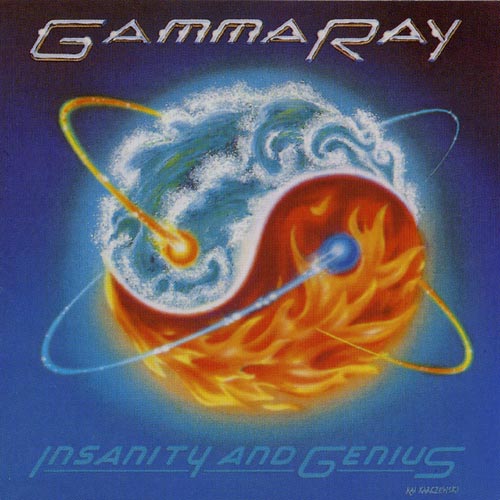
Released in 1993, Insanity and Genius is the least obedient record Gamma Ray had made to that point, and the last with Scheepers on it: mid-tempo where the style demanded speed, ironic where it demanded a straight face, and unsure from one track to the next which band was playing. Listeners have called it the most divided record in the band's catalogue ever since.

Helloween went considerably further. Chameleon, released by EMI in 1993, hired an orchestra into a room built for four, sat four London session players, Simon Clarke, Tim Sanders, Paul Spong and Roddy Lorimer, where the amplifiers had been, credited on three of twelve songs, and carried the double kick out through the door, and what came back was a pop record, a soul record and a folk song sharing a sleeve with the band's name on it.
"When the Sinner" was the single pulled off it, seven minutes long, built on a slow riff with a brass section behind it and a chorus that refuses the lift the style had made compulsory. It is not a bad song. It is a song by a band that had stopped reading its own instructions, which in commercial terms cost more than a bad song would have.
The line-up that had written those instructions was finished. Ingo Schwichtenberg left the band first in 1993, and Michael Kiske followed within weeks. Schwichtenberg died in 1995.
None of that stopped the orders being carried out elsewhere. Blind Guardian, Rage and Running Wild worked the German end of the style straight through the years its authors spent away from it, and hundreds of bands who had never been within five hundred miles of the Elbe were reading the same sentences off the records. What came out of their rehearsal rooms was recognisably Helloween power metal with nobody from the band in it. The wider arc, from the first Hamburg pressings to the arenas of the present decade, is set out in the KaosMetal power metal overview.
Then Helloween came back to the orders as a reader like anybody else. Recorded with Andi Deris at the microphone and Uli Kusch newly behind the drums, Master of the Rings arrived in 1994 with the kick drums level again, the guitars back in two voices and "Where the Rain Grows" resolving on the major chord the style had been waiting three years to hear. The band was following its own rules at that point, not writing them.
That is the difference between a style and a rulebook. A style belongs to the people who can play it and it goes into the ground with them. A rulebook belongs to whoever opens it next. By 1994 that was half of Europe, and the four men who had written it were standing in the queue with everybody else.
