
Chicago built four separate kinds of heavy music and never built a scene to hold any of them. Doom slowed past the point of politeness, street metal played to two crowds in one weekend, speed metal with a woman's voice over it, death metal written on a bass and industrial fed on thrash riffs, and almost every one of them was heard first by somebody a thousand miles away. The city kept the rehearsal rooms. Other cities kept the records.
The story of the Chicago heavy metal bands sits in one box of tape. Recorded between April and October 1985 at Seagrape Studios in Chicago for Combat Records, then shelved after a contract dispute, the first album by Master sat in a box until From Beyond Productions finally put it out on 2 June 2003, as Unreleased 1985 Album, in a vinyl run of 666 copies. The bassist and singer whose tapes waited out that whole stretch in the dark was Paul Speckmann, and by the time they surfaced, half the death metal bands on earth had already chewed the demo cassettes of those songs down to hiss.
The bar circuit, the suburbs and the labels two thousand miles away belong with the rest of where the scenes grew. What the city actually played is another matter. Los Angeles heard it. Rotterdam heard it. The bars along Irving Park Road mostly heard each other.
Chicago heavy metal bands and the slowest riff in America
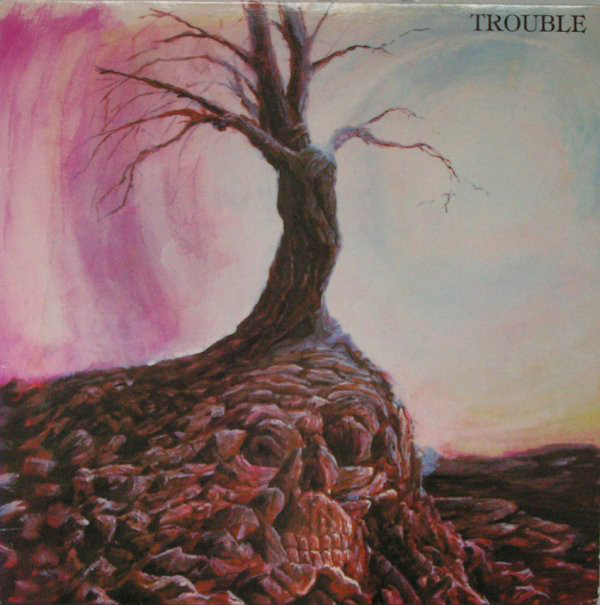
The Chicago quintet that slowed the riffs of 1970 back down to walking pace, at the exact moment every other young band in America was racing to play them faster, was Trouble. On the debut Metal Blade released in 1984, known ever since as Psalm 9, Eric Wagner's high, pleading voice rides over guitars that lean on every chord until the floorboards under it split, and never once shift out of first gear.
What set the record apart from everything it had learned from was the pair of guitarists. A man on a bucket chain never reaches the fire he is putting out. He takes the full pail at arm's length, swings it on to the next pair of hands already open for it, and turns back for the one behind, so that the water keeps moving up the line without once stopping or touching the ground. Bruce Franklin and Rick Wartell hand the riff and the harmony between them that way through "The Tempter" and the title track, and the line never breaks where the hands change.
The lineage is plain. It is Black Sabbath for the tempo and the tritone, Judas Priest for the twin leads, and something entirely local for the gravity in the voice. Every American doom band of the next twenty years had a copy.
The city kept the rehearsal rooms. Other cities kept the records.
Street metal and speed on the North Side
The Chicago four who played to punk crowds and metal crowds on the same weekend, and who called what they did street metal because neither camp's name fit, went out as Zoetrope. Their Combat debut, Amnesty, in 1985, welded hardcore's two minute songs to thrash riffs and put the founding drummer, Barry Stern, on lead vocals behind the kit, so that the beat and the bark came from one pair of lungs. Crossover had many birthplaces. This was one of them.
Led by a singer who called herself Nicole Lee and built around the guitarist Ian Tafoya, the band that took speed metal's racing tempos and gave them a woman's voice at a time when almost no American metal band had one was Znöwhite. All Hail to Thee came out on Enigma in 1984 with almost no promotion, and by Act of God, released on Roadrunner in 1988, the speed had hardened into thrash that could crack the plaster in a rehearsal room.
Death from the bass up
Speckmann never waited on anyone. Across the eighties his bands, War Cry, Death Strike and Master, recorded demos that went out through the tape trading network with a bass tone that sawed through cheap cassette decks and a bark that owed more to Motörhead and to the hardcore of the city's own clubs than to any metal singer. When Nuclear Blast finally released Master's self-titled album in 1990, several of the songs reached back to those shelved 1985 sessions, and still sounded new. They were a rough draft of death metal, written a long way from Florida.
Downers Grove, out past the city line, answered with Macabre, a trio that sang about real murderers over a sepulchral mix of grind, death metal and folk tunes, which says more about the city's refusal to stay in one lane than about heavy metal proper.
The cuckoo hen builds nothing at all. She watches a warbler's nest from cover, drops one egg among the clutch in the few seconds the owners are off feeding, and never comes back, and the chick that hatches first heaves the other eggs over the rim, breaks them on the ground below and then takes every beakful the pair bring until it sits twice their size in a nest built for somebody else. Chicago laid its records in other cities' nests. The birds that raised them took the name, and the city kept the box of tape.
When the city finally had a label
Chicago did own one label that mattered to heavy music, and it was not a metal label at all. Wax Trax!, the shop Jim Nash and Dannie Flesher opened at 2449 North Lincoln Avenue in November 1978, built its catalogue on industrial and dance records through the eighties, and it gave a local producer's side projects, the Revolting Cocks among them, a home.

The producer was the one man in the city who took the machines of that label and the guitars of the metal bars and bolted them onto the same chassis: Al Jourgensen of Ministry. The Land of Rape and Honey, released by Sire on 11 October 1988, set down-picked thrash riffs over drum machines and tape loops, cut the guitar parts into samples and fired them back in sequence, and made a sound that no metal band and no industrial band had made alone.
Chicago never agreed on what heavy meant. It only agreed that the next band should be heavier than the last one, and then went and proved it somewhere else.
Declan Rourke, KaosMetal
"Jesus Built My Hotrod", the single Sire released on 7 November 1991 and folded into Psalm 69 the following year, pushed the method to its limit: a riff looped at a speed no human arm could hold for five minutes, Gibby Haynes of the Butthole Surfers babbling over the top, and a sound that rips the gearbox out of the hot rod in the title. It was the bridgehead industrial metal needed. Every band that later wired a drum machine to a distortion pedal walked across it.
The same habit, carried on
The pattern held into the new century. The Chicago four who turned clipped, percussive riffs and a singer who used his voice like a snare drum into a debut, The Sickness, released by Giant on 7 March 2000, were Disturbed, and the record sold across the country long before the city claimed it. The RIAA certified it five times platinum in 2018. Novembers Doom, formed in 1989, carried Trouble's slowness into death-doom through the nineties, a growl and a clean voice taking turns over riffs that wade rather than walk. Neither sounded like the other. That was the point.
No single Chicago sound ever formed, because no single Chicago institution ever held the bands together long enough to cut one. What formed instead was a habit of heaviness pulled sideways, doom slowed below the tempo of its teachers, speed crossed with hardcore, death metal written on a bass, industrial fed on thrash, and every one of them heard first somewhere else.
Half a world away, a scene with the reverse problem, buyers waiting in every city and bands arriving late to meet them, grew up in a single hall in Tokyo, and that story continues as Japanese heavy metal. Chicago never got a hall like that one. It got the bands anyway, and kept sending them out.
