
Built in central Tokyo for the judo contests of the 1964 Olympics and roofed like a temple, with a golden ornament on its crown, the Nippon Budokan belonged to the martial arts until the summer of 1966, when a Liverpool quartet played five shows there, nationalists protested that a sacred room had been handed to long haired foreigners, and the band walking into the argument was The Beatles.
Every loud band that followed played the same room with the same charge hanging over it, and japanese heavy metal music grew up in its shadow, first as the support act sent out before the Western headliners, then as the headliner itself. The Budokan was the examination hall. The domestic bands sat the paper for fifteen years.
Far to the south of Tokyo, in November 2013, an undersea vent began pushing lava up beside the little island of Nishinoshima, and within two years the new rock had poured over the old island and buried most of it under black basalt, steaming where it met the sea, a coastline nobody had drawn built out of heat that rose from below. The Japanese bands built their ground the same way. The heat came from abroad. The rock was local, and it swallowed the imported shoreline.
Of all the heavy metal scenes that took Western records as their seed, the Japanese one is the scene where the market came first and the music learned to stand on it, and what the bands did to the sound on that ground counts for more than any business deal struck around them.
The hall that judged every band
A room built for throws and holds, roofed like a shrine and still carrying the charge of 1966, is a hard place to walk into with a wall of amplifiers, and every band that did it was weighed twice, once against the headliner that had stood there before it and once against the building itself. Every downstroke landed under that temple roof like a sledgehammer swung at a bronze bell, a noise the hall was never raised for and learned to carry.
The visitors and the hosts did not walk in on equal terms. The Western bands arrived with the records already sold and the crowd already won. The Japanese bands arrived with nothing but the stage and the time between the lights going down and the headliner coming on. That gap was the whole school.
For the visitors, the hall was a trophy. For the hosts, it was a verdict.
Bow Wow in front of the headliners
Sent out as the opening act on the Japanese tours of Aerosmith and Kiss and made to win over rooms that had paid for somebody else, the quartet that learned its trade in front of other people's audiences was Bow Wow. The schooling happened on the stage.
Its weapon was two lead guitars rather than one. Kyoji Yamamoto and Mitsuhiro Saito both played lead, a twin-guitar interplay that became the band's trademark from the first records on, and on those records the two lines go at each other like two sumo wrestlers locked at the belt in the ring at Ryogoku, neither man giving an inch until one heel touches the straw and the bout is over in the length of a breath.
The support slot taught that lesson. A band with a short set before the stars came on had no time for a slow build, so the fight went up front, in the leads, where a crowd that had come for someone else could not miss it. Bow Wow stood in the vanguard of every Japanese band that followed it onto a Western bill.
Loudness and the speed of japanese heavy metal music
The guitarist who took the second guitar away and made the first one carry the whole weight of the band, from its opening record onwards, was Akira Takasaki, and The Birthday Eve, the 1981 debut of Loudness, already held the method: fast picking, two handed tapping and riffs heavy enough to stand under a solo with no second guitar propping them up.
Double bass drumming set the pace behind him and a high, hard tenor sat on top, so that a four piece band sounded as though it had cut a whole guitar section out of the arrangement and never missed it. Critics then and since have called the playing flashy. The word is fair, and it misses the weight underneath.
Ten years from the first record, the circle closed. On 31 May 1991 Loudness headlined the hall that had belonged to the visitors, and the night went onto a live record carrying the building's name, Live Loudest at the Budokan '91, the same way the Western bands had put it on theirs. The support act had become the bill.
Anthem kept the line straight
Formed in Tokyo at the start of the eighties and held on course by one bassist through everything that came after, the band that took the most metal of all nouns for its name and then played exactly what the name promised was Anthem, and its standard-bearer from the first rehearsal to the latest record has been Naoto Shibata.
Where Loudness chased speed and Bow Wow chased the duel, Anthem stayed with the lineage of Judas Priest: galloping mid tempo riffs, a clean twin guitar attack and choruses pitched for a hall to sing back. Of the four, it was the band written most plainly for the Budokan floor, a sound built to be answered by a room.
"Wheels of Fire", the first single from Crimson & Jet Black, released on 21 April 2023, runs on the same straight gallop the band laid down on its 1985 debut, the riff trampling the verse flat so the chorus has open ground to land on. Forty years and not one detour.
The Budokan was the examination hall. The domestic bands sat the paper for fifteen years.
X Japan before the make-up took over
The drummer who played double bass at speed metal tempo and then sat down at a grand piano for the ballad, often in the same set, was Yoshiki, and the band he led, X Japan, spent its first records as a speed metal band with a conservatory bolted to its side.
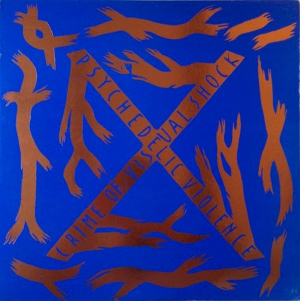
Blue Blood, released in April 1989, is the early band in full: twin guitars running at thrash tempo, a tenor climbing above them, a piano ballad, then the blast again. The spectacle was already there on the sleeve. The music still led it.
"Kurenai", the single from it, shows the method inside one song: a slow, sung opening, then Yoshiki's kit coming down on the verse at double time, a speed most Western speed metal bands of 1989 would have been glad of. The painted style that took the name visual kei grew out of the make-up rather than the music. Within a few years the look had outrun the riffs.
What came out different
Put the four side by side and the Japanese sound stops looking like a copy. Taken from records made abroad and rebuilt in front of crowds that had paid for the originals, the forms came back with the technique dragged to the front of the song: two leads fighting in the open, one guitar doing the work of two, a gallop held dead straight for forty years, and a drum kit that battered speed metal tempo into a piano ballad and back.
None of it was an accident of taste. It was what a support act needs to be heard. The playing had to be louder in the argument than the headliner was in reputation, and the habit stayed after the headline slots came.
Back to the Budokan
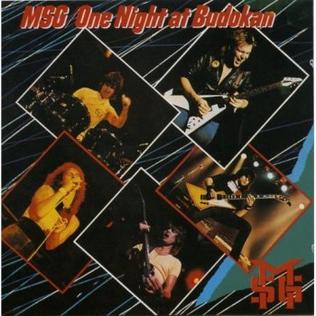
The German guitarist who recorded a whole live album in the hall on 12 August 1981 and put its name on the cover was Michael Schenker, and One Night at Budokan, issued by the Michael Schenker Group in February 1982, turned the building into a selling point on record racks far from Tokyo.
The Western bands wanted a record from the room for exactly that reason. A buyer in a shop on the other side of the world did not need to know what judo was or who had protested in 1966; the name on the sleeve told him that the band had filled a sacred hall a continent away. The building did the advertising. The playing only had to hold up.
From then on the Budokan meant two different things. Western bands went there to prove they were big; Japanese bands went there to prove they had arrived, and the distance between the two claims shrank every year until Loudness and X Japan stood on the same stage as the visitors, with the same audience, on the same terms. The hall had become a bastion held by both sides at once.
Heard across heavy metal through the decades, the Japanese story is the rare one in which the buyers came before the bands, and the bands, once they came, stopped needing the buyers to look west.
A continent away, a scene with plenty of bands and no market at all was forming in towns where the plants were closing, and that story runs on as Michigan and the rust belt sound.
The visitors kept coming. The hosts stopped waiting for them.
