
In the spring of 1970 a Detroit single entered the Billboard Hot 100 and climbed to number seven, a folk song about a New Orleans brothel played at a volume nobody had thought to use on it. The quartet that put Gary Ray Thompson's fuzz and wah-wah through "House of the Rising Sun" like a cutting torch through a scrapped fender, while Richard Stevers hammered the drums flat underneath, was Frijid Pink, and the gold record it earned said the heavy metal bands from Michigan had arrived before the word did.
At the far end of a Detroit assembly line comes the moment the workers call the marriage. A painted body, swung down from the overhead line on hooks, drops onto a rolling chassis already carrying engine, axles and exhaust, and a crew underneath drives the bolts home in the seconds before the line carries both halves on. Michigan's heaviest records were built on the same station. The body was volume and distortion. The chassis underneath was the rhythm and blues the city's clubs had been playing since before any of these players were born, and nobody ever managed to separate the two again.
Some of the chassis was built a few miles away. The studio on West Grand Boulevard that Berry Gordy called Hitsville U.S.A. had spent the sixties cutting records around a bass player and a drummer who never let a song stand still, and the teenagers who grew up on those singles carried that pocket into their garages, where it met fuzz boxes and stacks and was hammered into something the Motown session players would not have recognised. The groove survived the beating. Nothing else did.
That is why the state sounds different. Where the Midlands bands straightened the swing out of the riff, the Detroit and Flint bands kept a drummer who danced.
The recession of the eighties, the bar trail through Cleveland and the rest of the regional geography belong to the map of the scenes. The sound came from the bandstand, and it starts with a fuzz box.
Heavy metal bands from Michigan before the name
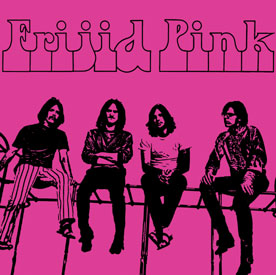
Released on Parrot, a subsidiary of London Records, early in 1970, the debut album Frijid Pink carries the hit and not much else of its weight, but Thompson's tone on it is the first Michigan guitar sound that a heavy metal listener would recognise at once as kin. The band never found a second song as heavy. The one was enough to mark the ground.
The guitarist who had already taken the Amboy Dukes into the charts with "Journey to the Center of the Mind" in 1968, and who opened his first solo album for Epic in 1975 with eight minutes of slow, grinding riff, was Ted Nugent. "Stranglehold" is the Michigan method in its plainest form: Derek St. Holmes sings over a groove that never hurries, the hollow-bodied Gibson Byrdland feeds back on the edge of control, and the long solo, cut in a single take, rides the rhythm section rather than trampling it.
The Flint trio that critics loathed through 1969 and 1970 went out as Grand Funk Railroad, and what their records did to the sound came from the bottom: Mel Schacher's bass, mixed nearly as loud as Mark Farner's guitar and played with a heavy, rolling fuzz, gave the band a weight the three of them could not have reached by volume alone. Nobody asked them to be subtle. They obliged.
The five who left Los Angeles for a farmhouse outside Pontiac in 1970 and came back with a sound built for Detroit crowds recorded as the Alice Cooper band, and on Love It to Death, released by Warner Bros. in 1971 with Bob Ezrin producing, "I'm Eighteen" hangs its chorus on a riff as blunt as a tyre iron. The stage show has its own history. The riff is the Michigan part.
Where the Midlands bands straightened the swing out of the riff, the Detroit and Flint bands kept a drummer who danced.
The MC5 and The Stooges stand at the head of this lineage, and on record both leaned toward the fast, bare noise that punk would inherit. Their records sit a few miles from these ones and a genre apart.
The eighties, on the bar trail
The Detroit four who started in 1983 in costume and make-up, took the name of the holiday and pressed Don't Metal with Evil in 1985 on the local Motor City Metal label were Halloween, and the record plays its horror film props straight: short songs, galloping riffs and titles such as "Trick or Treat" and "The Wicked Witch". Forty years on they still play Detroit every October. No residency in the state is more reliable.
The band formed in Detroit in 1980 around the guitarist David Black, which played "Crash Landing" in front of Penelope Spheeris's cameras for The Decline of Western Civilization Part II: The Metal Years and put out Too Much Ain't Enough on I.R.S. Records in 1988, was Seduce. Theirs was a harder, rawer strain than the Los Angeles bands beside them in the film, a bar band's hard rock bolted to a heavy metal rhythm section. It never went national. The film preserved it anyway.
Flint, Waterford and the heavier line
Flint sent the next generation somewhere much harder. Repulsion, formed in the town that had given the world Grand Funk, recorded Horrified in 1986 and saw it released only in 1989, and its blast beats and blown-out bass tone went straight into the foundations of grindcore. It is not heavy metal in the narrow sense. It shows how far the tonnage of the state could be pushed.
The Waterford five who took the twin-guitar harmonies of the British wave, sped them up past any tempo Iron Maiden ever used and set a death metal voice on top were The Black Dahlia Murder, and Nocturnal, released by Metal Blade on 18 September 2007, entered the Billboard 200, the American album chart, at number 72, and Ritual climbed to number 31 in 2011. "What a Horrible Night to Have a Curse" opens it at a sprint. The melodies under the blast beats are pure sheet metal cut from 1980 patterns.
The paint shop of a car plant lowers every new body on hooks into a long tank of primer and runs an electric current through it, so that the coating is drawn into seams, cavities and box sections no spray gun could reach, and the shell comes up out of the bath sealed against Michigan salt in places the owner will never see. The Detroit quintet that has played death and doom metal together since 2013 plays the same way: Temple of Void, whose albums, from Shadow Kingdom to Relapse, coat every riff in a thick, slow layer of low-tuned guitar until no gap in the song is left bare.
The older line never died out. The Detroit group that ran from 2010 to 2013 and left one album on the German label High Roller, full of keyboards and twin leads taken straight from the early British wave, was Borrowed Time, a small, loyal garrison holding the old post while the city's heavier bands went elsewhere. Jean-Pierre Abboud sang and played the keyboards, and the record sounds as though it had been pressed in 1982 and found in a Detroit basement thirty years later. The band did not last. The record did.
What the plants taught the players
Michigan never had a label that mattered to metal, a magazine that named a scene or a club that became a legend. It had a rhythm section, and that turned out to be the one thing nobody else could copy.
Declan Rourke, KaosMetal
Across fifty years the thread holds for the heavy metal bands from Michigan. A drummer who swings under the fuzz in 1970, a riff that grinds rather than gallops in 1975, a bar band that plays tight because the room would leave if it did not, and in the new century a death metal band that still hears the British twin leads underneath everything it plays. The vanguard never came from here. The groove did.
The march came from an English city of car plants, motorcycle works and gunsmiths, Birmingham, where heavy metal began, and the two cities have been trading parts ever since.
Detroit kept the swing. Everyone else kept the march.
