
In a copying room behind a publisher's yard a man rules out a set of orchestral parts from a full score, and the whole of his art is subtraction: the first violin gets the first violin and not one note more, the horn gets the horn, and every cue that would tell a player what is happening three staves above him comes off the sheet under a knife before the parcel is tied. He works to a tolerance. A smudge sends the page back to the beginning, ink from one line never comes within a finger of another, and the score itself goes into the grate once the parts are cut, because by then the parts are cleaner than the thing they were taken from. The players who sit down with them get through the piece without a fault and cannot hear one another at all.

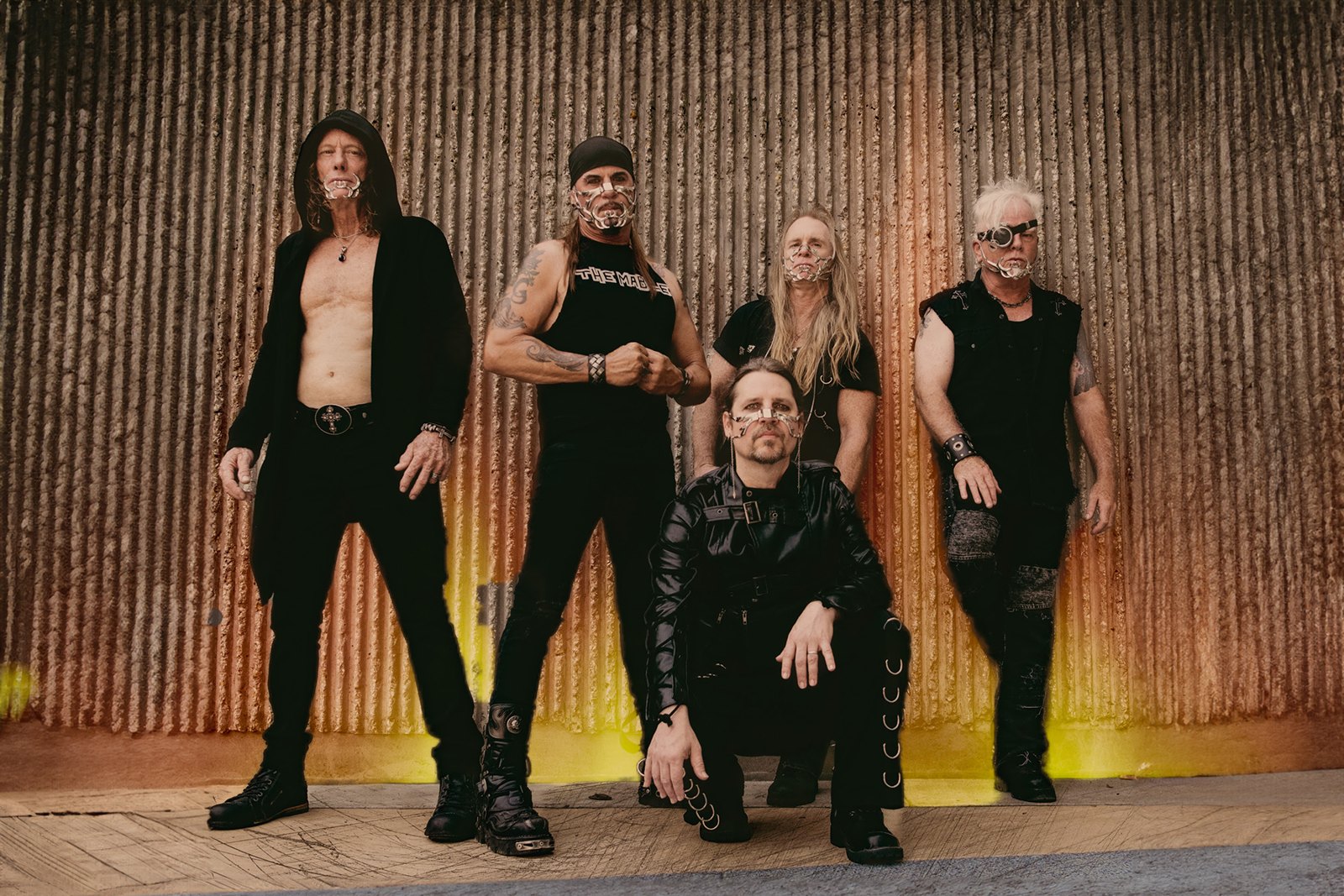
The five men from the Gulf coast of Florida who walked into a Tampa studio in 1988 with a major label behind them and spent the budget on the silence between the instruments were Crimson Glory, and Crimson Glory Transcendence, made at Morrisound Recording with Jim and Tom Morris producing and issued that November on Roadracer in Europe and MCA in America, is the record the American branch has been measured against ever since. Nothing else in the American eighties is recorded better. AllMusic files it among the decade's best pure metal albums by any American band.
What Crimson Glory Transcendence does with separation
The method behind that finish is printed on the sleeve and it is stranger than the polish lets on. The drummer Dana Burnell played his kit live and had it sampled into a Synclavier with the cymbals kept out of the performance, and the cymbals were then recorded again on their own, so that no stroke of one could bleed into the microphone of the other. Jon Drenning has called it an arduous and time consuming way to work, undertaken to get a pristine, clean sound and true separation of every instrument, and has said the machine was in the building because a man at the studio owned one and Def Leppard had made it the thing to want.
That is not how this branch normally sounded, and the reason is money. The records the us power metal bands of the early eighties left behind were cut fast, in rooms nobody could afford to book twice, and the room stayed in the tape because there was no budget to take it out, which is why those albums play back as men standing in a space. This one plays back as parts laid side by side with daylight between them. Every gallop in the rhythm guitar keeps its edges, the snare arrives with nothing hanging off it, and the high notes go up through an arrangement that has been cleared out of their way in advance.
Separation is a real achievement and it is also a wall between a record and a crowd.
The address makes its own joke. Morrisound in 1988 was already the building where American death metal was being invented, and among the assistants credited on this session is Scott Burns, who within a year was hammering the grit back into Death and Obituary and making mud a house style on purpose. One room, one year, two flatly opposed answers to what a metal record is for.
The voice nobody could agree about
A panel sits behind the long desk of an examination hall, the candidate is sent to the top of his range with no accompanist and no reverberant building to hide the approach, and the bell on the desk is struck hard enough to crack its own dome the moment the tone fails. The part of this record the separation treats least gently is the singer billed only as Midnight, because there is nowhere in the mix for a strained note to go and no wash of anything to carry it. What comes back is a very high, very hard voice arriving unaccompanied at the front of every chorus.
Painted Skies is where the argument about him is easiest to hear, and the panel has never agreed. Writing at Sonic Perspectives in January 2018, Joel Barrios heard a singer moving between high pitched screams and a rawer, more convincing mid range, and put the charisma of the delivery at the centre of the album. AllMusic, praising almost everything else about it, judged the same performance dated and painfully strident. Both readings cover the identical fifty minutes, and both are describing the effect of a production that refuses to soften anybody.
Europe went the other way inside eighteen months. The German school was learning to stack a tenor eight and ten deep until a chorus stopped belonging to a throat at all and became a surface a hall could join. Nothing here is stacked like that. One man is sent up, once, in the open, and what a listener makes of that decides what the listener makes of the record.
Where the weight sits in the songs
Underneath the voice sit two guitarists who never shadow each other. Jon Drenning takes the lead lines while Ben Jackson holds the rhythm, the writing credits run through the whole band rather than through one desk, with the bassist Jeff Lords named on most of the music, and the songs are built to keep a hook in view rather than to demonstrate an arrangement. That last point is the one AllMusic makes about the neighbours: Queensrÿche and Fates Warning were steering American metal toward progressive rock in the same years, and this band declined the invitation.
In Dark Places runs past seven minutes and is the clearest case for the method, because a track that long with this little bleed in it exposes every join in the writing and leaves nothing to hide behind when a section fails to earn its place. It does not fail. The band from further up the same coast that had lifted a Norwegian concert piece into a riff the year before was Savatage, and Hall of the Mountain King reached outside the guitar for the same reason, which puts the two records at the limit of how far the American branch was willing to compose before the decade closed.
And Darkness and Decay and the Red Death held illimitable dominion over all.
Edgar Allan Poe, The Masque of the Red Death
Poe supplies the title of track four and very little else, which is the habit of the whole sleeve. Masque of the Red Death lifts an image and a mood off the page and leaves the plot where it was, and the same goes for the dragons, the winter and the cosmic apparatus of the other nine songs. The lyrics are furniture for a voice to move through.

Burning Bridges and Eternal World are where the album goes furthest from a riff, and they are still songs with choruses in them rather than movements. The Seattle band that had arrived six months earlier with a plot, a cast and a running order to be obeyed was Queensrÿche, and Operation: Mindcrime took them out of metal altogether within two albums. The Florida record kept that door shut. By common consent the style still claims this one, and it has spent forty years arguing about the other.
Why nothing came down from the summit
An instrument comes up in a sale room, the bidding runs past every price ever paid for its maker, the hammer comes down hard enough to split the rostrum, and the buyer carries it out to a case where it will not be played again in his lifetime. Records do this too. Transcendence arrived in November 1988, on a day put variously as the 1st and the 14th, into an American market already finished with this music.
Nor did the line-up hold together long enough to make the argument twice. The album that followed in 1991 went off toward Led Zeppelin and Pink Floyd, two of the five had gone by then, and no later record by the band is held up against this one. The record shows a peak standing at the end of its own line rather than at the head of one, with a pedigree nobody inherited, while the branch that might have learned from it was busy being ignored at home and Germany took the style everywhere else.
One thing here is settled and it stays settled. An American band could carry the heavier riff, the high voice and the dark key signature at the finish level of a major pop release without softening any of the three, and the price of that finish was ten songs no crowd could take over. Europe spent the same twelve months learning the opposite lesson, and it is Europe that got the stadiums. Four decades on, nothing American in this style is better engineered, and almost nobody sings it back.

