
In a ballad printer's shop the press throws off sheets that carry no music at all. The words are set in worn type, the same woodcut of a crowned man is hammered onto a sheet about a shipwreck one week and a hanging the next until the king's face is beaten down to a smear, and where the notes ought to stand there is a single line naming a tune, because the tune is not the printer's to sell and never was. It is already out in the street. What survives that trade is one kind of melody only: a single strain, no second subject, nothing in it that asks for a trained throat, taken whole at one hearing by people who cannot read a stave, while the tunes that have to teach themselves go into the gutter with the rain on them by Saturday night.
The Florida band that came off a pop-facing record nobody wanted and walked into a New York room with an outside producer attached was Savatage, and Savatage Hall of the Mountain King, recorded at the Record Plant with Paul O'Neill producing and issued by Atlantic on 28 September 1987, set a hundred and twelve year old Norwegian theme on side two and walked out of it into its own song. The album stopped at 116 on the Billboard 200, the American album chart, which in this branch counted as a result.
The Norwegian who wrote that theme in 1875 as incidental music for a scene in Henrik Ibsen's Peer Gynt, and who set it in B minor down among the cellos, the double basses and the bassoons where no listener could mistake it for something to admire, was Edvard Grieg. What he left there is two phrases repeated without development, transposed upward, thickened instrument by instrument and driven to prestissimo until the orchestra collides with itself and stops. There is no second subject. There is nothing to follow. The thing accumulates and then tears its own frame apart, which is the shape of a metal song arriving a century before the amplifiers that would need it.
The tune was built like a riff before anyone reached for it
Grieg had no patience with it himself. He said as much in an 1874 letter to his friend Frants Beyer. What he had written for the mountain king's hall, he told him, reeked of cow pats and ultra-Norwegianism, and he could not bear to hear it, though he hoped the irony in it would carry, which is close to the least generous thing any composer has said about his own most played four minutes. The chroniclers can keep the irony. What matters to a guitarist is that the theme came out of the workshop stripped of everything a concert audience is normally sold.
It escaped the play early and never went back. By 1931 a whistled version was doing duty in Fritz Lang's M as the signal that a killer had come into the street, and it has carried menace through films, cartoons and advertising ever since, so that the melody now arrives in most ears with no Ibsen attached to it at all. That is the condition it was in by 1987. Not a score to be honoured, and beyond dispute not an obscurity: a piece of public signage any listener reads correctly inside four bars.
What Savatage Hall of the Mountain King does with the theme

The quotation is not where the sleeve says it is. It sits in Prelude to Madness, three minutes and thirteen seconds of instrumental arranged by Criss Oliva, which opens on another borrowed march, the Mars movement of Holst's The Planets, before the Norwegian theme walks in on a single guitar in the register Grieg gave the cellos. The band arrives underneath at the bar where the orchestra thickens. Nothing is added to the melody and nothing is prettified, and the arrangement takes the one liberty a metal band is built to take, which is to let the accumulation get louder than an orchestra can.
The theme was not honoured. It was taken at its word and then made good on.
Then the prelude runs straight into the title song, and the title song owes Grieg nothing. Its riff is the band's own and its chorus is the band's own, and the only inheritance is the pacing: a figure stated low, repeated, and pushed until it will not hold. Jon Oliva sings it with the rasp left in and a theatrical lift on the long notes that no European tenor of the same year would have risked, while the guitars behind him stay on the riff through the chorus instead of thinning out for it. The quotation does not decorate the record. It teaches the listener how to hear the next five minutes.
The other road into the repertoire
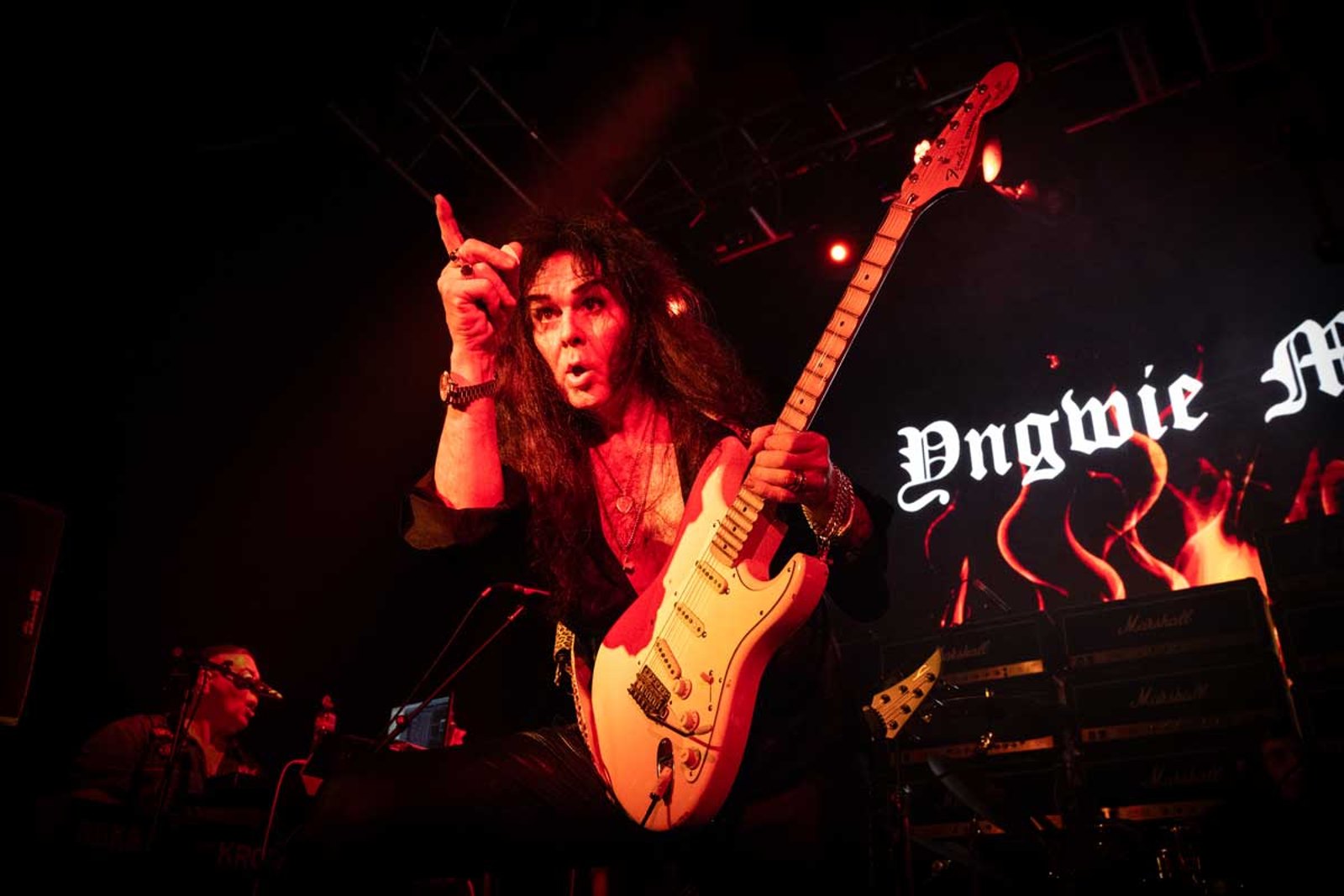
American metal already had a way of using European concert music by 1987, and this was not it. The Swedish guitarist who had arrived in Los Angeles with the harmonic minor scale, the diminished arpeggio and a pile of Paganini figuration, and who spent all three inside the guitar solo where an audience would credit him for them, was Yngwie Malmsteen. That route takes the vocabulary and leaves the building. A pupil can strip a concerto of every turn and mordent, drive a pin through each one and mount the row on a board, then fire the lot off inside one solo, and still hold nothing that would stand up once the accompaniment is taken away. What the Florida record took instead was a whole piece with its architecture intact, and that belongs with the rest of what harmony, speed and the voice make of borrowed material.
Europe spent the same twelve months on a third answer again, stacking choirs and building the classical reference into the arrangement rather than quoting anything outright, which is the line Helloween opened that year and the Italians took to its limit a decade later. The descent of that habit runs through the power metal pillar and never comes near a New York mixing desk. The American practitioner had no orchestra, no budget for one, and no interest in pretending otherwise. He had a tune the whole room already knew.
The record around the quotation
Forty minutes of it hold up, and the thing listeners agree on first is the guitar. Criss Oliva's tone here is heavy enough that even a static riff reads as a statement, and that description recurs across reviews running from 97 percent down to 75 percent, otherwise incompatible readings of the record. Jon Oliva is the second point of agreement, a tam-tam struck with the butt of the beater instead of the felt head so that the bronze answers with the blow still inside the note, and reviewers across that same spread hear him move between a raspy, aggressive delivery and a shrieking falsetto inside single songs. AllMusic gave the album four stars out of five and Rock Hard 8.5 out of 10.
In the Hall of the Mountain King is just made to be done by a heavy metal band. We had a field day with that.
Paul O'Neill, quoted by Fred Phillips, Something Else Reviews, 28 September 2015
The dissent is narrow and worth as much as the praise. A minority hears the mix as neither polished nor raw but dulled at the edges, and one reading calls the playing short on aggression against the quality of the writing. Both complaints are about the room rather than the songs, and both describe the same major label finish that put this band in shops where the account that frames it mostly could not be found at all. The other American record of those two years to get a major and an outside producer, Sanctuary's Refuge Denied, spent the same advantage on speed and got nothing like the same afterlife.
Where the borrowing went

The next record opened its title song on a piano Jon Oliva sat down at during the sessions, its cover pulled back to show, a studio hand told him, that it had belonged to John Lennon, and the opening line came out of him before he had time to feel the weight of that. The one after that, in 1991, was billed on its own sleeve as a rock opera. Once a band has learned that a hall will follow a borrowed theme through four minutes of pure accumulation, the next question it asks is how long an audience will follow a story, and the answer turned out to be long enough to fill arenas every December under another name.
That is what the borrowing actually produced, and it is not a classical career. No American band of the eighties got a second life out of playing scales faster. This one got one out of staging, and the staging began on side two of a 1987 album with a melody that had been common property since before the gramophone.
Which leaves the narrow thing settled. A metal band does not need a conservatory to use a concert piece. It needs a piece whose construction already matches its own, and then the nerve to put its own song immediately afterwards and let the two be compared. Grieg supplied the first half in 1875. The second half was written in Florida.

