
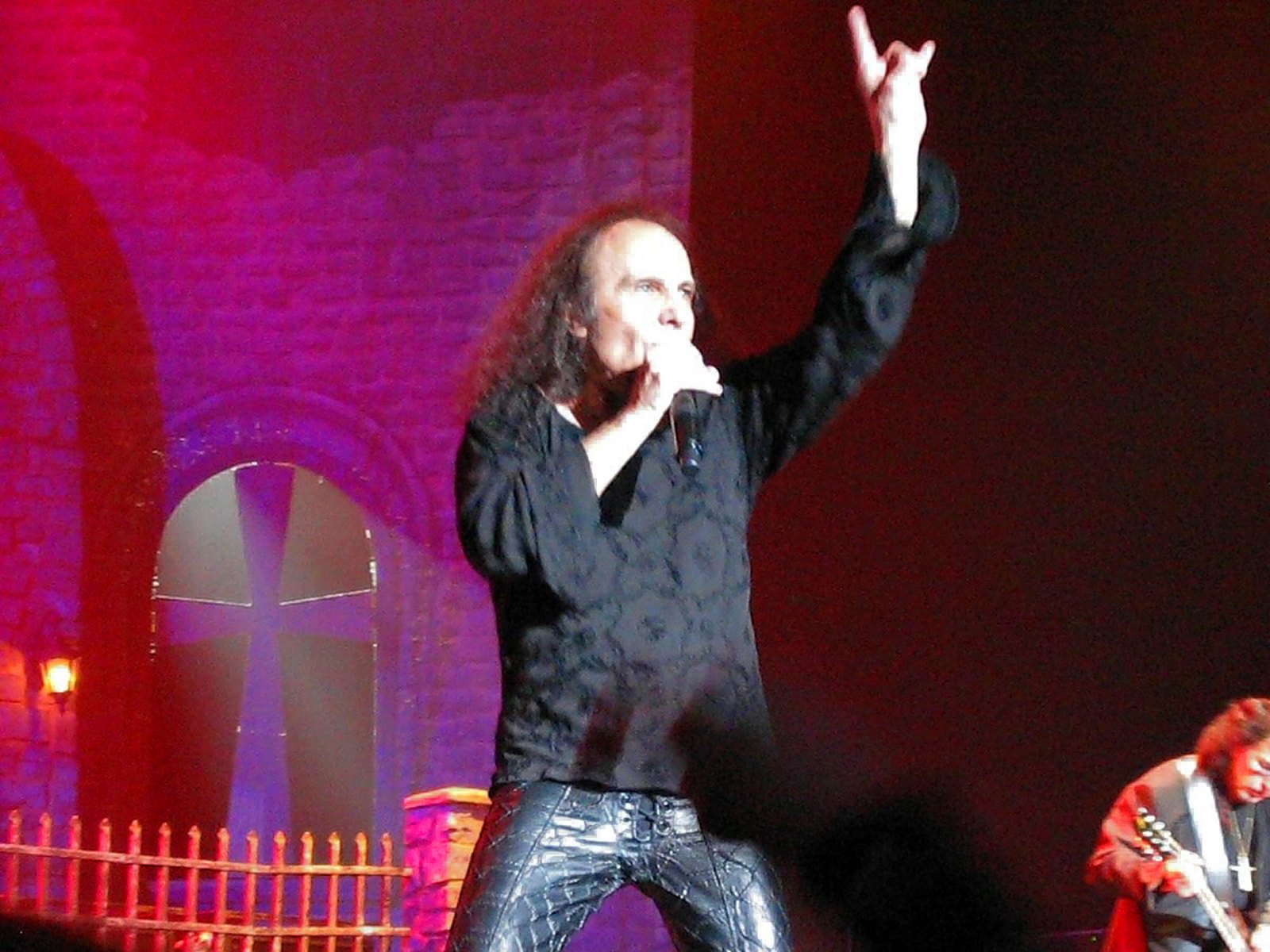
At the conclusion of his words, the thief lifted his hands aloft with both the figs, crying: take that, God, for at thee I aim them.Dante Alighieri, Inferno, Canto XXV
The heavy metal horns hand sign is the most copied gesture the music has ever produced and the least documented. Two fingers go up, the index and the little one. The middle and the ring fold down and the thumb clamps them there. The arm straightens and the wrist locks, and at sixty metres in a dark hall, through smoke, over eight thousand heads, it is still legible, which no other shape a human hand can make reliably is.
The singer who took a microphone in 1979 that a large part of the audience did not want him to have, who stood a good deal shorter than the man he was replacing and who needed something of his own to throw at the back of a room rather than the peace sign his predecessor had made a trademark, was Ronnie James Dio. He threw the horns. Within two years they were coming back at him from the floor of every hall on the tour.
Where the hand came from before that has been told fifteen ways, and the plainest answer to it grows on a railway embankment. Nobody sowed the buddleia. Its seed is fine enough to leave on the draught of a passing train, it takes hold in a crack no gardener would call soil, and inside a generation it is standing on every siding, every goods yard and every dead chimney in the country, thickening until it prises the joints apart. Fifteen people will tell you where the first one came from. Not one of them can produce it.
Where the heavy metal horns hand sign comes from
The shape itself is centuries older than any band and belongs to the Mediterranean, where the mano cornuta is made against the evil eye and sold in silver and coral as a charm to hang round a child's neck. Its second life is the opposite of protective. Aimed at a man's face in the same street it calls him a cuckold, and it has been starting fights on that account for as long as anyone has bothered to write the custom down.
Dio told the story of how he came by it many times, and the tellings do not sit still. The versions differ on whether his grandmother used the hand to turn the evil eye away or to put it on somebody, on whether he was taught it or simply saw it made around him as a child, on the Italian word he used for it, and on whether the first stage use came with Black Sabbath in 1979 or on the tour that followed the next year.
Other claims exist and most of them are older than his. The Chicago band whose singer was photographed making the sign on a sleeve in 1969, eleven years before any of this reached an arena, was Coven. The bass player who has pointed at the cover of Love Gun in 1977, and who separately dated his own first use of the hand to a night in November 1974, is Gene Simmons of Kiss. The campus that has made the same shape under a different name, for reasons that have nothing to do with any of this, since a pep rally before the football game against Texas Christian on 11 November 1955, is the University of Texas. None of these is evidence of invention, because the hand was already in circulation in three continents by then and none of these people put it there.
What the hand means, and to whom
The thumb decides more than anything else. Clamped down over the folded fingers it is the horns. Extended out to the side it belongs to somebody else. With the thumb clear of the palm the same hand says I love you in American Sign Language, a different sign with a different history, and that is why photographs of the wrong shape are still argued over by people who believe they are arguing about metal. The direction matters as much. Held up towards a stage it is allegiance; pushed at a person, in the right country, it is an accusation about his marriage.
A cattle market makes the same point without any theology in it. A finger lifted an inch above the rail buys a heifer for eleven hundred pounds inside the ring, means nothing at all three feet outside it, and in the wrong ring on the wrong afternoon gets a man thrown through a gate by the owner of the animal. The hand has not changed. The room has. Every argument about who owns this gesture is really an argument about which room it is being made in.
What Dio did was not invention, it was consecration. He took a household charm out of a kitchen in an immigrant family and made it the salute of a stadium, and he did it deliberately, because the job he had taken required a sign that belonged to him and not to the man before him. The stagecraft around it, the voice and the ritual working on the same room, is taken apart in the chapter above. The gesture is the one piece of that ritual the audience took home and kept.
Why this shape and not another
The hall chose it, and the reasons are unromantic. It works with one hand, so the other can hold a drink or a jacket. It reads as a silhouette, which a fist or a thumb does not, and it survives being photographed badly. It needs no language, no training and no agreement in advance, and a fourteen year old can copy it off a television screen in a second and a half without being told what it means. A sign with those properties spreads without a sect to spread it.
A fourteen year old can copy it off a television screen in a second and a half without being told what it means.
The spread was visual from the start. It travelled on photographs in the weekly music papers, then on television, then on the sleeves of live albums where the front row is part of the picture, and by the middle of the eighties it was the standing greeting between strangers in the queue outside a venue. No organisation ever taught it. Nobody printed instructions. It moved the way a covenant moves through a village, by being made in front of people until they made it back.
The trademark, the emoji and the long dilution
On 9 June 2017 Gene Simmons filed an application with the United States Patent and Trademark Office to register the gesture as his own mark, the drawing showing the thumb held out rather than clamped down, the same shape as I love you, and withdrew it twelve days later after an objection from most of the people who had ever made it and a good deal of laughter. The application failed on the plainest possible ground. A thing that several billion people already do cannot be handed to one of them.
The dilution had been running for years by then and it has not stopped. Politicians make the sign at rallies with no idea what they are quoting, advertisements use it to sell telephone contracts, and a football crowd in a country with no metal scene worth the name will throw it at a camera. An oracle would have predicted none of that in 1980. The gesture that was shorthand for one music became shorthand for enthusiasm in general, which is what happens to any sign that works too well.
What the sign is worth now
Nobody owns it, nobody can license it and nobody can spoil it, which together make it the most durable thing the music ever produced. It has survived being claimed by a grandmother's kitchen, by a Chicago occult act, by a bass player with a lawyer and by a university sports team, and it will survive the next claimant as well. What keeps it alive is the same property that got it adopted: it costs nothing, it is visible from the back, and it commits the person making it to precisely one thing.
The same hall that made the shape legible also decided which voices could carry across it, which is the argument taken up by the baritone metal singers. The hand and the voice were solving the same problem, which is how to reach the back row of a large dark room with no help from anything but the body. One of them needed a lifetime of work. The other takes a second and a half to learn.

