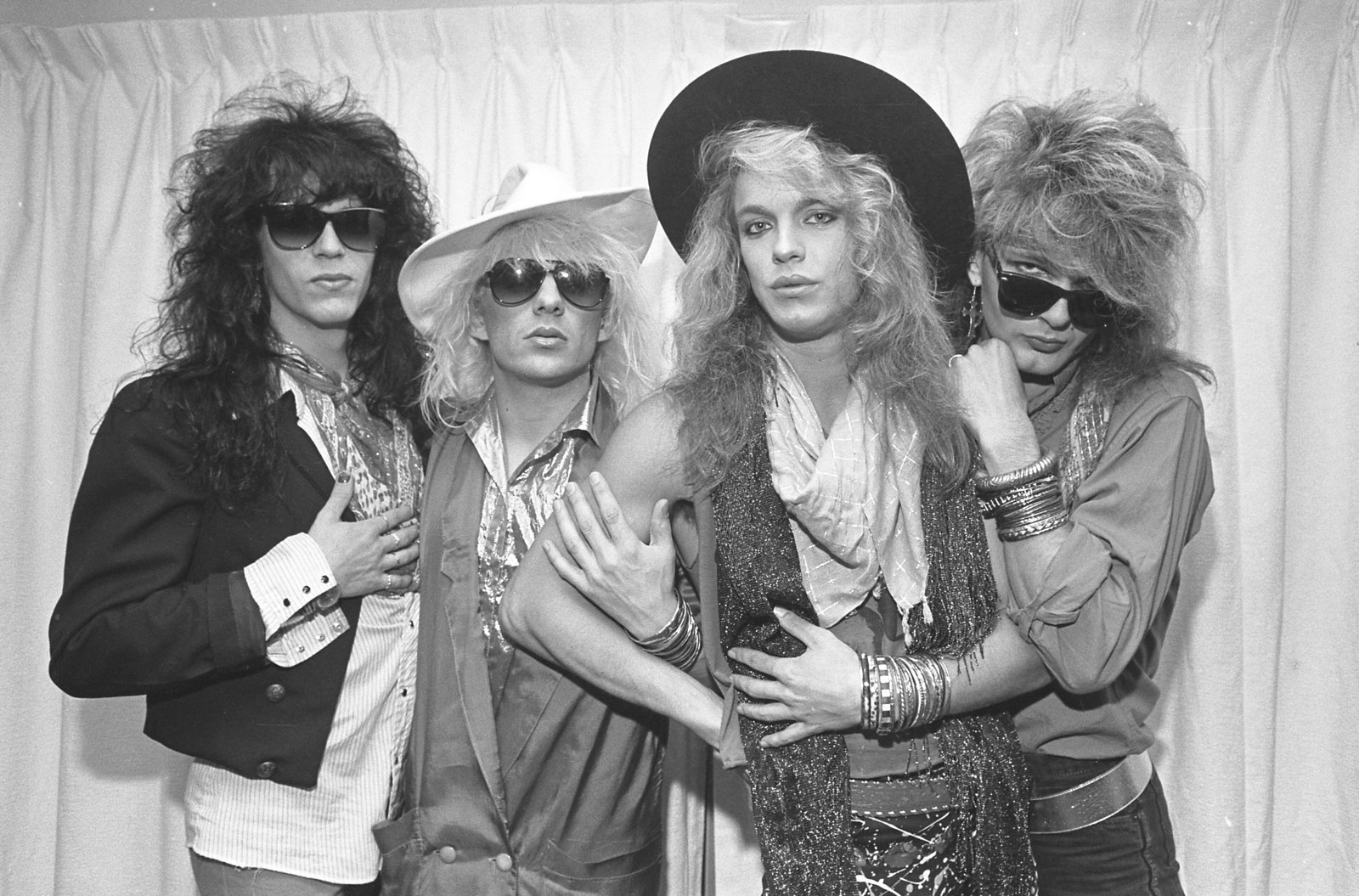
In 1958 a chemist at DuPont reworked a polymer until the fibre spun from it would stretch to several times its own length and spring back without a sag, and the company took it to market under the trade name Lycra. The DuPont chemist who handed the world spandex was Joseph Shivers. Its first customers made girdles. Twenty-five years later it was holding up half the trousers on the Sunset Strip.
80's glam metal fashion was assembled out of materials exactly that humble: a stretch fibre sold to the corsetry trade, a can of hairspray, a stick of kohl, a scarf off a thrift rack and a guitar dragged through a spray booth. Worn under club lights between 1983 and 1987, that kit tore the denim and the sewn patches off the legs and backs of a whole street, and left it full of young men who looked, from across Sunset Boulevard, like the chorus line of a musical nobody had written. Then the copying began. The copying is the story.
The pipevine swallowtail spends its life as a caterpillar chewing a vine laced with poison, keeps the poison in its body when it takes wing, and flies in a blue-black so iridescent that any bird which has once swallowed one and brought it straight back up leaves that colour alone for good. The dark females of the tiger swallowtail carry no poison at all. They wear the same blue-black and live safely off another insect's reputation, but only for as long as the real article outnumbers them in the woods. The Strip's first wardrobe was the poison. Its last was only the wings.
The clubs, the cameras and the ballads that built the market are set out in the chapter above. The clothes kept their own calendar. They arrived a year or two ahead of the records, and they wore out a year or two ahead of them as well.
80's glam metal fashion, from the corsetry counter up
Spandex won because it did three things leather could not do. It took a print as readily as it took a stretch, so leopard, zebra, tiger stripe and colours no animal has ever grown could be run off by the bolt; it moved with a body that spent two hours a night jumping off drum risers; and it cost a fraction of a leather jacket on a street where most bands were paying the club for the privilege of its stage. The aerobics craze had already hung stretch leggings in every shopping mall in America. The bands only had to walk in.
The Pennsylvania four who drove west to Los Angeles in 1984 and dressed themselves on a budget that ran more to eyeliner than to hide were Poison, and by the time Enigma released their debut in 1986 the band's make-up had driven every rival on the Strip either further toward the dressing table or back into denim. There was no third queue. A band stood in one or the other.
The face was the cheapest part of the kit and the most provocative. A pencil and a compact cost less than a set of strings, and the paint turned five young men from the suburbs into something a parent in Ohio could object to on sight, which was worth more to an unsigned band than any review in any fanzine. The spectacle paid for itself. It was the only part of the operation that did.
I say, beware of all enterprises that require new clothes, and not rather a new wearer of clothes.
Henry David Thoreau, Walden
The guitar joined the wardrobe
The man who took coarse sandpaper to his own home-built guitar at the end of March 1979, masked it with tape and sprayed a coat of red over its black and white stripes because other players had started copying them, was Eddie Van Halen. The copyists caught up with the red as well. By then the instrument had become part of the costume, and there was no taking it back out.
Whether the man who painted the first stripes belongs in the same wardrobe at all is the case argued in is Van Halen hair metal. What is beyond dispute is that his guitar set the fashion for the instrument itself. Kramer, the company he endorsed from 1982, became the best-selling guitar brand of 1985 and 1986, selling pointed bodies in gleaming neon, splatter paint and stripes to teenagers who could not yet play them.
A pike lure is painted chartreuse and firetiger orange, colours no fish has ever met in a river, because it has to catch a man's eye on the rack of a tackle shop in March before it can drive three barbed treble hooks into a jaw in June. The guitars of 1985 were painted on the same principle. They had to win the music shop before they ever reached a stage.
They had to win the music shop before they ever reached a stage.
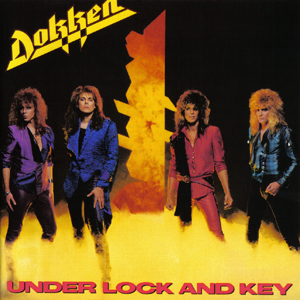
The Los Angeles quartet that posed for the sleeve of Under Lock and Key, released by Elektra in November 1985, in shirts of purple, blue and cerise open to the sternum, belts slung low and hair sprayed into manes, with a wall of flame rising behind the four of them, was Dokken. It is a better catalogue of that year's clothes than any fashion page printed in it. The flames were painted on. The shirts were real.
The video for "It's Not Love", released as the album's third single in June 1986, is where George Lynch first showed the guitar that proved an instrument could be a costume and a weapon at once: a body carved from a single block of maple into a skull and a column of vertebrae. The Hollywood special effects man who carved it for his neighbour, and set one of his own teeth into the skull's jaw, was Johnny "J. Frog" Garcia. ESP put its logo on the headstock. It still sells the shape.
Bred from the television
By 1988 the labels were signing bands off the photograph, and the photographs had begun to match: the same leopard print, the same scarves knotted at the wrist, the same pointed guitars in the same neon, worn by young men who had learned the uniform from music television rather than from the clubs where it had first been a provocation. The copies soon outnumbered the originals. Then the audience learned to tell them apart, and stopped buying either.
The bands with real songs in them were the first to change clothes. The Pennsylvania quartet that had worn the full kit on the sleeve of Night Songs in 1986 and, by Heartbreak Station in 1990, had stripped the reverb and the overdubs out of the mix chasing the blues records Tom Keifer grew up on was Cinderella, and the dobro was in before the wardrobe caught up. The wardrobe followed the music. It never led it.
The women on the same stages wore the same kit and got a different reading. A man in leopard spandex and lipstick was a threat to the neighbours, while a woman in identical clothes was sold by the same labels as a pin-up, and the players among them spent the decade fighting to be photographed with the guitar in the frame. The wardrobe had one cut. It had two price tags.
None of the kit was invented in Hollywood. The studs, the leather and the patched denim that came before it, the pedigree the spandex was trying to shake off, are traced in the culture chapter. The Strip's contribution was the colour, and the speed at which it could be copied.
What the wardrobe left behind
When the flannel arrived in 1991 the spandex went back where it had come from, to the gymnasium and the dance studio, and within a single season a pair of leopard leggings on a man had turned from a declaration into a punchline. The kohl went back into the make-up bag. The scarves went back on the rack.
The guitars stayed. The skull-and-bones shape is still made, the pointed superstrat in neon still hangs on the wall of every music shop, and in 2007 the company that took over Van Halen's own brand built three hundred replicas of the striped guitar, every scratch and cigarette burn reproduced, at twenty-five thousand dollars each. Nobody has ever reissued the trousers. On any honest reading, that is the verdict.