
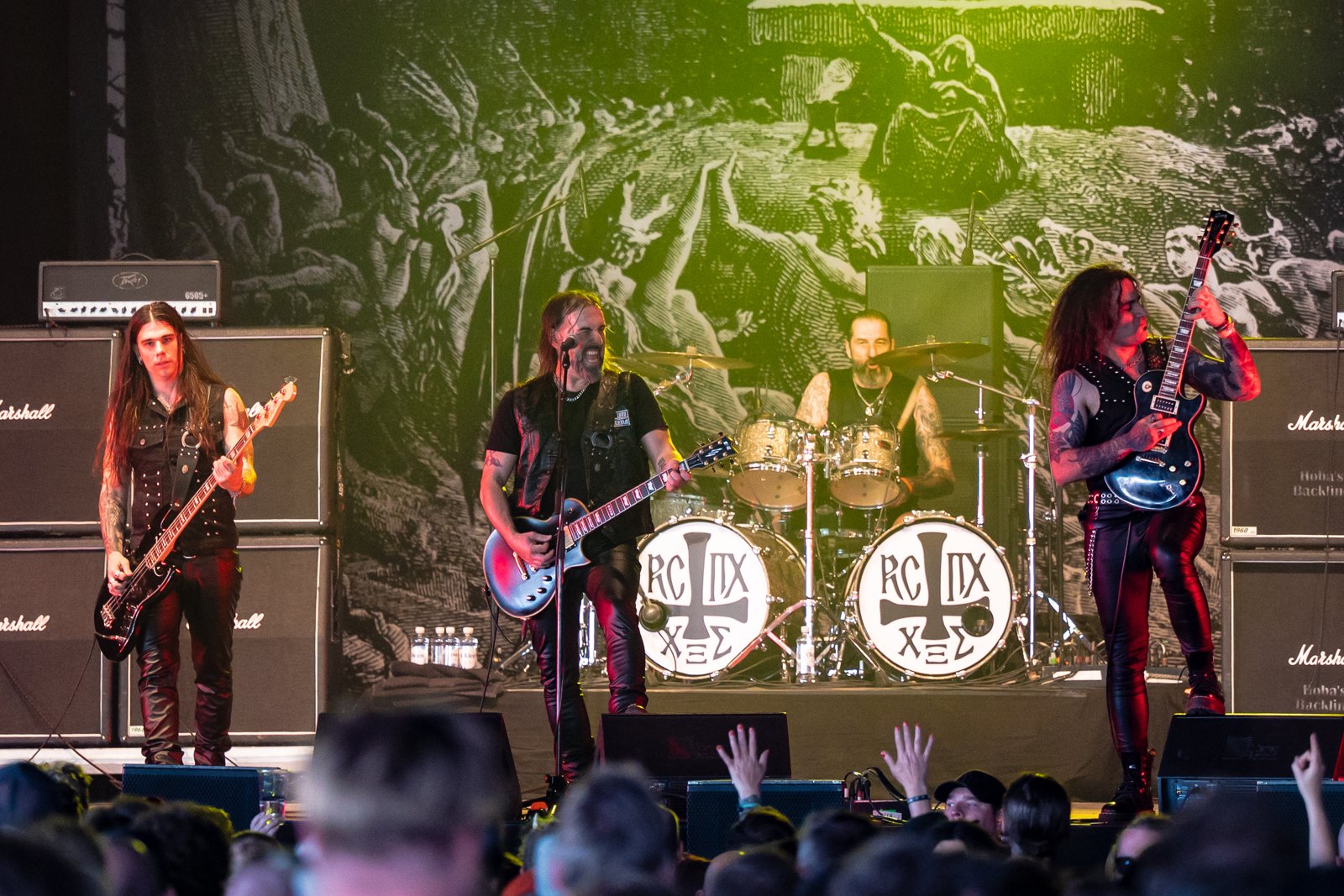
Greek heavy metal is nobody's late copy. It is a scene that began with none of the parts an industry would recognise, no domestic label worth the name, no pressing plant that wanted the work, no distribution past the counter of one shop in a city, and it spent thirty years building the missing parts by hand until the records were going out of the country faster than they came in.
The economics were those of a silk reeling shed. A cocoon the size of a thumb goes into hot water, the moth inside it killed by the heat before it can chew its way out and cut the thread in two, an end is lifted with a brush, and what comes off the reel is one filament that will run the better part of a kilometre so long as nobody stops turning the handle. Snap it and the work begins again with another cocoon. The worms will eat mulberry and nothing else.
The two brothers who started in 1987 with a drum machine, a tape recorder and a name calculated to cause the maximum possible trouble in an Orthodox country, and who were still closing European festivals three decades later, were Sakis and Themis Tolis of Rotting Christ. They were not the first Greek band to own amplifiers. They were the first whose tapes got out.
Greek heavy metal started late, and paid for the delay in full
The delay was political and everyone in the country knows its dates, so the scene's real handicap is the duller one that followed it. Imported records were scarce enough that fans called them gold dust and priced past most students' reach, the shops that stocked them counted on one hand, and national service took every male musician out of his band for the best part of two years at exactly the age when bands are made or lost. A band that survived conscription had already proved something that no band in Los Angeles was ever asked to prove. The Athens group whose Made in Hell and Merciless Slaughter carried Greek thrash abroad through the tape trading post in 1985 and 1986 was Flames, and a handful of others put out one album each and were never heard of outside the country at all.
Anyone looking for where it sits in the story should start with that arithmetic rather than with the records. Scenes are built on whatever the local conditions leave standing, and in this one the conditions removed the money, the pressing and half of every line-up in turn, which is why the bands that came through the eighties came through with a stubbornness that is audible.
The labels, and the records that had to leave to come home
The pattern of the nineties was a scene with a queue of bands and no company at home able to put out a record properly, so the records left. The Athens band that signed to the French label Holy Records because nothing in Greece could do the job was Nightfall, and the group that Efthimis Karadimas founded in 1991 spent its first decade with a foreign address on the back of every sleeve. Septicflesh, formed in Athens in 1990, went out the same way, and Rotting Christ put Thy Mighty Contract into the world in 1993 through Osmose Productions in France.
What came back was a reputation the country could not have manufactured domestically. By the middle of the 2000s Septicflesh were working with a full orchestra and choir on records made for Season of Mist, Communion in 2008 and The Great Mass in 2011 among them, and the traffic finally reversed. The label that turned it around, reissuing at home what Greeks had been importing for twenty years, is No Remorse Records, and a Greek company pressing epic heavy metal for the rest of Europe is the closest thing this scene has to a monument.

The guitarist who left for Boston's Berklee College of Music in 1998, dropped out inside a month and turned the demo he cut there into Firewind before the year was out, was Gus G. Eleven years of hauling that band around Europe led to the phone call that put him in Ozzy Osbourne's touring line-up in 2009, and made Firewind the first Greek act most European audiences could name without being metal specialists. Nothing about that career is typical of the scene. It is what the scene had instead of an industry: one player good enough to be hired out of the country and stubborn enough to keep the band going after he was.
Antiquity as raw material rather than decoration
Every scene in Europe reaches for its own past eventually and most of them get sword and sorcery out of it. The material available here was older and better attested, and the bands used it the way a farmer uses a ruin. A carved block is prised out of a fallen temple, dragged down the hill on a sledge and mortared into the corner of a sheep pen three centuries later, the god's face turned sideways and doing an honest job of holding up a wall that has nothing to do with him.
The Athens band that took Homer and the epic cycle as working material rather than as costume, and that put Mark Shelton of Manilla Road on Codex Epicus months before his death in July 2018, is Battleroar. Rotting Christ went further and began singing in Greek, most openly on Kata Ton Daimona Eaytoy in 2013, its title the phrase from Marcus Aurelius usually rendered as according to one's own daemon. An exponent of the style elsewhere would have called that a gimmick. Here it is the local stone.
The material available here was older and better attested, and the bands used it the way a farmer uses a ruin.
The loyalty that turned into an institution
The other thing this country did with metal was refuse to let go of it. Greek audiences kept buying epic and traditional heavy metal through the years when the rest of Europe was selling its collection, and that loyalty eventually hardened into a garrison of small institutions: a specialist label, a festival circuit in Athens devoted to the old style and carried for two decades by Up the Hammers, and a generation of bands who play it without irony.
The Athens five who started in a cellar in 1995 and kept a melodic heavy metal band running through the whole of the lean period, changing singers more than once and never changing the brief, are Innerwish. Alongside them Sacral Rage took the speed metal end of the same inheritance into the 2010s, and the country that had to import the style in the first place now exports both versions of it. The same instinct, pointed at a different past, produced Italian epic heavy metal a few hundred miles west, and the two scenes have been reading each other's records for years.
What the scene is now
Greek heavy metal today is three things at once, and they do not always get on. There is the black metal wing that carried the country's name abroad first and still draws the biggest crowds outside it. There is the melodic and power metal wing that tours the European circuit like any German or Swedish band. There is the traditional and epic wing, the smallest and the most loyal, which is the one that kept the record shops alive when nobody else was buying. All three were assembled by the same kind of person under the same conditions, which is why they share an audience even when they cannot share a bill.
For the iron of itself draws a man thereto.
Homer, The Odyssey, Book XVI
The black metal wing is the part of this the rest of the world learned first, and its sound is distinct enough that foreign writers gave it a name of its own before anyone in Athens asked for one. That is a story with its own weight and its own records. What matters for the heavy metal side of the scene is what the export did for everybody else, because a booking agent who has already taken one Greek band across a border will take a second, and half the tours of the last twenty years were built on that first crossing.
What none of them has is an easy market at home. A country of just over ten million people, carrying a decade of economic damage, cannot support a full professional circuit, and the bands know it, which is why the tours are booked abroad and the merchandise pays for the van. The scene was assembled by people who were never going to get rich from it and who kept going anyway. That is the muster, and it has not thinned in forty years.
