
On 27 May 1840 a violinist of fifty seven died in Nice without receiving the final sacrament, and the Bishop of Nice refused him a Catholic burial, partly for the missing sacrament and partly for the rumour, repeated across half of Europe, that the man had bought his left hand from the devil. It took four years and an appeal to the Pope before the coffin could even travel to Genoa, and it was not put into the ground until 1876, in Parma.
The corpse that waited thirty six years for consecrated earth belonged to Niccolò Paganini, and the classical music influence on heavy metal begins there, with a reputation rather than a scale: a virtuoso so fast that the faithful of his own century could only account for him by a contract signed in blood.
When lightning drives into a dry beach it blasts the sand along its path to a heat far beyond melting and fuses it into a hollow tube of glass, a fulgurite, forked and rough and running down into the dune exactly as the bolt ran, and long after the storm has rolled out to sea the shape of the strike is still in the ground, preserved to the last branch. Heavy metal kept the fulgurite. It did not keep the weather.
The guitarists who carried the shape of that strike into the music, and the Bach progression and the harmonic minor they carried with it, are named in the full chapter. The traffic ran the other way too, onto the concert platform itself, and it paid a price there.
The classical music influence on heavy metal starts with a myth
The legend was older than Paganini. The Paduan violinist who told Jérôme Lalande, on a visit from France, that he had dreamed of selling his soul to the devil and handing him his violin, and that the devil had played a sonata more beautiful than anything he could write down on waking, was Giuseppe Tartini. He dated the dream to 1713, and Lalande did not publish the account until 1769, the year before Tartini died; the piece salvaged from it is still called the Devil's Trill.
Behind the legend sat a real body of work, and it is the part of Paganini that guitarists actually play. His twenty four caprices for solo violin, the last of them a theme and variations in A minor, pack into a few minutes each the tricks that made audiences cross themselves: arpeggios thrown across all four strings with a bouncing bow, runs in octaves, harmonics at the top of the fingerboard and left-hand pizzicato plucked between bowed notes. Every one of those tricks is a demonstration first and a piece of music second. That order of priorities crossed the centuries intact.
Heavy metal inherited the story whole, with the guitar in place of the violin. The guitarist who played the devil's own man in Walter Hill's film Crossroads in 1986, and who wrote and recorded both sides of its final guitar duel, was Steve Vai, and the piece that beats him on screen, "Eugene's Trick Bag", is built largely on Paganini's Caprice No. 5. Hollywood had worked out the family tree before the critics did.
No apostle of the style ever asked for a better origin story. A blues myth at a Mississippi crossroads, settled with a Genoese caprice played at full gain: that is the whole creation account of neoclassical metal, told in a single cinema reel.
Beethoven in the run-out groove
Quotation came next, and it came without apology. The three men who arranged the theme of the finale of Beethoven's Ninth Symphony for a heavy rock band and put it at the end of Rainbow's Difficult to Cure, released by Polydor on 9 February 1981, were Ritchie Blackmore, Roger Glover and Don Airey, and the album went to number three in Britain, the band's highest chart placing to that date.
The instrumental ends in a joke. On the original vinyl a burst of Oliver Hardy's laughter is looped into the run-out groove, so that the needle circles Beethoven's hymn to brotherhood with a comedian cackling at it until somebody lifts the arm. It is the most honest account of the relationship on record. The music was borrowed in earnest. The reverence was not.
Truce at the Royal Albert Hall
On Christmas Day 1914 soldiers on stretches of the Western Front climbed out of their trenches, crossed the wire into no man's land, swapped cigarettes, buttons and tins of jam with the men who had been shooting at them the day before, and in places kicked a ball about on the frozen mud. Within days the machine guns were raking the same ground again. Nobody ever mistook the truce for a peace.
Every formal meeting between a heavy band and a symphony orchestra has gone the same way. Deep Purple played Jon Lord's Concerto for Group and Orchestra with the Royal Philharmonic under Malcolm Arnold at the Royal Albert Hall on 24 September 1969, Blackmore called the whole project a gimmick in a magazine interview decades later, and the score itself went missing in 1970 and had to be rebuilt from the recording nearly thirty years later.
The Swede who wrote a Concerto Suite for Electric Guitar and Orchestra in E flat minor and released it on 4 February 1998, with the Czech Philharmonic under Yoel Levi, was Yngwie Malmsteen, and even that meeting was conducted by post: the orchestra recorded its parts in June 1997, and the guitar went down that September. The two never shared the room.

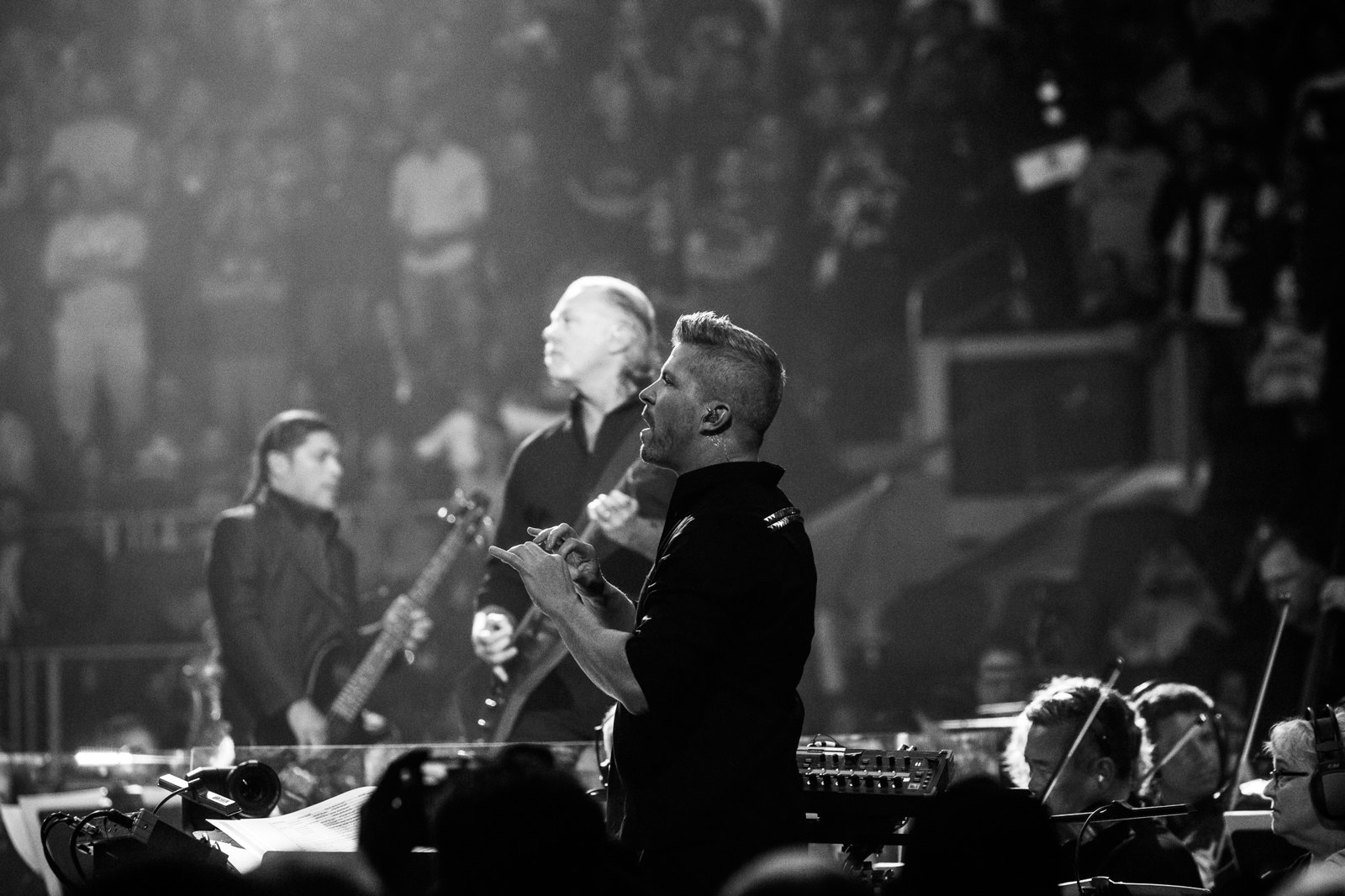
The film composer who scored the orchestral parts for Metallica's two nights with the San Francisco Symphony at the Berkeley Community Theatre, on 21 and 22 April 1999, was Michael Kamen, and S&M, released that November, went to number two on the Billboard 200. "No Leaf Clover", one of two new songs written for the nights, is where the orchestra comes closest to belonging, the strings opening the song before the guitars shove their way in and flatten everything beneath the chorus.
The German band that took the Berlin Philharmonic onto a stage at Expo 2000 in Hannover on 22 June 2000, with Christian Kolonovits arranging and conducting, was Scorpions, and Moment of Glory, released by EMI Classics that August, went to number three in Germany. Written as Expo 2000's official anthem, the title song did its job for one night, well received on both sides, before both sides went home afterwards.
Four summits in thirty one years, from Kensington in 1969 to Hannover in 2000, and the pattern holds in every one of them: a hall or a studio booked, the orchestra's part recorded, an album sold, a round of polite reviews, and the band back with its own amplifiers by the next tour. The orchestra went home too. None of it lasted.
What stayed in the concert hall
Set the borrowings side by side and a pattern is attested on every record. Metal took the virtuoso and his legend, the storm in the minor key, the arpeggio at speed and the orchestra as a colour behind the band. It left the architecture where it stood: the sonata's long argument between two themes, the development section that takes a melody apart and puts it back, and above all the dynamic range, a symphony's climb from a whisper to a full orchestra that a Marshall stack flattens into one level of loud.
Metal took the virtuoso and his legend. It left the architecture where it stood.
The exceptions prove the rule by how hard they have to work. A band that wants a real quiet passage has to stop the guitars altogether and hand the bars to an acoustic instrument, a lone voice or the orchestra it has hired for the night, because a distorted chord cannot be played softly, only turned down, and a turned-down distorted chord is still a shout heard from the next room.
What it built in place of that architecture is its own, and none of it needed a conservatory: the riff repeated until it becomes the floor, the pedal note, the power chord, all laid out in the anatomy of the riff. The schism was never a failure of nerve. A band that wants every bar at full weight has no use for a quiet slow movement.
That is also where the family quarrel with rock begins, since rock took almost nothing from the concert hall and never pretended otherwise, which is half the argument in heavy metal vs rock. Metal went into the concert hall for the virtuoso and came out with him. The furniture is still there.
