
Typed in January 1985 and sent down to the local committees of the Komsomol, the Communist youth league, and to the managers of the dance halls that answered to them, a list of foreign groups whose songs were judged ideologically harmful set out, band by band, what each one was guilty of. The Birmingham quartet that sheet charged with violence and religious obscurantism was Black Sabbath. The five charged with anticommunism and racism were Judas Priest. Iron Maiden drew the same charge as Sabbath.
The list was meant to tear those records off every official turntable from the Baltic to the Pacific, and for heavy metal behind the Iron Curtain the dance halls largely obeyed. It also handed a generation of teenagers a printed catechism of what to hunt for on the black market. The ministries never solved that problem. They tried a cleverer one.
Before there was a vaccine, the physicians of the eighteenth century fought smallpox by variolation: they scraped matter from the sores of a mild case into a cut on a healthy arm, trusting a weak dose of the disease to teach the body its enemy, and every so often the patient went down with the full pox, raw and blistered from scalp to heel, and carried it into every house on the street. The Eastern Bloc states treated heavy metal exactly that way. They licensed it, pressed it and booked it, and waited for the fever to pass. It spread instead.
Heavy metal behind the Iron Curtain went through the state's own gates
Every country of the bloc had one record company, or near enough, and every heavy metal band that wanted vinyl had to get past it. That made the censor and the producer the same office. Melodiya in Moscow, Supraphon in Prague, Amiga in East Berlin, Balkanton in Sofia and Jugoton in Zagreb pressed rock when it suited the ministry and refused it when it did not, and what came out the far end was a music with an official stamp on the sleeve and the West in the grooves. That gatekeeping, one office holding both the pencil and the pressing plant, sets the bloc apart from every other region in the wider story.
The Moscow players who walked out of Aria in February 1987 after a quarrel with its artistic director took the name Master, the bassist Alik Granovsky and the guitarist Andrei Bolshakov at their head, and by October 1988 Melodiya had pressed their debut in a run that officially topped a million copies, platinum by any Western count. The state label had lost a band to a split and paid the breakaway to record.
"Shield and Sword" was the video Master filmed in 1987 with its first singer, Alexander Arzamaskov, and it shows the whole arrangement in four minutes: a Soviet band dressed for the part, filmed in the year of the split, playing the kind of heavy metal the Komsomol had filed under anticommunism when it came out of Birmingham. The garrison had opened its own gates. Master turned harder and faster within a few years, and its thrash belongs to the thrash story.
| Country | State label | Band and record | Year |
|---|---|---|---|
| Soviet Union | Melodiya | Master, Master | 1988 |
| Czechoslovakia | Supraphon | Citron, Radegast | 1987 |
| East Germany | Amiga | Formel 1, Live im Stahlwerk | 1986 |
| Poland | Pronit | Turbo, Kawaleria szatana | 1986 |
| Bulgaria | Balkanton | Ahat, Pohodat | 1989 |
The Ostrava band that had been playing hard rock since 1976 cut its most ambitious record for Supraphon in 1987 as Citron, and Radegast, a concept album built on Slavic myth with Ladislav Křížek newly arrived from Vitacit at the microphone, ripped the Slavic gods off the painted backdrops of the state folk ensembles and set them to twin guitars. The heresy went out on the label's own paper.
Poland licensed the crowd
Poland went further than any of its neighbours, because the state there had decided that a crowd it could see was safer than a crowd it could not. The Jarocin festival, running every summer from 1980, and after 1986 the Metalmania festival that Tomasz Dziubiński organised in the Spodek hall in Katowice gave thousands of young Poles in denim a licensed field to shout in, with the police at the gate and the secret police in the crowd.
The Opole band that won the young bands' contest at Jarocin in 1981 and put out its first studio album on the Polton label in 1983 was TSA, the name an acronym for a Secret Society of Abstainers, and on any fair count it was the first Polish heavy metal band to fill halls. Its riffs came straight off the British records of 1980. Its crowds came off the factory floors.
The Poznań quintet that Henryk Tomczak started on guitar in 1980 made its name in 1983 as Turbo with Dorosłe dzieci, the title song written for the grown-up children of its title, a generation with a factory job and nowhere to spend the wage, and three years later Kawaleria szatana on Pronit sent a salvo of speed and a title about Satan's cavalry through a Catholic country run by atheists. The title stayed on the sleeve.
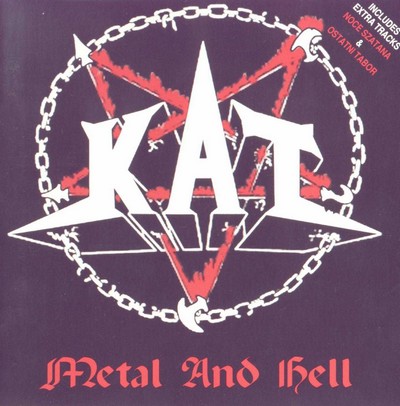
The same system that licensed the crowd sometimes licensed the export, and that is where Poland left the rest of the bloc behind. Recorded in Warsaw studios in the autumn of 1985 and released in April 1986 in an English version as Metal and Hell, with a Polish version titled 666 the same year, the debut pressed that April by the Belgian label Ambush Records, among the first metal records from the bloc sold to Western buyers, belonged to the Katowice band Kat.
Kat's later records lean toward the extreme end, and the Polish death metal that followed, with Vader of Olsztyn on the first Metalmania bill, belongs to the death metal story. The heavy bands stayed on the licensed field. They filled it every summer.
The censor and the producer sat in the same office, and the West came out of the grooves under an official stamp.
East Germany listened on its own youth radio
The German Democratic Republic kept the tightest hand on the pressing plant and the loosest on the airwaves. The East Berlin quartet formed on 1 January 1981, singing in Berlin dialect over riffs taken from Judas Priest and Saxon, was Formel 1, and Amiga issued its Live im Stahlwerk, taped over two nights in March 1986 in the Hennigsdorf steelworks, as the first heavy metal album of the East. It stayed nearly alone on the shelf.
What Amiga would not press, DT64, the state's own youth broadcaster, recorded in its studios anyway. From 1987 its programme Tendenz Hard bis Heavy put homegrown bands such as Biest and Babylon on the air alongside Western imports. The station worked like a dead drop run by the very service meant to be hunting it: a hollow spike pushed into the turf of a park at dusk, a roll of film inside, collected by a courier who never saw the agent and would be shot if caught with it. Every cassette deck in the republic was a courier.
Bans still fell wherever a district official wanted one. The Erfurt band founded in 1985 and banned from the stage in the autumn of 1986, after the Stasi watched a gig at the city's Stadtgarten spill into a near riot, was Macbeth: its tour van was deregistered, its rehearsal room taken back, and it played on as Caiman until the Wall fell without ever releasing an album. The anathema did nothing to the tapes. They went on circulating.
From the Balkans to the Billboard chart
Yugoslavia, outside the Warsaw Pact and open to Western tours and imports, ran its heavy metal almost like a Western market with a Belgrade accent. The Niš quintet formed in 1981 that won the Subotica Youth Festival in May 1983 and went into the Aquarius studio in Belgrade that July was Kerber, with Gordon Rowley, bassist of the British band Nightwing, producing, and its debut Nebo je malo za sve made it a national name within the year.
The title song of Nebo je malo za sve is melodic heavy metal with a chorus built to carry across a sports hall, closer to the Scorpions than to anything the Komsomol feared, and Divlje Jagode, a band whose home is given as both Zagreb and the Bosnian town of Bihać, ran the harder line beside it. Bulgaria came late. The Sofia band founded in 1986 by students of the music academy and the university of chemical technology and metallurgy called itself Ahat, and Balkanton pressed its debut, Pohodat, in 1989, the year the whole bloc came down.
The last act went West. The Moscow trio that recorded an English-language album for the German arm of WEA in 1988 and toured Europe on it was Kruiz, and the Moscow five that Jon Bon Jovi and Richie Sambora walked into Mercury Records a year later was Gorky Park, whose debut reached number 80 on the Billboard 200. The licence had turned into a ticket out. Nobody in the ministries had planned that either.
By the time the Soviet Union dissolved in December 1991, every country of the old bloc had its own heavy metal bands, its own festivals and its own fans who knew the Priest catalogue better than the party programme, and every one of them had been raised with a state stamp somewhere on the paperwork. The ministries had printed the licences. The bands kept them. Across the ocean a different set of generals was running the same experiment, and Latin American heavy metal came out of it just as loud.
