

Three thousand per cent in a single year. That was what Argentine prices did in 1989, which meant that an imported album ordered on the Monday had a new price written on it by the Friday, and that a teenager saving for one was running up a hill that kept being raised under him. The Buenos Aires bass player who answered that arithmetic by refusing the import altogether, writing in Spanish about work and the street and the country he was standing in, and building a band the customs shed could not touch, was Ricardo Iorio. Across the continent the same decision was being taken in a dozen cities at once, and it tore the foreign price tag off the whole enterprise.
An astronomer with no observatory and no money grinds his own mirror. He buys a disc of plate glass, spends six months pushing it face down over a second disc with wet carborundum between them, changing to finer grit and then to rouge on a pitch lap, testing the curve against a knife edge in a dark hallway, and silvers the finished surface over a basin in his kitchen. When he finally points the thing at Saturn he sees the rings, at the same distance and in the same detail as the observatory does. The glass was never the difficult part. Nobody was going to hand him one.
Latin American heavy metal is what a continent built when nobody handed it anything: no pressing plants that wanted the music, no distribution worth the name, currencies that melted, customs regimes that treated a record as a luxury good, and, in four countries at once, governments that regarded a teenager with long hair as a matter for the police. What grew out of that is the subject of the wider map of heavy metal scenes around the world. The southern half of that map is the part where the audience arrived first and the industry never really turned up.
Brazil built the whole chain out of a shop counter
Brazil had the largest audience on the continent and almost nothing to sell it. Foreign records came in under import tariffs that ran as high as fifty per cent through the eighties, and the majors in Rio and São Paulo wanted nothing to do with a domestic band playing at that volume. So the chain got built from the bottom, one link at a time, and the first link was a shop.
The record shop that opened in Belo Horizonte in 1980, then turned into a label in 1985 rather than wait for anyone in Rio to agree, was Cogumelo, and by 1986, with the Overdose split Bestial Devastation and then Sepultura's own Morbid Visions, it was the bastion of the whole Brazilian underground, putting out the raw, badly recorded, internationally traded vinyl that made the country's name abroad. The counter matters more here than the band does.
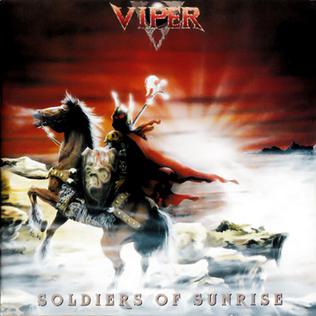
São Paulo took the other road, toward melody and technique. The teenagers who taught themselves Iron Maiden's harmony lines note for note and then rented the hall and worked the door themselves to launch it, rather than wait for a bigger stage that was never coming, called themselves Viper, and Soldiers of Sunrise, cut at Guidon Studios in 1987 and issued by the independent Rock Brigade label, is the sound of that ambition running well ahead of the equipment available to it. The playing is beyond the recording. Everything about it points forward.
What it pointed at arrived in 1993. Angra's Angels Cry was made by Brazilians in São Paulo, cut at a studio in Hamburg, and released that November on Eldorado, Victor and Polydor, and "Nothing to Say" opens it with a run of harmonised guitar and a high clean voice that a European label would have been glad to claim. The exports had begun. Nothing about the domestic industry had improved at all.
Argentina made it a national music, in Spanish
Argentina is the one country on the continent where heavy metal became a mass popular music rather than a subculture, and the reason is the language. The hard blues guitarist who had already spent a decade making Argentine rock respectable, and who put an amplifier behind it in 1980 with a band that most of the country's metal musicians name as their starting point, was Norberto Napolitano, who worked as Pappo and led Riff, formed in Buenos Aires in 1980. After him nobody had to sing in English to be taken seriously.
The band that took that lesson furthest, formed by the bassist Ricardo Iorio in 1987 and gone by the end of 1994, was Hermética, and "Soy de la Esquina," the opening track of their last album Víctimas del Vaciamiento, is the clearest exponent of what it did: a fast, bare, unglamorous riff under a voice singing about a street corner in a city its audience could walk to. The crowds that record drew were not students. They were the same people the lyrics were about.
Argentina is the one country on the continent where heavy metal became a mass popular music rather than a subculture, and the reason is the language.
Chile and Colombia, where the tape did the distribution
Chile had a curfew that ran from the 1973 coup until it was finally lifted in January 1987. Under it the hours in which a hall could be full at all were cut short, halls were watched, and a band that wanted an audience beyond its own city had one channel open to it: the cassette, copied and posted. The Santiago band that put a demo into that network in 1987 and had its name known in Europe before it had an album anywhere was Pentagram, no relation to the Virginians of the same name, and the tapes went out under their own steam, with no company, no advertisement and no border check that could see them.
Colombia split into two scenes in one city. In Medellín, between 1983 and 1988, Parabellum and Reencarnación made a noise so deliberately ugly that local writers coined a name for it, ultrametal, because it sounded like it came from beyond the grave. Across the same city the melodic side of it was carried by Kraken, formed in 1984, whose singer Elkin Ramírez sang in Spanish about duty and endurance on a debut LP that closed out 1987, and whose audience has never stopped turning up. Two answers to one question, from streets that ran into each other.
Mexico's story runs on the same evidence and belongs to its own account, since the closing of the country's large stages after 1971 pushed the music into halls and yards on the edge of the capital for most of two decades. Peru, Venezuela and Uruguay each raised bands attested well enough by their own presses and badly served by everyone else's, and each still waits on the chapter that will do them properly.
What latin american heavy metal had that nobody else did
| Country | The obstacle | What got built instead |
|---|---|---|
| Brazil | Import restrictions, majors that would not sign | A record shop that became a label, and self funded debuts |
| Argentina | Inflation that made imports pointless | A native music sung in Spanish, filling halls |
| Chile | Curfew and watched venues | A tape network that reached Europe before any label did |
| Colombia | No industry in either direction | Two scenes in one city, and a free festival that outlived both |
| Mexico | Large stages closed for two decades | Backstreet halls and a circuit nobody advertised |
Across the continent, families who could never save alone put the same small sum into one hand every week, and every week a different household takes the whole pot, so that by March each one of them owns the thing none of them could have bought, with no bank involved at any point and no interest charged to anybody. Mexicans call it a tanda; the name changes at every border and the arithmetic never does. The latin american heavy metal scenes ran on exactly that arithmetic. One band's borrowed amplifier, another's cousin with a van, a fanzine run off after hours on somebody's employer's machine, and each month it was a different band's record that got made.
Everywhere else the industry built the scene. Here the scene went on for thirty years waiting for an industry that never showed up, and stopped waiting.
Declan Rourke, KaosMetal
The difference shows most clearly against a scene that had everything the south lacked. Two small rich countries with open borders, import shops on every high street and a label and a festival of their own inside five years are the subject of the Dutch and Belgian heavy metal scene, and the contrast is instructive in both directions. The north had the trade. The south had the crowds.
It still has them. Bands that could not fill a mid sized hall in Britain play to the same banners and the same shouted choruses in Santiago, Bogotá and São Paulo that they were meeting there in 1991, which is the one thing the spreadsheets never predicted and the promoters have long stopped arguing with. The industry never arrived. The audience was always the point.
