
The parental advisory sticker is a black and white rectangle in the lower right corner of an album cover, PARENTAL ADVISORY in white capitals on a black field above EXPLICIT CONTENT on a white strip, and it says one thing only: the record company has judged the words on the record too strong for children. No law in the United States requires it. No government office checks it. The labels print it themselves.
The trade body that wrote the rule, speaking for companies that sold more than nine of every ten records bought in America, is the Recording Industry Association of America, and the logo it settled on in 1990 went on to sweep whole albums off the racks of the biggest discount chains in the country and to send the most savage cover art of the decade back to the photographer. Rap took most of the blows. Heavy metal took the first salvo.
Where the parental advisory sticker came from
The first sticker bill in America had nothing to do with swearing. Passed unanimously by the Arkansas legislature in 1983 and vetoed by Governor Bill Clinton, it would have forced a warning label onto any record carrying hidden messages recorded in reverse, which means the preachers' crusade against backmasking had written the idea of a label on a sleeve into a state bill two years before anyone in Washington proposed one.
The deal that followed on 1 November 1985 was looser than its reputation. The companies in the association agreed either to print a warning on records they themselves judged explicit or to print the lyrics on the back of the sleeve, and each label decided which records qualified and what its warning looked like, so that one release carried a sticker, the next a line of small print and the third nothing at all. Compliance was erratic. Much of the new metal was pressed by small independent labels that never joined the association and were bound by no agreement at all.
How the labels were marched to that table, and what the senators heard on the way, belongs to the wider the censorship chapter. The rectangle is another story. By early 1990 bills to make labelling compulsory had been introduced in 21 state legislatures, several carrying fines and jail terms for shopkeepers who sold a marked record to a minor, and the association moved before the states could.
Announced in March 1990, the uniform logo was drawn by the graphic designer Deborah Norcross in the plainest black and white a printer could manage, set at the lower right of the cover, and reserved for lyrics dealing with sex, violence, suicide, drug abuse, bigotry or satanic worship, the last item on the list reading like a street address for every heavy metal band in the country.
| Year | What changed |
|---|---|
| 1983 | Arkansas passes a warning label bill aimed at reversed messages; the governor vetoes it |
| 1985 | Record companies agree to warn on explicit records or print the lyrics, each in its own design |
| 1990 | One black and white logo for the whole industry; 2 Live Crew's Banned in the U.S.A. carries it first |
| 1995 | The BPI brings the logo to British record shops |
| 1996 | EXPLICIT LYRICS becomes EXPLICIT CONTENT |
| 2011 | The label reaches download stores and streaming services |
The first record to wear the new logo was not a metal album but 2 Live Crew's Banned in the U.S.A., released on 24 July 1990 by a rap group already fighting an obscenity ruling in Florida, and by May 1992 about 225 records carried the mark. The wording changed once. In 1996 EXPLICIT LYRICS became EXPLICIT CONTENT, and the rectangle has not been redrawn since.
The racks that closed
A sticker only bites when somebody refuses to sell what it marks, and the refusal came from the discount chains, Walmart first among them. By the early 2000s the chain's guidelines said in writing that it would not stock music carrying the sticker. The policy ran through the record business like a sluice gate dropped across a mill race, cutting the water off from the wheel in one stroke and flinging every marked record down the flood ditch towards the specialist shops, while cleaned-up edits flowed on to the small towns where the chain was the only record counter for fifty miles.
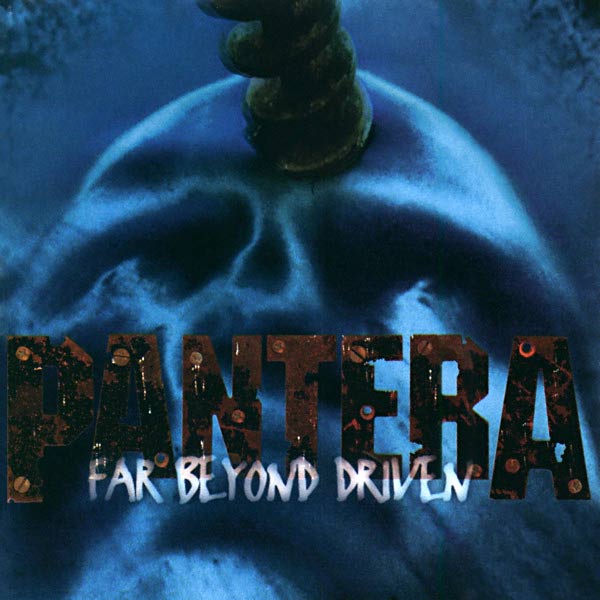
The gate reached the artwork before the music. The Texas quartet that wanted a drill bit on the cover of its seventh album was Pantera, and its label turned down Dean Karr's first photograph for Far Beyond Driven for fear that Walmart and Target would refuse to rack it, so the drill went into the frontal lobe of a skull instead and the original was kept back for the vinyl pressing.
Released on 22 March 1994 with a parental advisory logo on the sleeve and "I'm Broken" as its first single, a riff that grinds a groove into the floor and then stamps on it, Far Beyond Driven went straight in at number one on the Billboard 200, the American album chart. Rock journalists have called it the heaviest record ever to debut there, a description nobody has since had to retire. The chains had changed its clothes. They had not stopped a single buyer.
The chains had changed its clothes. They had not stopped a single buyer.
The Boston quartet that learned how fast the gate could drop was Godsmack, whose self-titled debut had been in the shops for the better part of a year, carrying "Whatever" onto rock radio, when a father complained to Walmart in June 1999 about the language on it. Walmart and Kmart pulled the album off their shelves. The label added the sticker, the chains reordered the marked copies, and the singer Sully Erna told Rolling Stone that in all that time it was the one and only complaint.
What the sticker did to sales
The argument that the rectangle sells records is older than the logo itself. A Tower Records manager said in 1990 that 2 Live Crew's previous album had been dead in the racks until the obscenity fight gave it a second life, and the record went on to sell more than two million copies. Godsmack's debut went platinum on 15 June 1999, nine days after the chains pulled it.
The laboratory disagreed with the shop floor. In a study published in the Journal of Communication in March 1992, Peter Christenson played music to middle schoolers aged eleven to fifteen, some of it in a stickered sleeve and some not, one of the two songs a hard rock track with nothing explicit in it, and found the labelled music was liked less, not more. The forbidden fruit tasted of very little. The association's own line has always been that children choose their music by rhythm and melody long before they listen to the words, which is an odd defence of a label that exists only because of the words. The teenagers who bought the records were older than his subjects, and heavy metal fans had never needed a label to find the loudest thing in the shop. On any honest reading, the sticker never cost the music a sale that anybody has managed to count.
The rectangle as an image
Most of the people who type parental advisory sticker into a search box today want the picture, not the history. The logo has come off the sleeve and onto T-shirts, phone cases, hoodies and album-cover parodies, carried off the way a student carries a weight limit sign unbolted from a condemned bridge at three in the morning and screwed to the wall above his bed, a warning that has become the ornament, the one object in the room everybody asks about.
Heavy metal took to it without any irony at all. A genre that had already put pentagrams, skulls and severed heads on its sleeves found nothing on the rectangle to be afraid of, the faithful wore it on their chests like one more of the band's banners, and the stickered record became as ordinary in the racks as the gatefold sleeve, from the thrash albums of the late eighties through Pantera and on to death metal pressed by the tens of thousands. The sticker spread over the genre from Sabbath to the stadiums like any other piece of the furniture.
The British Phonographic Industry adopted the logo in 1995 and gave it more prominence in 2011, the same year it arrived on download stores and streaming services, where it survives as a small E beside the song title. The sleeve it was printed on has mostly gone. The rectangle has not.
