
On 1 April 1987 Noise Records released the third album by a speed metal band from Hamburg, and nobody at the label called it the start of anything.
Recorded at Soundhouse Studios in 1986, produced by Dirk Steffens alongside the band's own singer and guitarist, and packaged with a ship on the front and the four musicians painted in pirate clothes on the back, the record that hoisted the first skull and crossbones over German metal was Under Jolly Roger by Running Wild, and every argument about pirate metal still has to begin on its opening track.
It was not planned. By the account Rolf Kasparek has given in interviews since, the idea came from one riff and a song title, which he carried into the rehearsal room as a song about pirates, and the rest of the band answered by naming the whole album after it. In a single pass the record scraped the devils and hellfire off the sleeves of a band that had traded in Satanic imagery since Gates to Purgatory in 1984, and it never put them back.
One riff, one flag, one change of costume

Look at the tracklist and the revolution shrinks to its true size. Of the eight songs on Under Jolly Roger, the title track carries the flag while War in the Gutter, Raw Ride and Raise Your Fist are street-level speed metal that could sit on any German record of the year. Diamonds of the Black Chest follows a man who spends years hunting a legendary treasure, only to open the chest on his own reflection, undone by his own greed. The pirate was a costume before he was a creed.
The costume gave an old attitude a better story. Kasparek has told interviewers he sees the pirate as a rebel against authority, pirates as history's first democratic republic and the Jolly Roger a banner for people with no other way to be free, and that reading let the band keep the defiance of its Satanic years while dropping the props that had made the defiance look borrowed. The next record, Port Royal in 1988, took the idea further out to sea, and by then the image belonged to the band the way a signature belongs to a hand.
The title song itself is the blueprint, and it is pure metal with no folk in it at all. Built on a mid-fast gallop, a twin-guitar melody that climbs like a hornpipe without a single fiddle to play it, and a chorus pitched low enough for a hall to shout back, the song stands as a forebear that the later bands would dress in accordions and rum, but its chassis is the German speed and power metal of Noise Records in the same years that the label was also releasing Helloween. Kasparek's riffs sound filed rather than played, squared off at the edges the way a luthier files a fret flush with the board, sharp enough to open a thumb that slides along it carelessly.
What pirate metal sounds like
Strip the hats off and pirate metal turns out to be a set of arranging decisions laid on a power metal frame. The drums run the double-kick patterns of the speed metal wing, the guitars stack harmonised leads in thirds, and the vocals stay clean or roughly clean, but the melodies are cut from the sea shanty and the hornpipe, which move in short, repeating phrases with the stress landing on the downbeat, so that a stranger can sing a line by its second time round.
Then come the instruments that folk metal owns: the accordion, the concertina, the tin whistle, the fiddle. Pirate bands use them, and how they work inside a metal band is folk metal's own subject. What matters is where they sit. They carry the tune, doubled by a keyboard, while the guitars hold the chords underneath like a pit orchestra that has agreed to stay out of the singer's way.
The gang chorus finishes the design. A shanty was a work song, called by one sailor and answered by a crew hauling rope in time, and pirate metal keeps that shape exactly, lead line and bellowed reply. The effect is a conductor's baton snapped over a knee and thrown into the stalls, with the whole room left to keep the beat by stamping on the floor.
The effect is a conductor's baton snapped over a knee and thrown into the stalls, with the whole room left to keep the beat by stamping on the floor.
The wider family tree is drawn in the account that frames it, and one fact decides where the pirates hang on it: the subgenre stays in the power metal family because its inventor came out of German speed metal, not out of a folk club. The instruments were added later. The pedigree was fixed in 1987.
The revival from a Scottish studio project
For nearly twenty years the pirate was one band's property.

Started in Perth in 2004 as a studio project called Battleheart by Christopher Bowes and Gavin Harper, grown around a song called Heavy Metal Pirates, and renamed after it signed to the Austrian label Napalm Records late in 2007, the keytar-wielding crew from the east of Scotland is Alestorm, and its debut Captain Morgan's Revenge in January 2008 is where the second life of pirate metal begins.
Nothing about it is solemn. The band bills itself as True Scottish Pirate Metal, a slogan that announces the joke before the first note, and where Kasparek's pirate was a political symbol, Bowes's pirate is a man who has lost his boots in a tavern. The songs are about rum, scurvy, keelhauling and drink, and the keyboards play hornpipes over a power metal gallop at a volume no ship's fiddler could ever have reached.
Keelhauled, from Black Sails at Midnight in 2009, is the song that made the method famous and the one that best explains it. Its accordion patch, played on a keytar, sounds like a church harmonium wheeled out of the vestry into a harbour bar and pumped until the leather of its bellows splits, still wheezing out the tune over double-kick drums, and that wheeze, not the guitars, is the melody every voice in the room is following.
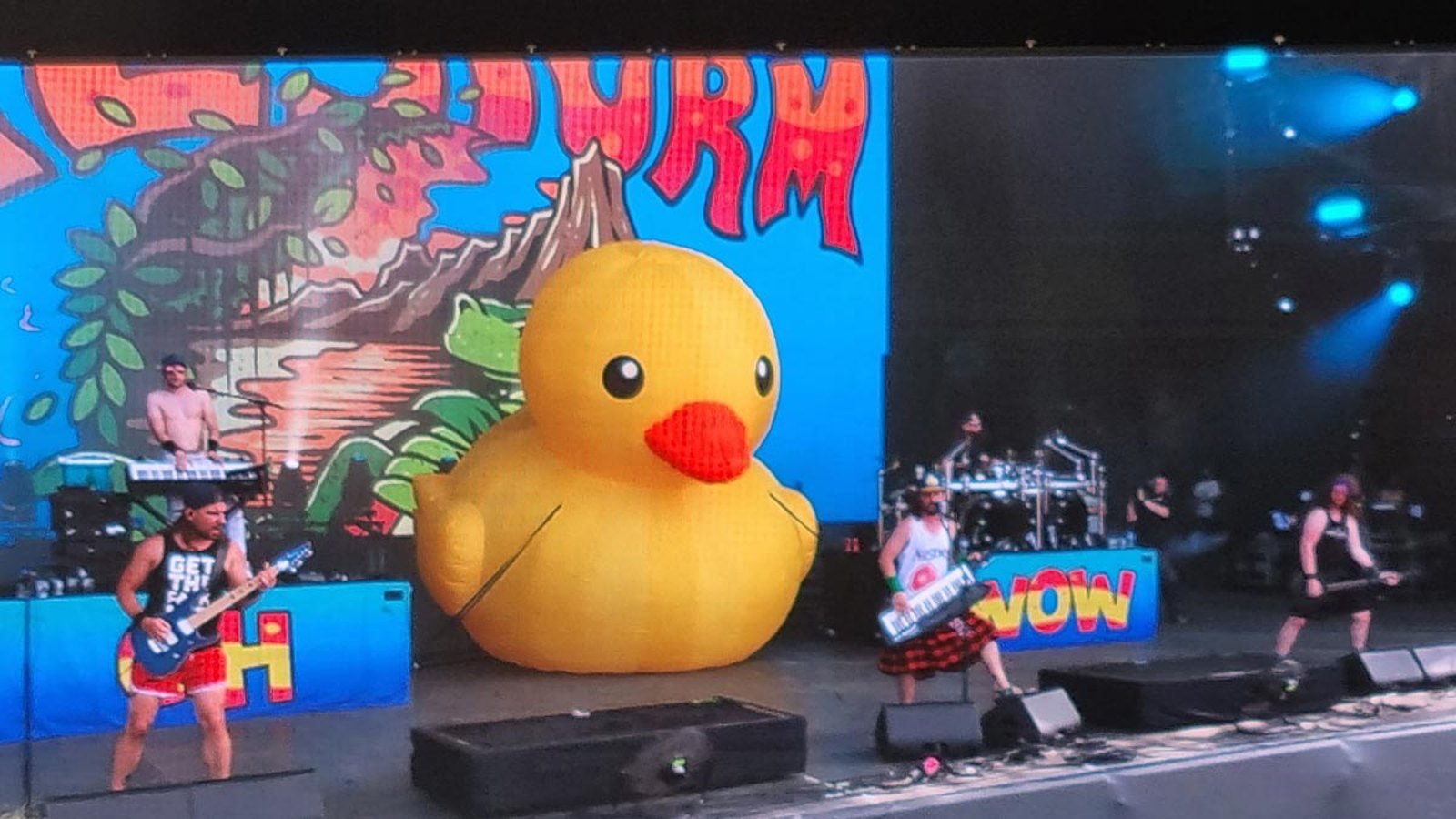
The joke then grew in both directions at once. Sunset on the Golden Age in 2014 went to number one on the UK Rock Chart, led off by a single simply called Drink, and carried a straight-faced metal cover of Hangover, the Taio Cruz pop hit. No Grave but the Sea in 2017 topped Billboard's Heatseekers chart, the American listing for artists yet to break through. A giant inflatable duck has shared their stages since the mid-2010s, growing bigger each tour. The records sell. The self-parody is the business model.
The fleet behind the flagship
Once Alestorm had proved the audience existed, other crews put to sea from very different harbours.
| Band | Country | Formed | What sits under the costume |
|---|---|---|---|
| Alestorm | Scotland | 2004 (as Battleheart) | Power metal, keytar hornpipes |
| Swashbuckle | United States | 2005 | Thrash and death metal |
| Ye Banished Privateers | Sweden | 2008 | Folk rock, no metal |
| Rumahoy | Scotland | 2011 | Folk metal, pirate schtick played straight-faced |
| Lagerstein | Australia | 2010 | Folk metal drinking songs |
| Storm Seeker | Germany | 2013 | Folk metal, hurdy-gurdy |
The New Jersey crew Swashbuckle took the costume to the thrash side of the family, and Back to the Noose, released by Nuclear Blast on 24 July 2009, crams twenty-one tracks into under forty-two minutes of shouted thrash and death metal, the tempos lurching like a score kicked down a conservatory staircase and played in whatever order the torn pages happened to land. It proves the image travels. It also proves the image is not a sound.
The Swedish crew Ye Banished Privateers, formed in 2008 and signed to Napalm for First Night Back in Port in 2017, share the audience, the festivals and the costumes, and they are not a metal band at all. Their music is acoustic folk rock built on Irish and Scandinavian tradition. They belong on the same bill and in a different section of the record shop.
The rest of the fleet sits closer to the power metal core. The Australian drinking-song specialists Lagerstein built a catalogue on titles such as All for Rum & Rum for All from 2016, the pseudonymous crew of Rumahoy, fronted by a singer who calls himself Captain Yarrface, released The Triumph of Piracy through Napalm on 9 February 2018, and the German band Storm Seeker brought a hurdy-gurdy aboard. By common consent Alestorm remain the flagship, and the others are measured against them.
Why the joke keeps working
Power metal is the most earnest music in the family and the most mocked for it, with its dragons, swords and falsetto. Pirate metal takes every one of those charges and pleads guilty before the trial begins. A band singing about rum in a tricorn hat cannot be accused of taking itself too seriously, and so it plays the style's melodic habits at full strength.
Underneath the joke, the craft is serious. Choruses built on the shanty's call and answer are among the most effective singalong devices ever written, because they were designed for untrained voices doing something difficult together, and a festival crowd is exactly that. The same arithmetic of hook and repetition runs through the metal opera, where it serves a cast of star singers instead of a drunken crew.
Kasparek played the pirate straight, as a symbol of defiance, and Bowes plays him for laughs, as a symbol of the night out. What joins them is the fanfare, the twin melody and the chorus pitched for a crowd, which is to say power metal, and the full family of branches around it is laid out in the index of the series.
The flag came from a riff. The rum came twenty years later. The chorus was there from the start.
