
Five minutes and forty five seconds of a 1997 album, and nobody sings a word on any of it.
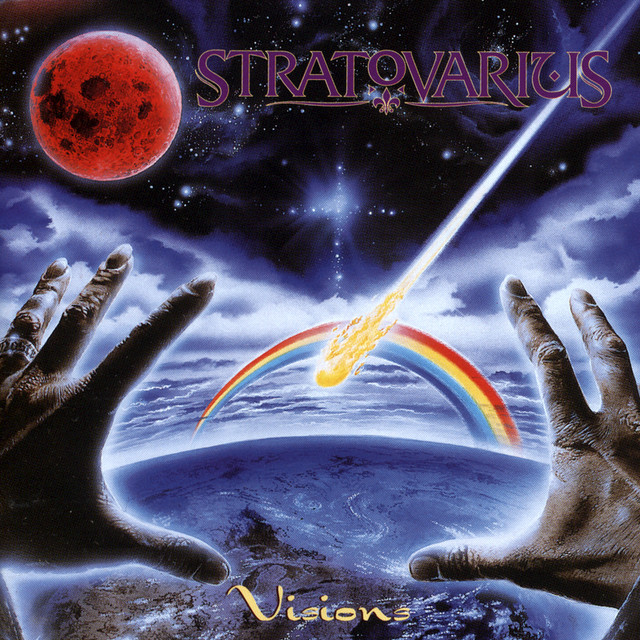
Cut at Finnvox in Helsinki between October 1996 and February 1997, produced by its own guitarist, and released on 28 April 1997 onto a Finnish album chart it then held for twenty three weeks, the band that gave a whole track of Visions to an instrument and no voice was Stratovarius, and the track is "Holy Light", seventh of ten.
Nothing about that was accident. In the old full length ballets the display is not an interruption of the evening but a numbered piece of it, the variation written into the score between the slow duet and the coda, in its own key and at its own tempo, with the pit cut back to plain chords and a beat so that one body at the front of the house can be heard working. A company with nobody who can take it does not put the ballet on at all. The satin is beaten off a pair of shoes before the end of it. Another pair is broken open for the second house.
The power metal 80s guitar 90s inheritance runs on the same arrangement, and it is not a mood or a loyalty. It is a credit list, a running order and a count of bars. Through the decade when much of American rock pulled the lead break out of the song and was congratulated for the economy, the bands working out of Hamburg, Helsinki, Trieste and Fulda were still handing the guitarist a section of his own, and in a few cases a whole track with nobody singing on it.
Where the solo sits in the song
Follow the minutes. Visions runs sixty one minutes across ten tracks and closes on "Visions (Southern Cross)" at ten minutes and seventeen seconds, longer by four minutes than anything else on the record, the nine songs in front of it sitting between four and a half minutes and a little over six. Then the band spends the length of two more of them on one piece.
Words and music on it are Timo Tolkki's from first bar to last, and it closes a concept record about Nostradamus. Steve Huey of AllMusic heard the ten minute title track as the spot where the material sinks under its own weight.

The habit was not one band's. Helloween opened Better Than Raw in 1998 with "Deliberately Limited Preliminary Prelude Period in Z", one minute and forty five seconds of instrumental credited to the drummer Uli Kusch, a track that was never a single and spends its whole length with no voice on it. Gamma Ray hung two more of them on Somewhere Out in Space, "Cosmic Chaos" and "Rising Star", each one under a minute. Three stretches of bars bought and paid for, numbered on the sleeve like any song, and no voice laid across a single one of them.
The power metal 80s guitar 90s inheritance is a credit list
Open the sleeves and count the chairs. Blind Guardian credit André Olbrich with lead, rhythm and acoustic guitars on Imaginations from the Other Side and Marcus Siepen with rhythm, a division of labour the band had kept since the eighties. Helloween put Roland Grapow beside Michael Weikath from 1989 to 2001 and kept two guitarists in the band through the whole of the nineties. Gamma Ray shifted Dirk Schlächter to the bass by 1997 so that Henjo Richter could stand at the second guitar beside Kai Hansen, which is a band carrying two wages for lead playing at the moment much of the market had made the idea anathema.
Across the map the second guitar chair outlasted a market that wanted it sawn off: Angra paired Rafael Bittencourt with Kiko Loureiro from 1992, and Edguy had Jens Ludwig on lead and Dirk Sauer on rhythm from the same year. Rhapsody of Fire set Luca Turilli's guitar against Alex Staropoli's keyboards from the first record, so the other voice at the front of that band was never going to be a second guitarist, and Sonata Arctica had Jani Liimatainen on guitar for its first record in 1999 and kept him in the chair until 2007.
| Band | Record | Guitars credited |
|---|---|---|
| Blind Guardian | Imaginations from the Other Side (1995) | André Olbrich (lead, rhythm, acoustic); Marcus Siepen (rhythm) |
| Stratovarius | Visions (1997) | Timo Tolkki |
| Gamma Ray | Somewhere Out in Space (1997) | Kai Hansen; Henjo Richter |
| Helloween | Better Than Raw (1998) | Michael Weikath; Roland Grapow |
| Angra | Fireworks (1998) | Kiko Loureiro; Rafael Bittencourt |
| Rhapsody (now Rhapsody of Fire) | Symphony of Enchanted Lands (1998) | Luca Turilli |
| Edguy | Theater of Salvation (1999) | Jens Ludwig; Dirk Sauer |
A chair in the band was not always a desk in the writing room, and the single off that Helloween record makes the point. "I Can" went out in April 1998 with the music credited to Andi Deris and Michael Weikath and the lyric to Weikath, while Roland Grapow, who held the other guitar on the record, is credited with none of its eleven tracks. The job was a job. Somebody was employed to do it whether or not he wrote the four minutes around it.
What the records ask the guitarist to do
Composition, in two of them, sat in the guitarist's hands: Tolkki wrote all the music on Visions and produced it himself, and every one of the nine songs on Blind Guardian's Imaginations from the Other Side is credited to Hansi Kürsch and Olbrich and to nobody else. In the third, Kai Hansen produced Somewhere Out in Space with Schlächter at Hansen Studio in Hamburg between March and June 1997, so the break had a guitarist standing at the desk.
There is an old word for a line written like that. The obbligato is the instrumental part set on the same system as the voice, the two of them answering each other inside one number, the parts sewn into the binding together, so that shortening the number means tearing the singer's own stave out along with the player's. A break is something a band leaves room for. An obbligato is what a band builds the room out of.
The scales, the picking hand and the harmony running underneath those bars are what the band is actually playing, which is a separate subject with its own arithmetic.
"Imaginations from the Other Side" opens its album at seven minutes and nineteen seconds, cut at Sweet Silence in Copenhagen between August 1994 and March 1995 with Flemming Rasmussen at the desk, a Dane who had already worked with Metallica, and a seven minute opener leaves a great deal of floor for one man's hands.
The years the break came out of everything else
Set that beside what the largest metal band on earth did with the same device. Recorded with Bob Rock between 2001 and 2003, released by Elektra on 5 June 2003 and running seventy five minutes over eleven songs with not one lead break anywhere on it, the band that had spent the eighties teaching a generation what a guitar solo was for was Metallica, and St. Anger is the record where it stopped.
Kirk Hammett's account was that the solos were tried and kept sounding like an afterthought, and the NME read the same gap as a band taking metal apart and starting again from scratch, a hole described as an achievement. The absence went down as a credit.
A band that credits one man rhythm and another lead has already decided the solo is a job and not a mood.
What that decade cost the device in the United States, and what one games console handed back to it, is Guitar Hero and power metal, a story about a chart on a television rather than a chart in a shop.
Who learned the parts
A spectacle written down is a spectacle that travels. A composed solo is a text, and a text can be lifted off a record note for note by somebody who will never meet the man who wrote it, so the velocity of the late eighties was there for anyone to take. Everything checkable about the power metal 80s guitar 90s succession is printed on a sleeve or audible in a running time.
So the device did not survive because anybody argued for it in print. It survived because bands kept writing it into the middle of their songs and kept a specialist hired to play it, through a decade in which the same section of the same kind of song was being deleted across much of the rest of rock. DragonForce would later build a career on two men doing the job at once. The longer account of those years is where the story stands now.
