
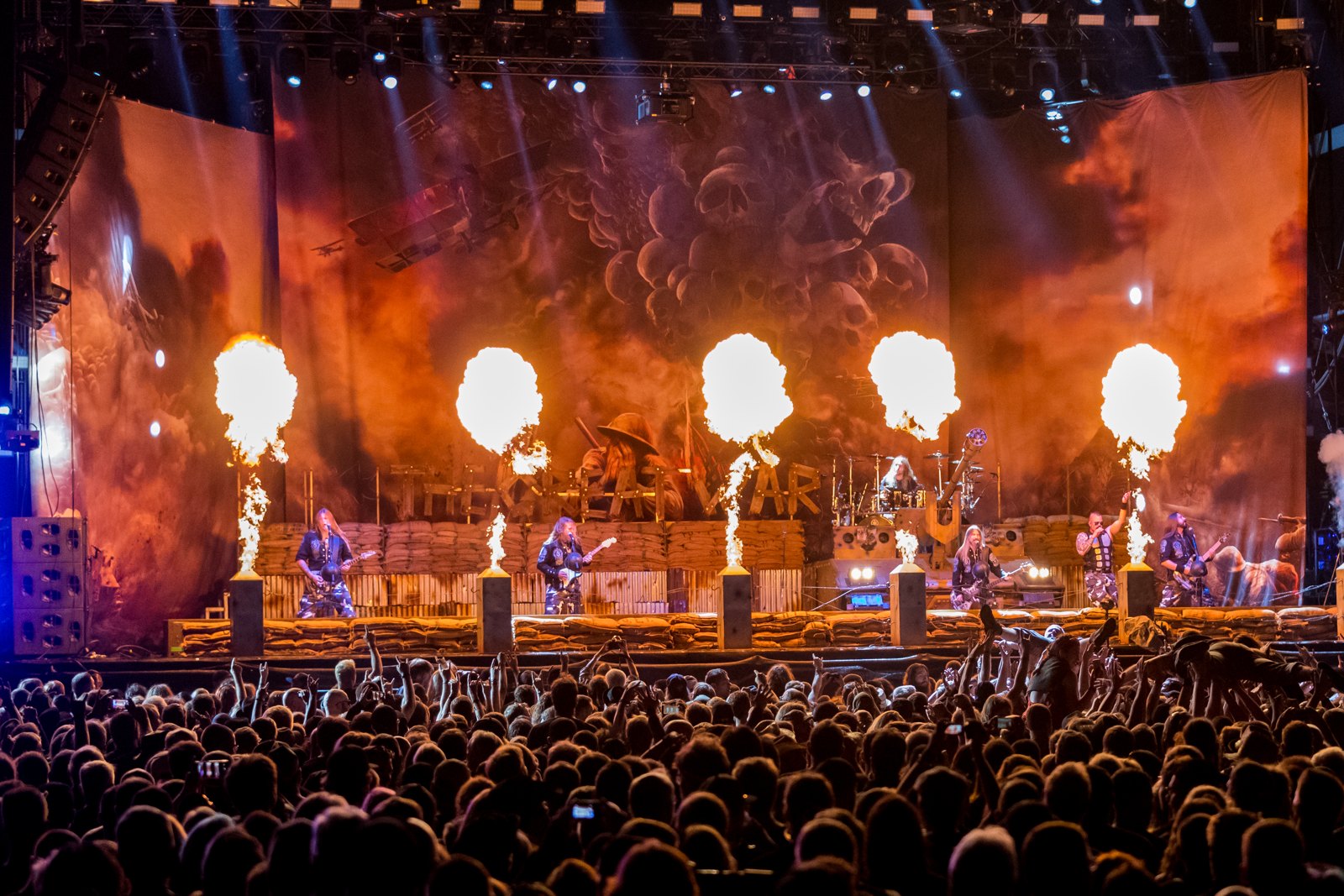
On 2 August 2013 the Official German Album Chart printed on its first line a record sung in part in church Latin over a church organ, and the five Saarland exponents of that liturgy who had never stood nearer the top than twenty third place were Powerwolf, whose Preachers of the Night went in above Robin Thicke's Blurred Lines at three, Black Sabbath's 13 at seven and Daft Punk at nine.
It held that line for one week. Six weeks after it arrived the album was out of the hundred altogether, its last entry at 77, torn off the page it had just headed. The summit was real. The tenancy lasted six weeks.
Read in a row, the power metal charts of the 2010s carry two facts at once: a genre walking up the German list out of its lower half and onto its first line in a little over four years, and the counting method under its feet being rebuilt halfway through the walk. Both are unarguably in the figures. Only the first is ever told.
The fiddle was once taught at a waterfall, and it was the tariff that settled the lesson. A man who wanted the whole art went up on a Thursday night with a fat he-goat, cut its throat on the lip of the fall and threw the carcass in with his face turned away, and the thing under the spray took his right hand and worked it along the strings until the blood came out from under his nails. A lean beast bought less. A kid with its ribs showing bought the tuning and nothing after it, four strings brought into agreement and not a tune in the hands that had tuned them, and as the valley emptied the offering fell from a fat goat to a kid to a shank with half the meat off it. What never fell was the name. A man who came back down that path had been taught at the falls, by common consent, and the phrase kept every syllable it had when the goats were fat.
A German number one in the 2010s is a name of that kind. The figure at the head of the chart has not changed since there was a chart to head; the trade standing behind it has. In 2013 Germany bought 107 million albums, 84 of every hundred of them on a physical disc, and the audience this music had kept still bought objects in the week they appeared. The Hamburg band that founded the whole style, whose Keeper of the Seven Keys Part II stopped at fifth place in September 1988 and that waited until 2021 for a German number one, was Helloween.
Two climbs up the same chart

Three rungs carried the Saarland band from the bottom of the list to the top of it, and the first two splintered behind it: Bible of the Beast entered at 76 in May 2009 and was gone inside a week, Blood of the Saints entered at 23 in August 2011 and lasted three, and Preachers of the Night entered at the top in 2013 and held. Four years, seventy five places, no detour.
The song that led that middle record out as a single, with a video behind it the year after, was Sanctified with Dynamite, put out by Metal Blade in May 2011, and the anthem carries everything the chart would later reward: the organ and choir in front, a chorus built for singing back, nothing kept back. An audience that learns a chorus ahead of the release buys the album the week it reaches the shops.
The Swedish band whose five studio records of the decade climbed nineteen, seven, three, two and one in that order, never once stepping backwards, is Sabaton. The ladder took nine years to climb, and its top rung, The Great War, went in at number one on 26 July 2019 and put Ed Sheeran at four and Rammstein at five beneath it.

The middle rung is the instructive one. Heroes entered at three on 30 May 2014 and stayed nine weeks, three times the life of the live album issued the autumn before, and it took the top at home in Sweden. Its single To Hell and Back, the first off the record that spring, hangs a western soundtrack hook over a stomping chorus, and nothing in it waits.
| Entered | Band and album | Peak | Weeks |
|---|---|---|---|
| 8 May 2009 | Powerwolf, Bible of the Beast | 76 | 1 |
| 4 June 2010 | Sabaton, Coat of Arms | 19 | 2 |
| 12 August 2011 | Powerwolf, Blood of the Saints | 23 | 3 |
| 8 June 2012 | Sabaton, Carolus Rex | 7 | 5 |
| 2 August 2013 | Powerwolf, Preachers of the Night | 1 | 6 |
| 30 May 2014 | Sabaton, Heroes | 3 | 9 |
| 24 July 2015 | Powerwolf, Blessed & Possessed | 3 | 8 |
| 26 August 2016 | Sabaton, The Last Stand | 2 | 9 |
| 27 July 2018 | Powerwolf, The Sacrament of Sin | 1 | 12 |
| 26 July 2019 | Sabaton, The Great War | 1 | 12 |
What the power metal charts counted, and when it changed
On 5 February 2016 streaming entered the German album chart, and from that Friday a placing stopped being a tally of what the shops took at the till. A clerk had ruled, in a formula nobody who plays and nobody who listens had a hand in, how many hearings of a track in a rented catalogue are worth one disc paid for over a counter, and the trade rearranged itself around the figure he wrote. The dates in the account that frames it fall on both sides of that line.
Runs on the power metal charts lengthened across the decade, from the one week a 2009 entry managed to the twelve The Sacrament of Sin spent in the hundred after reaching the top in July 2018. How much of that belongs to the new count and how much to a grown audience is not something a chart will say.
The ceiling had been rammed before the first number one. The Krefeld band that put A Voice in the Dark, a song that bolts a choir of guest singers onto a gallop, out in front of an album of orchestral overdubs is Blind Guardian, and At the Edge of Time entered at second place on 13 August 2010, three years before anyone in the style reached the first, under the old count, on discs alone.
The same name, eighty seven places apart
Ten months after its number one the Saarland band put out The History of Heresy I, a reissued pair of early albums, which entered at 88 in June 2014 and was tipped out of the hundred after seven days. Four and a half years later the covers record Metallum nostrum managed 67 and one week, six months after that band's second number one. The name on the sleeve was identical both times.
The live records of the Swedish band keep the same shape, one at 17 in October 2013 and Heroes on Tour at 8 in March 2016, both dropped inside five weeks while the studio albums beside them ran nine. A chart does not record how much a record is loved. It records who walked into a shop in one particular week, which is on any honest reading a smaller question.
A chart does not record how much a record is loved. It records who walked into a shop in one particular week.
Five weeks in Germany against six years on a Swedish list
Two things that were played can go into the same ground in the same year. One is gut strung over a wooden frame, and the soil strips the gut off it inside a season and eats the frame down to a dark line in the earth that a spade goes through without anybody seeing it was there. The other is a length of a bird's wing bone with holes down it, and it comes up out of the floor an age later with the holes clear and the pitches where somebody put them, and a man who was not born when the last man to sound it died can pick it up and sound it. Both of them were played. Only one of them can still be played.
Carolus Rex is the second kind. In Germany it entered at seven on 8 June 2012 and was gone after five weeks; in Sweden it peaked at second on the album list and stayed 326 weeks on the hard rock list, better than six years with barely a gap, and reached quadruple platinum at home. Two years later Heroes took the Swedish top outright.
Price depends on the market underneath. Stratovarius had taken the Finnish chart with Destiny in October 1998, stayed on it seventeen weeks and gone gold there at twenty thousand copies, in a year when the same record stopped at 89 in Germany, and Elysium put the band back at the Finnish top in 2011. Five million people make a cheaper summit than eighty million do, and both of them are printed in the same type, under the same word.
What a placing cannot tell you
So the number ones of the decade are worth what they say and nothing more: that in one week of one country more people bought a given record than any other, in a shrinking trade, latterly with part of the count handed to a conversion rate for rented listening. They do not say the music had won an argument. They say its audience turns up on the Friday.
What the placings did change is audible in the records that chased them, shorter songs, refrains moved forward, arrangements built for a hall rather than for a listener with headphones, which is the business of the arena sound. The Gothenburg band that kept its 2010s studio albums battering the ceiling between fourth and ninth place, and never broke it, is HammerFall, whose debut had crept in at 38 in July 1997.
Between 2009 and 2019 two bands walked a chart from its lower reaches to its first line, a third reached second place in August 2010, when neither of the two had yet been inside the top ten, and the instrument that recorded all of it was rebuilt in the middle of the decade. The placings are facts. What they are facts about is seven days of buying in one country, which is a smaller thing than a verdict and a much harder thing to argue with.
