
Mercury Records paid for a New York studio in the spring of 1970 and got back forty minutes that shook the plaster loose from the ceiling of every room the tape was played in, three men at a volume no American chart had a slot for, the drummer singing over the top of his own kit because there was nobody else in the band to do it. The Brooklyn trio that made it was Sir Lord Baltimore. Nobody in that room could have called what they were doing proto metal. The words did not exist in that order, and would not for years.
A tray of struck stone comes out of the ground in 1968 and is set aside under a card pencilled with the name of the place and the year, and nothing else. Everything about that stone is already settled: who worked it, which way round the core was held, how many blows came off each face before the edge stood where the maker wanted it. Nothing about it changes when somebody arrives fifty years later and writes a term across the card in ink. What changes is that it can be found. Proto metal is the ink on the card.
The term is a back formation, and it is worth saying so flatly: no band in 1970 described its own music this way, no label printed it on a sleeve, and no shop anywhere had a rack to file it under. It was fastened to the music afterwards, by reissue labels and by collectors, and what it names now is a window of about six years, from 1966 to 1972, in which the volume, the distortion and the riff were all in place and none of the rest of the vocabulary was. What the music turned into once that vocabulary settled is the business of the full chapter.
What proto metal names, and where the window closes
The test is which part of the record carries it. On a loud blues record, and on most hard rock, the riff is a setting and the voice is the stone sitting in it, so that lifting the singer out leaves a backing track behind. On a proto metal record the riff is the subject, the voice is one more instrument arguing with it, and every other part exists to bring the riff back round. That is a structural difference rather than a matter of decibels, which is why a great many louder records have no place in this story at all. Where those riffs came from, and what had to be done to twelve bar form to force them out of it, is the blues roots of heavy metal.
The window shuts when the vocabulary arrives. By 1972 there were young bands writing to a template instead of feeling for one, and within a year the tempo, the minor key, the harmonised guitars and the high male voice had hardened into rules a beginner could learn in an afternoon. Everything before that hardening is proto, which is a word about timing and not about worth. Several of these records are better than the ones that followed them.
The American records that got there first
The three men from San Francisco who got there before anybody were Blue Cheer, whose Vincebus Eruptum went out on Philips on 16 January 1968 carrying a version of Eddie Cochran's "Summertime Blues" that climbed to number fourteen on the Billboard Hot 100. What the trio does to that song is the whole argument in miniature, the tune surviving by inches under a fuzz tone thick enough to bury it and the drums hammering the back of every bar flat. It is a salvo rather than a song.
The guitarist who walked out of that band and took the idea to its end was Randy Holden, whose Population II was cut by two men in 1969 in front of a wall of sixteen Sunn amplifiers and released the following year. Trouble with the release left him bankrupt, his equipment gone, and he did not return to music for more than twenty years. What is on the tape is one long low grinding tone with drums under it, and most of it would sit without complaint on a doom record made fifteen years later.
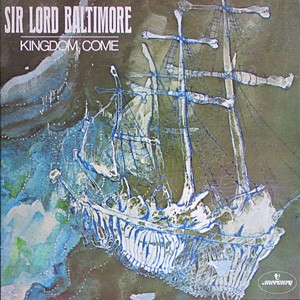
Kingdom Come arrived in December 1970, produced by Mike Appel and Jim Cretecos and mixed by Eddie Kramer, who had engineered for Jimi Hendrix, at Electric Lady in New York, and it sold badly enough that the second album came and went almost unnoticed. John Garner drummed and sang lead, Louis Dambra played guitar and Gary Justin played bass, and the division of those jobs is the point: nobody drums like that and sings like that at once without damaging one of the two, and Garner chose to damage the singing.
"Master Heartache" opens the record at a gallop, the guitar doubling the vocal line rather than accompanying it, the whole thing running faster than the players can comfortably hold. Nothing on it is tidy. That is what makes it evidence, because tidiness is what the next decade added and what this one did not miss.
Two more American names belong in any honest list. Dust, a New York trio whose drummer Marc Bell later kept time for the Ramones, cut two albums for Kama Sutra in 1971 and 1972 and tied a hard rock attack to harmony singing that drags the weight back towards the radio. Bang, signed by Capitol out of Philadelphia, wrote in the shorter Sabbath shapes with a rhythm section that swings where Sabbath plods, a forebear's difference rather than a failing.
Britain, Germany and Japan in the same three years
The London band Decca pressed in 1971 and then forgot about within the year was Leaf Hound, whose Growers of Mushroom opens on "Freelance Fiend" and spends its first minute on the thing British bands got right and the Americans did not, the riff written as a figure with a shape rather than as a rhythm to be hit. Peter French sang it, the first pressing sold almost nothing on release, and the market corrected that verdict in 2021, when a copy surfaced at auction and went under the hammer for eleven thousand pounds.
Three more European records sit in the same short stretch. Budgie, a trio from Cardiff, put out a first album on MCA in 1971 and wrote riffs that thrash bands would strip and reuse a decade later. Lucifer's Friend, built in Hamburg around the English singer John Lawton, made a 1970 debut that swings between organ heavy rock and something nastier. Night Sun cut Mournin' for Polydor's Zebra label in 1972 at a speed nobody else in Germany was attempting, and then stopped.
The band Tokyo sent in the other direction was Flower Travellin' Band, whose Satori came out in 1971 and is the least derivative record named here by a distance. "Satori Pt. 2" is built on a riff bent out of a scale no British band was using, with Joe Yamanaka singing above it in a register a long way from any blues shouter and Hideki Ishima playing as though the guitar owed him money. Australia's Buffalo got to much the same place in 1973 through sheer weight.
Why so few of them got a second record
A lifter can clean a bar to his shoulders, hold it there with his elbows up and his knees locked, and still have no idea how to get it overhead. Most of these bands were at exactly that point. The weight was up, held, plainly enormous, and there was no second movement to put it anywhere, because nobody had worked one out yet and there was no one to ask.
The weight was up, held, plainly enormous, and there was no second movement to put it anywhere.
The infrastructure that later bands took for granted did not exist. There was no specialist press, no network of clubs booking this music by name, no label whose whole catalogue was this and nothing else, and on any honest reading the majors signed most of these groups as psychedelic acts and dropped them the moment the psychedelic money moved. Decca, Philips, Capitol and Mercury each had one of these records on the books and each let it go. The bands broke up on the road, in the accounts, or in front of an audience that had come for something else.
What rescued the survivors was not the music press but the reissue trade of the late eighties, and after it the collectors who needed a word for what they were trading. Proto metal is that word, and it earns its keep, because it holds in print a shelf of records no major would have pressed again and it sends listeners backwards out of the genre's own history rather than forwards out of the charts of 1968. The map that runs from those records to every branch of the genre was drawn afterwards too, and it is no less useful for that.
Pentagram, formed in Virginia in 1971, shows how thin the ground was: it recorded for years, released nothing, and waited until 1985 for a first album, by which time a genre existed to receive it. The rest left one record each, attested by a catalogue number and not much else.
