
In August 1968 a man with his head on fire was number one in Britain. Standing in a burning metal headpiece with his face painted and his arms spread wide, pushing "Fire" to the top of the singles chart on Track Records, the singer under the flaming crown was Arthur Brown. The song went to number two on the Billboard Hot 100 a few weeks later, and almost every trick the shock rock heavy metal later inherited was already on his stage: the paint, the flame, the voice pitched as a threat and the song staged as a scene.
In the Holiness churches of the Appalachian hills a preacher will reach into a wooden box in the middle of the service and lift out a timber rattlesnake bare-handed, fangs intact and venom unmilked, because a verse at the end of the Gospel of Mark promises that believers shall take up serpents, and when a snake does strike it drives both fangs straight through the skin of the hand that holds it. Nobody in the pews calls it a trick.
Shock rock was a trick, and proud of it. Heavy metal carried the same props into church. It took up the coffins, the blood and the greasepaint the way that preacher takes up the snake, as articles of belief instead of stage business, and the handover ran through a surprising number of the same people, a road whose wider map, with every other branch of the family, sits in the chapter that covers it.
The route is not a straight one. It starts in rhythm and blues, crosses the London beat clubs, detours through one of the worst records ever released, and only reaches the genre in the eighties, when the audience itself started bringing the props.
Coffins, a top hat and a burning crown
Recorded for OKeh in 1956, "I Put a Spell on You" never reached the charts and became the founding document of the whole trade anyway. Three hundred dollars was what Alan Freed offered its singer to be carried on stage in a coffin at a Christmas show in 1956, and the man who pushed up the lid, rolled his eyes at a hall of screaming teenagers and climbed out in a cape with a skull on a stick was Screamin' Jay Hawkins. The coffin paid better than the record. He kept a skull on a stick, which he called Henry, as a partner in the act for decades, and the National Casket Company told funeral directors not to rent or sell him any more coffins, so he bought his own and kept a hearse to carry it.
Britain answered with a top hat and a kitchen knife. The London singer who stalked the stage during "Jack the Ripper" in 1963, cape flying, chasing a girl across the boards with a butcher's knife raised and stage blood everywhere, called himself Screaming Lord Sutch, and the single, produced by Joe Meek at his Holloway Road studio and promptly banned by the BBC, came out that same year. His backing band, the Savages, gave a teenage guitarist named Ritchie Blackmore his first professional job in May 1962 and took him back more than once before 1967, a year before he turned up in Deep Purple.
The link was personal, and it went on after the guitarist had left. Sutch went to Hollywood in 1969 with a heavier crowd, the record he made there came out in 1970, and the players on it had come to regard it as a joke long before it was released.
Arthur Brown had the more lasting pupils. His burning crown lit the way for every singer who later set something alight on purpose, and when Vincent Crane, his organist, and Carl Palmer, his drummer, walked out during a stalled American tour in the summer of 1969 they formed Atomic Rooster, one of the heavier organ bands of the early seventies. The musicians left. The fire stayed in the trade.
Where shock rock heavy metal stopped winking
Every one of those acts sold the danger with the trapdoor in plain view, and Alice Cooper, the next stage of the same trade, kept the wink even while he was being hanged, dying at the end of the set and coming back to take a bow. The audience was in on it. That was the contract.
The night the wink went out of it came in Des Moines, Iowa, on 20 January 1982, when somebody in the crowd threw a live bat onto the stage, and the singer who picked it up, took it for a rubber toy and bit its head off before he knew better, then spent the following days on a course of rabies injections, was Ozzy Osbourne. He had not planned it. A year earlier, at a CBS Records meeting in Los Angeles on 27 March 1981, he had bitten the heads off two doves that were meant to be released into the room as a publicity stunt, and that at least had been his own idea. The bat was somebody else's. The faithful had simply started bringing their own props, and the props were alive.
Shock rock was a trick, and proud of it. Heavy metal carried the same props into church.
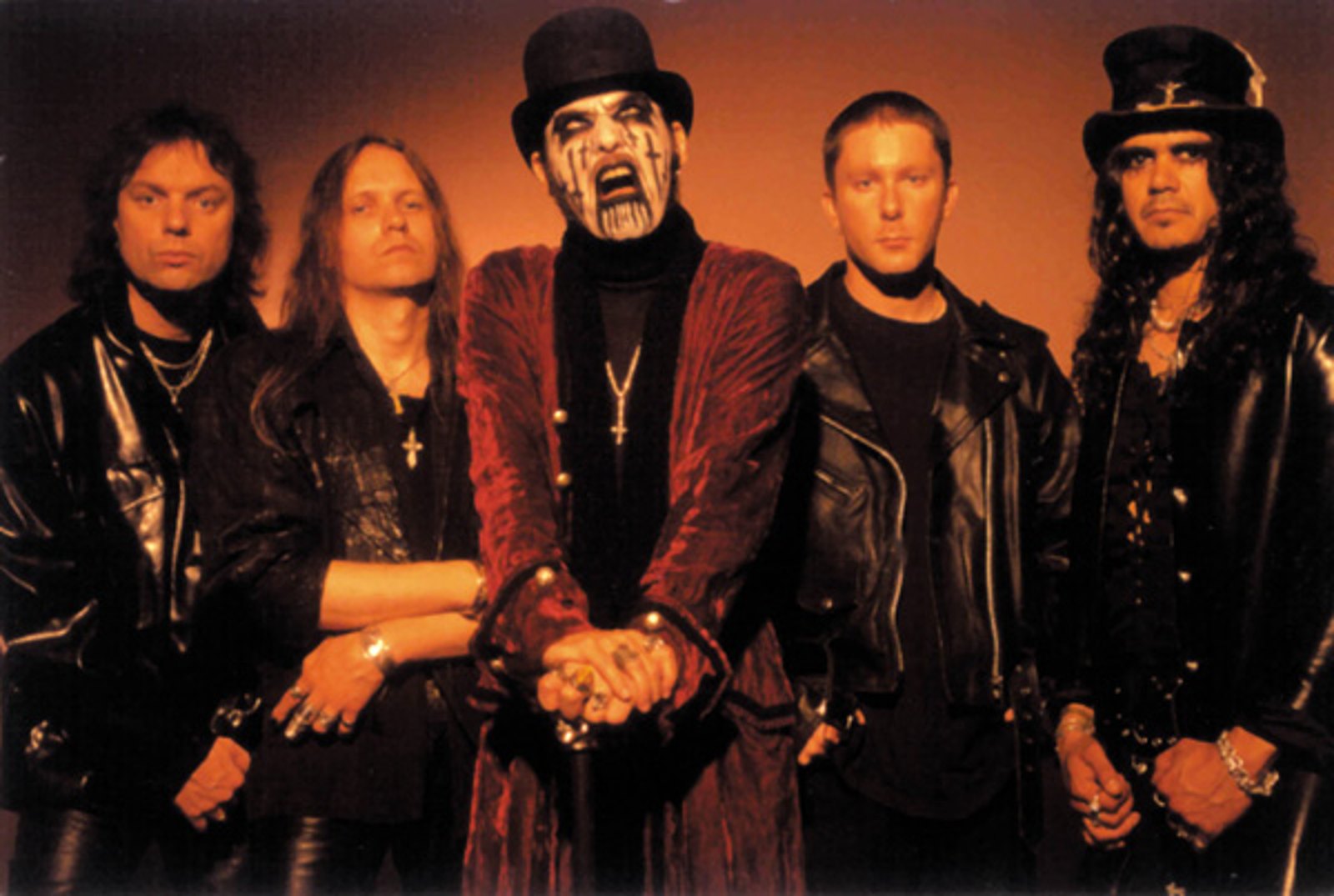
After Des Moines the shock rock heavy metal had borrowed was played for keeps, and the bands met the audience halfway. The Danish singer whose stage, from the Mercyful Fate years onward, presented its occult theatre as belief and not as vaudeville is King Diamond. W.A.S.P. in Los Angeles went the other way, towards blood and raw meat, and it too played the spectacle straight.
The founder climbs back into the can
Harry Houdini's milk can act put him, handcuffed, into a galvanised can filled to the brim with water, the lid clamped down over his head, a curtain drawn round the whole thing and Franz Kukol, his assistant, waiting with an axe to smash the metal open if the stopwatch ran too long, and the audience paid for the minutes it spent picturing him drowning. Shock rock had always worked on that contract. The terror was in the waiting, and the escape was guaranteed.
In 1986 the founder climbed back into the can with a heavy metal band around him. The guitarist who co-wrote Constrictor, released by MCA that year with Kip Winger on bass and "Teenage Frankenstein" sent out as a video, a bodybuilder who played with his sleeves cut off and his riffs tuned to the arena metal of the day, was Kane Roberts, and the Nightmare Returns tour that followed put Alice Cooper back under the guillotine blade every night, the old props updated rather than retired. It was his comeback. It was also a surrender to his heirs.
The return made commercial sense, because the arenas of 1986 were full of bands running his old routines at twice the volume. Twisted Sister had carried the greasepaint out of the Long Island bars, W.A.S.P. had the blood, and a whole generation of American bands had grown up treating his early records as a manual. The heirs owned the stage. The founder rented a place on it.
Raise Your Fist and Yell followed in 1987, darker and heavier, and the Live in the Flesh tour that carried it through Europe in 1988 put the gallows back for the first time since 1972 and drew real complaints, the German authorities forcing cuts to the show and a British MP demanding the whole tour banned, a microphone stand driven through an actor among the new routines that made the case for them. Then Trash in 1989 took the founder back towards the radio. The heirs kept the gallows.
Satire, the last turn

The Richmond, Virginia collective that took the shock line to its logical end, dressing as interplanetary barbarians in latex and foam, was GWAR, formed in 1984 when a punk band called Death Piggy joined a crew of Virginia Commonwealth University art and film students who called their workshop the Slave Pit. Scumdogs of the Universe, picked up by Metal Blade in 1990, set crossover thrash riffs under a show that ended with the front rows hit by a salvo of fake blood from hoses rigged into the costumes. The joke came back. This time everybody was in on it, including the Grammy committee, which nominated the long form video Phallus in Wonderland for Best Long Form Music Video in 1993, a trophy that went to Annie Lennox instead.
The hoses are still rigged. The stage was one inheritance from the late sixties. The other, longer songs, odd metres and whole sides given over to a single idea, came from the art school end of the same years, and it runs through the progressive rock DNA in heavy metal.
