On 10 September 1988 Billboard printed a new chart, Modern Rock Tracks, compiled from the playlists of college and alternative stations, and the first record to reach number one on it was "Peek-a-Boo" by Siouxsie and the Banshees. No hair metal band ever topped it. Somebody had started keeping a second score three years before Nevermind.
The suspect named first in every argument about what killed hair metal, a trio from Aberdeen, Washington whose second album was made in the spring of 1991 for a budget of about sixty five thousand dollars, is Nirvana, and the case against it rests on one video, in which a single four chord riff tore the sequins off every other clip in MTV's rotation inside a month. It is a strong case. It is not the whole one.
Title fights are not always lost on the night the champion goes down. Three judges at ringside score every round, ten points to the winner and nine or fewer to the loser, and a champion who has been out-jabbed, out-worked and opened up over both eyes for eight rounds can be losing on all three cards long before the punch the photographers catch, the one that only finishes what the scoring had already settled. Nevermind was that punch. The cards had been filling since 1988.
The rise, the sales and the spectacle of the Sunset Strip are all in chapter three. The losses came earlier and from more directions than the usual story allows, and two of them came from inside metal itself.
What killed hair metal first: a pipeline built for somebody else
By the end of the eighties the record business had built a second road for guitar music, and none of it was paved for hairspray. MTV had been running 120 Minutes, a late Sunday night programme of alternative videos, since 1986, the college stations had their own chart in Billboard from 1988, and the major labels had begun signing bands off the independent circuit, Soundgarden to A&M in 1988, the first grunge band to reach a major label.
The travelling festival that Perry Farrell put together as a farewell tour for his own band, Jane's Addiction, set out on 18 July 1991 under the name Lollapalooza, with Ice-T, Living Colour and Nine Inch Nails on the bill and not one band from the Strip. Jane's Addiction was itself a Los Angeles club band that had come up a few miles from Sunset Boulevard wearing none of the Strip's uniform. The tour sold out amphitheatres across America two months before Nevermind reached the shops. The pipeline was built. The water was already running.
The race is not to the swift, nor the battle to the strong.
Ecclesiastes 9:11, King James Bible
The metal fans went heavier
The loudest defection came from the metal audience, and it went the other way from Seattle. The producer who had given Mötley Crüe the only number one album of its career in 1989 was Bob Rock, and the band that hired him next, and spent the best part of a year in a Los Angeles studio with him, was Metallica. The sessions ran from October 1990 to June 1991.
Released by Elektra on 12 August 1991, the album the band called simply Metallica went to number one in America for four weeks, and "Enter Sandman" rolled in on a riff that turned over like a lorry diesel on a frozen morning, slow, certain and far too heavy to argue with, a single that sat on the same MTV playlists as the ballads and made every one of them sound thin. The single climbed to number 16 on the Hot 100. The fans who had bought Warrant for the guitars now had somewhere heavier to spend the money.
The same thing happened in Texas. Cowboys from Hell, released by Atco on 24 July 1990, set Dimebag Darrell's riffs on a groove that ran over the pop metal chorus like a road roller over a picket fence, and Pantera, a band that had worn the spandex itself earlier in the decade, took the heavier half of the Strip's audience with it. The fans had not stopped liking guitars. They had stopped liking the clothes.
The killers had worn the costume
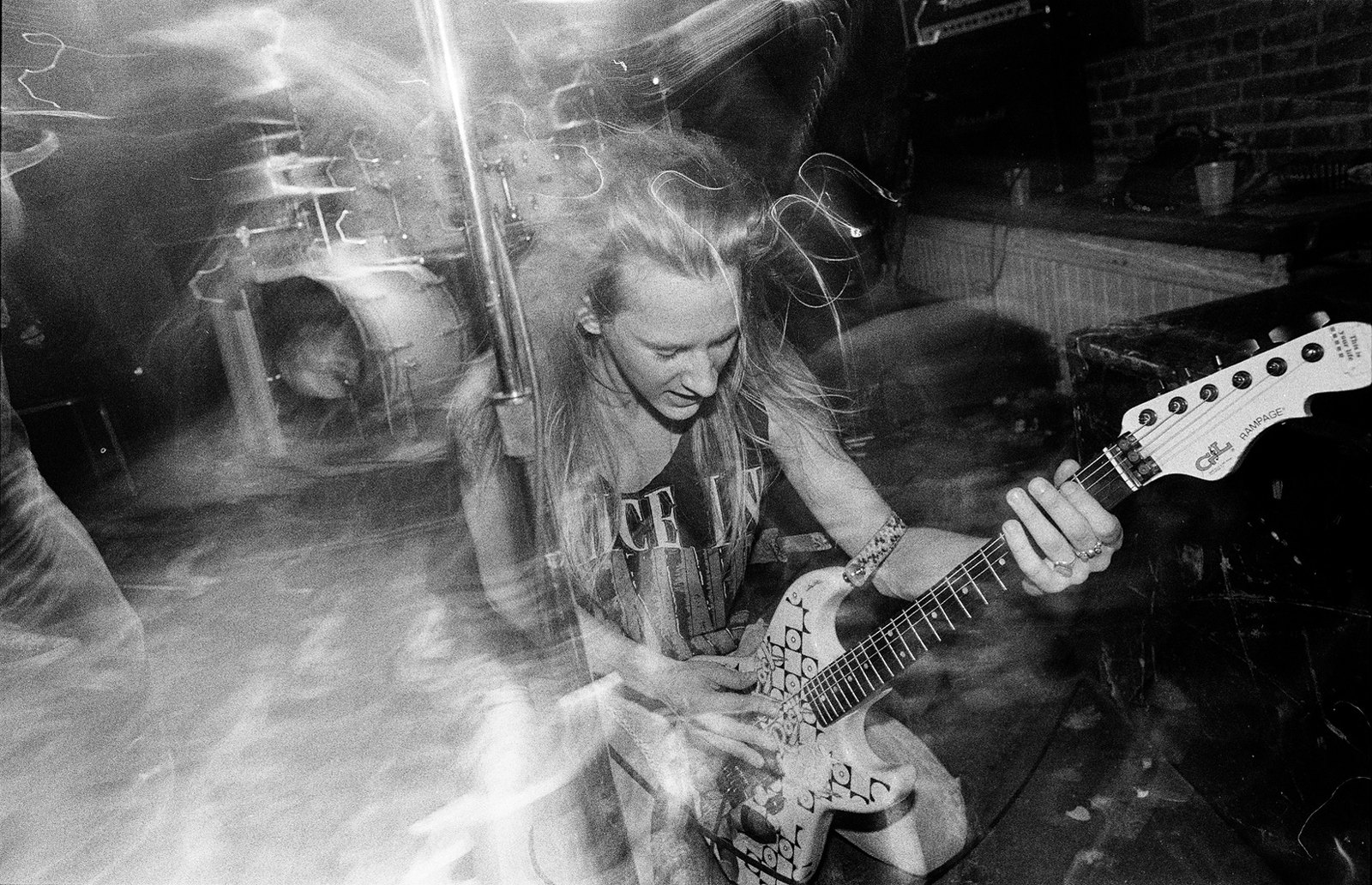
The Seattle singer who had fronted a glam band called Sleze in the middle of the decade, hairspray and all, was Layne Staley, and the band he formed with the guitarist Jerry Cantrell, who came out of a glam outfit of his own, Diamond Lie, answered to the name Alice in Chains. The executioners had served their apprenticeship in the condemned man's clothes.
The executioners had served their apprenticeship in the condemned man's clothes.

Facelift, released by Columbia in August 1990, sold slowly for months, a record by a band from a city the Strip had never thought about, on a label that had signed it before anybody knew there was a scene to sign from.
Then, in 1991, MTV put the video for "Man in the Box" into heavy rotation, Staley's voice wrapped around a talk box riff that dragged along the ground like a chain behind a tow truck, and by 11 September 1991 the album had gone gold, the first grunge record to do so, ten weeks ahead of Nevermind's own gold certification that November. The Strip's audience had already met Seattle. It had met it on the Strip's own channel.
Nevermind, and the change of clothes
The Strip itself was still standing that autumn, which is the strongest evidence against the idea of a single killer. The Los Angeles five who put out two albums on the same day, 17 September 1991, and took the top two places on the Billboard 200 with them the following month were Guns N' Roses, and they were the one band from those clubs that had always dressed down. What survived was the band without the costume.
| Date | Event | What it took away |
|---|---|---|
| Sept 1988 | Billboard starts its Modern Rock Tracks chart | The monopoly on guitar radio |
| July 1990 | Pantera release Cowboys from Hell | The heavier half of the audience |
| Aug 1990 | Alice in Chains release Facelift | MTV's rock rotation |
| July 1991 | The first Lollapalooza tour sets out | The summer amphitheatres |
| Aug 1991 | Metallica release Metallica | The metal fans and the Strip's producer |
| Sept 1991 | Nirvana release Nevermind | Everything that was left |
By the time Nevermind arrived in September 1991 the ground had been cleared. The labels had a pipeline for the new bands, the metal fans had Metallica and Pantera, and MTV had spent a year learning that Seattle sold. One single did the rest, and the story tells it as if it had done the whole.
The apostasy came from the survivors themselves, who spent the next five years changing their clothes. The guitarist hired to replace C.C. DeVille in Poison, a young player with a bluesman's hands, was Richie Kotzen, who had cut instrumental records for the Shrapnel label before he was twenty, and on Native Tongue, released by Capitol on 8 February 1993, he took the band toward horns and a gospel choir.
"Stand", the first single, is a better song than most of what made Poison famous, a choir swelling under Bret Michaels as the band walks away from the party, and the album still sold a fraction of what Open Up and Say... Ahh! had sold five years before. Native Tongue peaked at number 16 and went gold; Open Up and Say... Ahh! had reached number two and gone five times platinum. Def Leppard tried the same on Slang in 1996, recorded in Marbella and in Dublin with Rick Allen playing a partly acoustic kit again, darker and looser than anything the band had made. It peaked at number 14 in America, short of the top ten. Mötley Crüe changed singers altogether. None of it brought the old audience back.
So what killed hair metal? A second chart and a festival built without it, a Metallica record made by the Strip's favourite producer, a Texas band that had changed out of its own spandex, a Seattle singer who had worn it first, an audience that had come to treat the costume as anathema, and then Nevermind. The attrition did the damage. The single took the credit.
Whether anything that could be stripped off so quickly was ever a genre of its own, or only a look laid over one, is the real question behind what is hair metal. The bands that played well without the costume, and there were some, needed no answer.