
Hair metal is hard rock that went through a television set and came out the other side a different colour. The Hollywood quintet whose second album, released by Atlantic in 1985 with Beau Hill producing, put a centrefold on the sleeve, a locking tremolo on every guitar and a chorus shouted by the whole band on every single was Ratt, and that one record answers the question of what is hair metal better than any photograph of anybody's fringe.
The hair is the least of the evidence. Hairspray rinsed out in any hotel shower, while everything else that made the style was bolted into the guitars, burned onto two inch tape and hammered into the running order of the songs, and all of it can still be heard with the picture switched off. Four kinds of evidence settle the case. The haircut only confirms it.
A titration settles an argument of this kind without raising its voice. Clear alkali runs from a burette into a flask of acid, one drop at a time over a little phenolphthalein, and for most of the run nothing happens at all, until a single drop throws the whole flask pink from wall to wall and the chemist reads the answer off the glass to a tenth of a millilitre. Hard rock was the acid. The video decade supplied the drops, and hair metal is the name for the moment the colour turned.
What is hair metal? Start with the guitar
The instrument changed first. Patented by Floyd D. Rose in 1979, the locking tremolo clamped the strings at the nut and again at the bridge, so that a player could wrench the bar down until the strings hung slack and the note dropped through the floor, then let it spring back in tune. By the middle of the eighties it was screwed into nearly every pointed, gleaming guitar that Kramer and Jackson could build.
The Pasadena guitarist who had shown every club on the Strip what that bar could do, by common consent the most imitated player of the decade and a Kramer endorser since June 1982, was Eddie Van Halen, yet his own band played hard rock with a swing in its hips and never needed the hairspray to sell it. His imitators needed both. The dive bomb, a note hauled down until it growls and then let back up, became the style's signature noise.
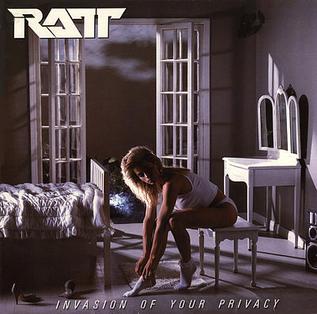
Released by Atlantic on the thirtieth of May 1985, Invasion of Your Privacy carries the evidence in its purest form, with Warren DeMartini and Robbin Crosby on locking tremolos, a Playboy Playmate of the Year, Marianne Gravatte, on the sleeve and songs that rarely run much past four minutes. The RIAA certified it double platinum in America. Nobody bought it for the lyrics.
"Lay It Down", the lead single, is a hard rock riff with the blues scraped out of its joints, a chorus sung by five men at once and a solo in which DeMartini spends his last bars diving on the bar and climbing back out. Take away the video and the guitar still tells you the year. That is evidence of the first kind.
The mixing desk: the band boiled down
The second kind is the sound of the studio. The South African producer who spent January to November 1982 building Def Leppard's choruses out of the band's own voices, recorded over and over and stacked until five men from Sheffield sounded like a stadium singing along, was Robert John "Mutt" Lange, and Pyromania, released by Mercury in January 1983, set the standard every Strip band's label would pay to copy.
"Rock of Ages" opens on a nonsense count-in that is Mutt Lange's own voice, recorded because he had grown tired of counting the band in the ordinary way, and then the stacked chorus comes down over a snare drum cut off so hard that it lands like a slammed boot lid. The riff is simple. The voices are the size of the building.
Behind the other bands stood men from the same school. The American producer whose name went on Mötley Crüe's Shout at the Devil, Twisted Sister's Stay Hungry and Poison's Open Up and Say... Ahh! was Tom Werman, while Beau Hill took Ratt, Winger and Warrant through their first albums. They worked a band the way a chemist works a mixture through a Liebig condenser. The whole brew was boiled until the light, bright fraction climbed the column and ran down the cold glass into the receiving flask, while the heavy, cloudy residue that made the band sound like itself was left behind to scorch on the bottom of the boiling flask.
The heavy, cloudy residue that made the band sound like itself was left behind to scorch on the bottom of the boiling flask.
The residue was often the best part. Bands that played the clubs as a rough, loud bar act came back from those sessions sounding clean enough for daytime radio, and some of them never sounded like themselves again.
The song, the words and the calendar
The third kind of evidence is the shape of the song. A hair metal single puts its title in the chorus, the chorus inside the first minute, a guitar solo of eight or sixteen bars after the second chorus, and, a track or two later on the same album, the slow song the label will release when the fast one has peaked. The riff exists to carry the chorus. In the older heavy metal it was the other way round.
The fourth kind is the words, and they stay at ground level. Where the British bands of 1980 climbed into war, myth and the occult, the Strip wrote about the party, the girl, the road and, with striking regularity, about rock itself, until a chorus about rocking was the most dependable anthem the style owned. The Maryland five who worked the bars of the East Coast for a decade before a ballad about someone on the other end of a phone call after a bottle of pills took them to number eleven on the Hot 100 in 1989 answered to Kix. It was the exception that proved the rule.
| Evidence | The mark | Where it came from | A record that shows it |
|---|---|---|---|
| The guitar | Locking tremolo, pointed body, the dive bomb | Eddie Van Halen and the Kramer and Jackson workshops | Ratt, Invasion of Your Privacy (1985) |
| The studio | Stacked choruses, a short hard snare | Mutt Lange's sessions with Def Leppard | Def Leppard, Pyromania (1983) |
| The song | Chorus in the first minute, a ballad as a single | British glam rock singles of the seventies | Quiet Riot, Metal Health (1983) |
| The words | The party, the girl, the road | Kiss and the American stadium rock of the seventies | Mötley Crüe, Girls, Girls, Girls (1987) |
| The hair | Backcombed, sprayed, often dyed | British glam and Hanoi Rocks | Poison, Look What the Cat Dragged In (1986) |
The calendar closes the case. Every record in that table falls between Metal Health reaching number one in America in November 1983 and the autumn of 1991, and a band playing the same songs in 1978 or in 1995 would have been filed as hard rock without a second thought.
The hair, last of all
Only then the hair. Backcombed until it stood a hand's breadth off the scalp and fixed with Aqua Net, the cheapest can on the supermarket shelf, it was the part of the spectacle a camera could see from the back of a hall, and its lineage runs from British glam rock through the Finnish thrift shop look to the Sunset Strip, all of it chronicled in the decade metal went glam. It was the loudest evidence. It was also the easiest to remove.
The test works on any band, including the ones that spent years denying they ever took it. The Arlington quartet that made four records in spandex for its own family label in the eighties and then disowned all four for the rest of its career was Pantera, and the case for and against those four records is weighed in was Pantera a glam metal band. The haircut went first. The riffs changed after.
So hair metal is not a separate music with a riff of its own, the way thrash or doom has one. It is hard rock finished for the camera: a guitar built for the dive, a chorus stacked in the studio, a single cut to three and a half minutes, words kept at the party and a head of hair to sell the lot. Strip the finish off and what stands underneath is the same hard rock that runs through the long road of heavy metal. Some of it was very good hard rock. Most of it was only well finished.