
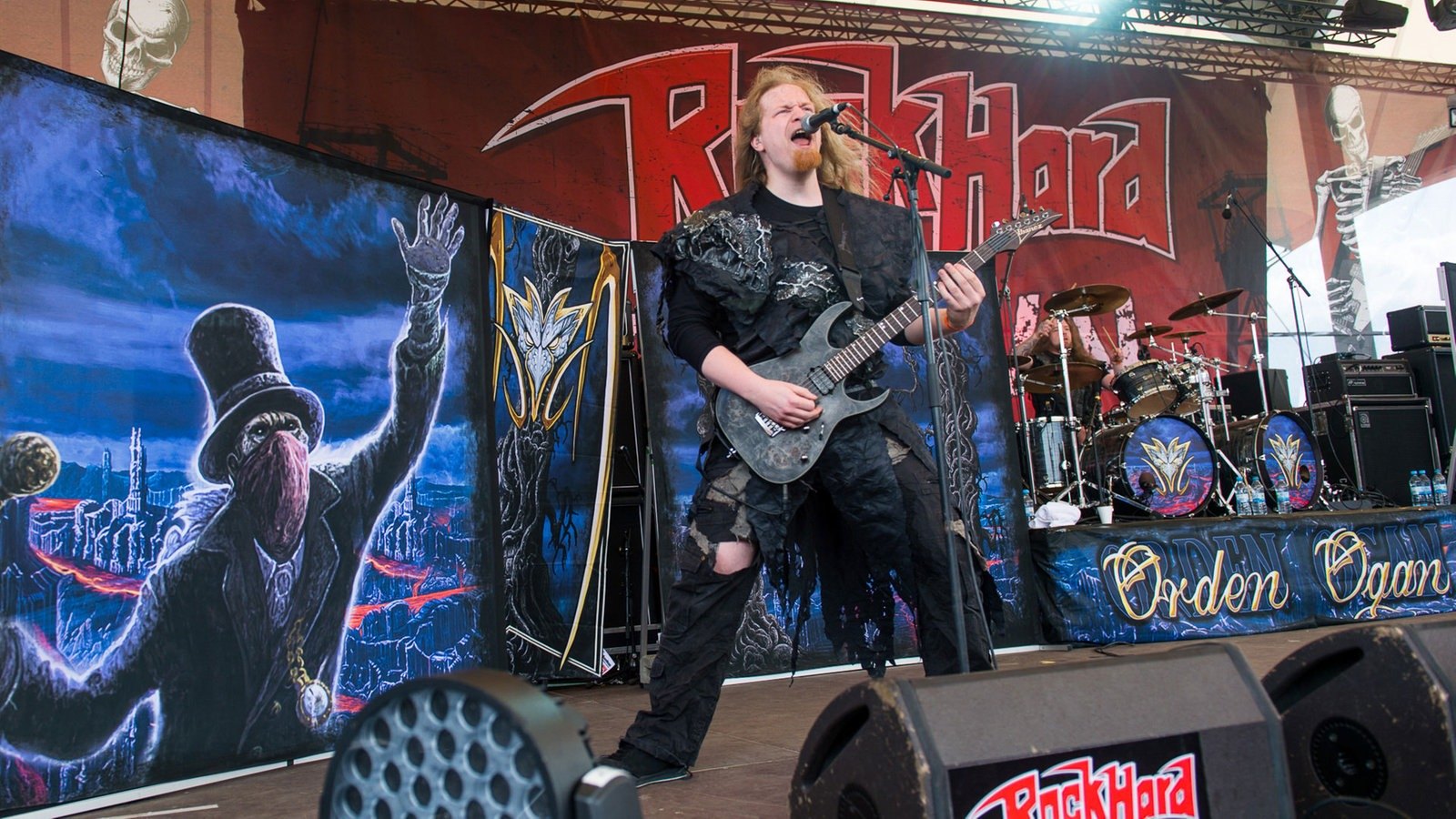
"Nuclear Blast has the most prestigious roster of hard rock and metal artists in the world." That is Thorsten Freese of Believe, the French distribution company, quoted by Music Business Worldwide on 10 October 2018, the day Believe announced it had taken a majority of the label for what the trade put at an eight figure sum. Prestige was not the thing that changed hands.
Founded in Donzdorf in 1987, with a vinyl compilation of American hardcore bands called Senseless Death for a first release, the German firm that sold control of itself thirty one years later to a French buyer was Nuclear Blast, and what the buyer took delivery of was a mail order house grown into a label, with offices in Germany, Britain and America.
Read as a trade rather than as a scene, the power metal labels are a short list of small companies that signed the bands, lived off a back catalogue and were eventually sold to somebody larger. Four questions settle it: who signed the music, what one named contract covered, who owns the recordings now, and which of these companies still trades under its own name.
A colliery band does not own its cornets. The company bought them and had its initials cut into the bells, so when a brewery buys the works the instruments cross with it, counted into the sale at valuation alongside the lamps and the lockers. A signwriter then chisels the old owner's name off the brass plate on the door and letters his own over the lid of every case. The following Sunday the same twenty five men play the same marches, note for note, in the same park. Nothing in the music moved. The lettering did.
That mechanism has run four times over on the biggest German firms alone. The six years in which those firms underwrote this music while nobody else would are the business of chapter four. What became of the firms afterwards is a separate ledger.
What one contract with a power metal label actually said
Terms first, because little in the legend survives contact with them. The Gothenburg side project that a German label approached in early 1997 with a European release deal covering four albums was HammerFall, and the narrowness of that word Europe is the point, because a deal for Europe left the rest of the map to other conversations.
A covenant of four albums and one continent is a narrow thing. A maker engaged to build four instruments for the shops of a single country has sold a count and a border and nothing else, and the order says nothing about the rest of the world, which waits on another conversation with another dealer.
The deal ran long enough for a third record to arrive. Renegade came out on 9 October 2000, entered the Swedish chart at number one and went gold on a reported forty thousand copies.
The opposite case is on the record too, and it is uglier. The Swedish band that delivered a finished debut to an Italian label in 2002 was Sabaton, and its bassist Pär Sundström remembers excuses piling up behind a release date until the label's last word was that heavy metal was dead. Metalizer reached the shops only on 16 March 2007 through Black Lodge, with two other albums already out ahead of it. A record can be finished, delivered and still left waiting.
The catalogue is the asset, and it outlives the firm
Nothing shows that better than the oldest of these companies. Noise Records traded on its own until 2001, when its founder sold it to the English Sanctuary Records Group, and the imprint went dark when Sanctuary went to Universal in 2007, until BMG, which had bought Sanctuary in 2013, threw the switch in 2016 and brought the name back as a reissue operation.

The reissue campaign is exactly what it looks like: two discs of Helloween from the Noise years, issued on 6 May 2016 as part of the campaign BMG opened that month. The tapes had changed hands three times in fifteen years, a new stamp on the ingot at every sale and the metal inside left exactly as it was.
Myth has a figure for a holding like that. The piper who lost the contest to Apollo was Marsyas, and he was flayed for losing it, his skin left hanging from a pine where the wind often filled it out as though he had struck up again. Nothing was ever added to that skin. A pine can keep a skin swelling. It cannot commission a second piper.
The firms kept dying. The catalogue never did.
Which is why who owns a power metal label's catalogue has a different answer from who runs the label, and why publishing has to be counted again separately. The New York publisher that carried off the whole publishing side of Century Media on 7 June 2017, three imprints and the songwriter contracts behind them, was Reservoir. Sony had taken the label two years earlier without the publishing, so one company's songs and its recordings now sat under two roofs, like a theorbo sawn through at the neck joint, the body in one house and the long neck with its pegs in another, each half priced by a different dealer and neither able to sound a note alone.
The power metal labels that got bought
By the middle of the last decade the power metal labels had become acquisition targets rather than acquirers. The Dortmund firm that Robert Kampf and Oliver Withöft started in 1988 was Century Media, and Sony Music bought it in 2015 with Kampf staying on to run it, for twelve million pounds, about seventeen million dollars at the time, a sum that surfaced later in filed British accounts. The Helsinki company that Riku Pääkkönen founded in 1990 had gone the same way earlier still, since Universal took Spinefarm in 2002.
What a founder sells and what a founder keeps is an older story than any German company. Hermes scooped a tortoise out of its shell to build the first lyre, strung the emptied shell with gut and then handed the finished instrument across to Apollo for a herd of cattle, which is the better bargain only until the cattle have been eaten. Every picture painted afterwards puts the lyre in the buyer's hands. The herd is in nobody's.
The consequence shows up on the roster lists rather than in the music. Nightwish and Sonata Arctica made their first records for Spinefarm before Universal bought it, Nocturnal Rites and Iced Earth made albums for Century Media before Sony did, and the owners changed above all four while the names on the sleeves stayed put.
| Label | Founded | Where the catalogue sits now |
|---|---|---|
| Noise Records | 1983 | BMG, reactivated as a reissue imprint in 2016 |
| SPV and Steamhammer | 1984 | Napalm Records, bought outright in November 2020 |
| Nuclear Blast | 1987 | Believe, majority stake since October 2018 |
| Century Media | 1988 | Sony Music, since 2015 |
| Spinefarm | 1990 | Universal Music, since 2002 |
| Napalm Records | 1992 | Independent, Eisenerz |
| Limb Music | 1997 | Still trading, Hamburg |
| Atomic Fire | 2021 | Reigning Phoenix Music, absorbed in January 2024 |
Who is still standing, and who bought the wreckage
Insolvency was never hypothetical in this trade. The Hanover distributor trading since the first day of 1984, whose metal imprint Steamhammer released Kamelot, was SPV, and on 25 May 2009 its founder Manfred Schütz filed for insolvency protection, the district court putting the lawyer Manuel Sack over the company as provisional administrator two days later. The firm that stood up again in November under Sack was a slimmed SPV, with its biggest acts and part of its catalogue opened to Sony Music for exploitation in Germany, Austria and Switzerland.

Ghost Opera reached German shops on 1 June 2007 and charted from Norway to Japan, none of which told a buyer anything about the health of the firm that pressed it.
The singer whom his own hired crew meant to rob on the crossing to Corinth was Arion, and he sang one last number in full performing dress, went over the rail with his kithara rather than leave it to the men holding the blades, and came ashore on a dolphin's back ahead of the ship. The ship docked second. The song was already standing on the quay.
Then the Austrians bought the Germans. The one firm on this list with no parent above it, opened in 1992 by Markus Riedler in the Styrian iron town of Eisenerz, is Napalm Records, and in November 2020 it acquired SPV outright, taking the Hanover catalogue and the Steamhammer imprint with it. Powerwolf, Alestorm and Gloryhammer record for it. The band that had signed the four album deal nineteen years before was HammerFall, which joined in March 2016 and went back to Nuclear Blast at the turn of 2023.
The smaller redoubts tell the same story at a smaller scale. The Hamburg house that R. Limb Schnoor opened in 1997 with Legendary Tales, the debut of the Italian band Rhapsody of Fire, then called Rhapsody, was Limb Music. The house of Edguy and Iron Savior, and from 2013 of that same Italian band, is AFM Records, part of Soulfood since 2010.
What the last few years added was a new kind of company, built out of people who had left the old ones. The man who sold the majority of Nuclear Blast in 2018 was Markus Staiger, and the label he started in 2021 was Atomic Fire, swallowed whole inside three years. The younger company that did the swallowing was Reigning Phoenix Music, launched on 18 July 2023 by Gerardo Martinez, formerly general manager of Nuclear Blast America, and the avionics entrepreneur Sven Bogner, which took the Atomic Fire roster into its own in January 2024 and signed Helloween that February.
One line of continuity runs under all of it, and it belongs to the players. Whoever held the masters, these records went on carrying long solos into a market that had stopped asking for them, which is the argument of how power metal kept eighties lead guitar alive.
The latest turn is also the loudest. The Swedish band that left Nuclear Blast after fifteen years was Sabaton, whose "Templars" of 25 April 2025 was the first music under a new contract with the American company Better Noise Music, a move Joakim Brodén traced to what had changed at Nuclear Blast once Believe bought it.
So the plain answer is that a handful of small companies signed this music, and that nearly every one of them has since been valued, sold, wound up or rebuilt by people who were nowhere near the room when the records were made. The playing is unarguably the bands' own. Who holds the masters was settled in boardrooms, by whoever bought the firm last, and no listener was ever asked.
