The best hair metal albums are the ones that go on working after the singles stop. Everything else about the style was built to be judged from outside, by a camera, a radio programmer and a release schedule that sent the fast song out in spring and the slow one out at Christmas, so the one test the decade could not rig is the test nobody designed for. Play track seven. The record has something there or it has a photograph.
A parachute is packed on a table forty feet long. The man packing it walks the whole length of the thing under a hard light, hauling the fabric flat, running every line out to its full stretch and checking each panel against the next, because a pack that looks right in the bag is a pack nobody has opened, and the opening shock tears a weak panel clean out of its tapes three seconds after that stops mattering. A single is the bag. The album is the table.
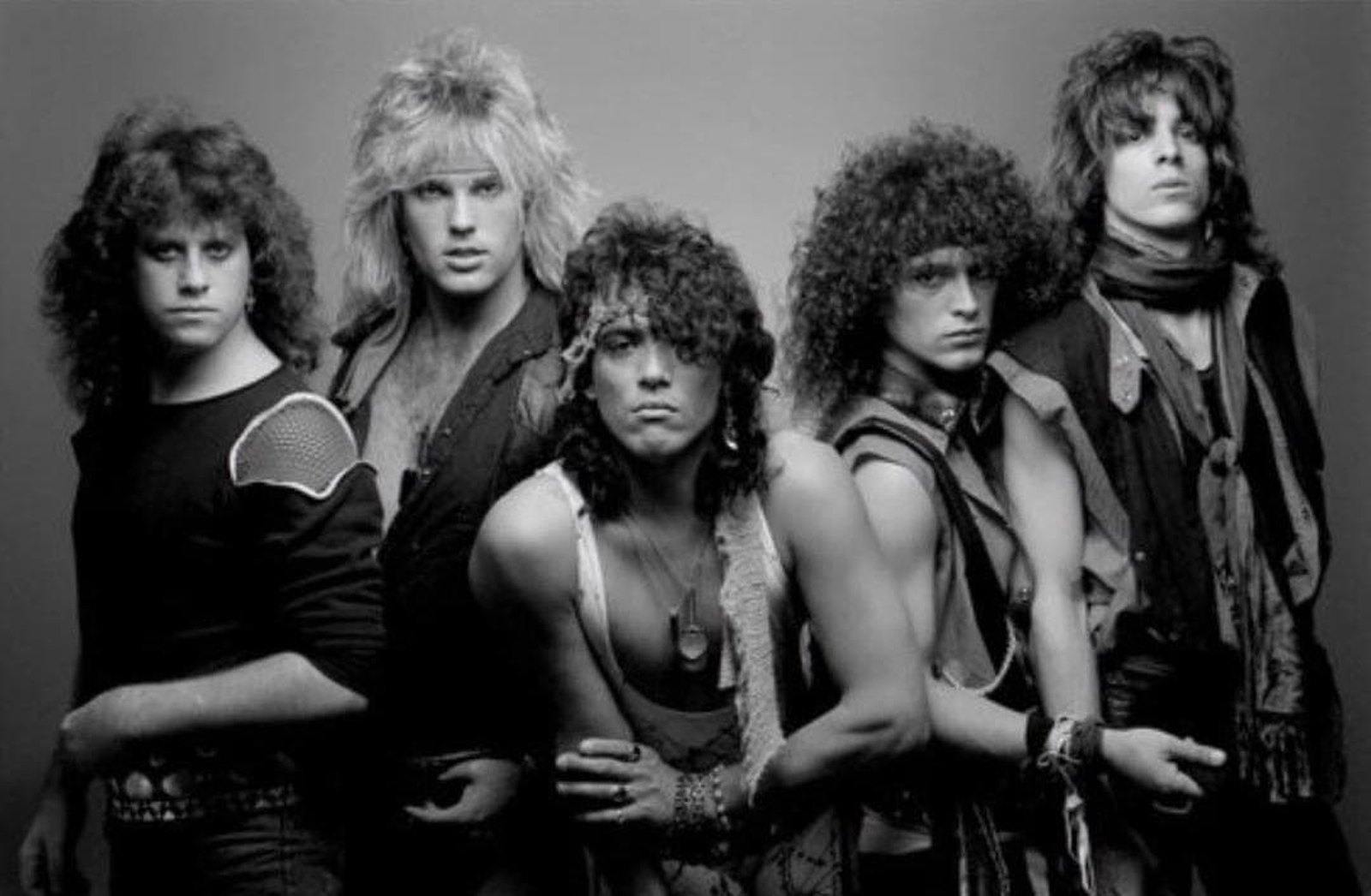
That shape was a specification, not an accident. The Hollywood quintet whose debut sold in millions on one unavoidable single was Ratt, and Out of the Cellar, eventually certified triple platinum by the RIAA, is the drawing the industry then ordered from by the dozen: a face, two choruses, a ballad held in reserve and the remaining running time bought as packing. Records were commissioned to that drawing. Most of them were delivered exactly to it.
The best hair metal albums begin where the singles stop
A dog shown in the breed ring is judged on its coat, its gait across ten yards of grass and the set of its ears, and it can take every rosette on the table without once being asked to move a single sheep. The trials field asks the other question. An album is the trials field, and the singles chart of the late eighties was one long breed ring, gleaming under its own lights and measuring the wrong animal.
Applied honestly the test thins the shelf fast. Records that sold three million copies turn out to be two songs and nine pieces of packing straw, while records that nobody advertised turn out to be sequenced, paced and finished. Where the whole decade sits in the longer story is where it sits in the story. What survives is a much shorter list than the sales figures suggest.
The failures fail in the same three places every time. The slow song sits at track four or track eight because that is where a label wanted it rather than where the record needed it, two or three songs carry a writing credit belonging to nobody in the band, and the running order collapses in the middle into interchangeable mid-tempo material that exists to bring the total up to ten. Read the sleeve before the review. The credits give the whole game away.
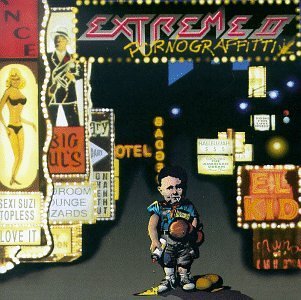
The Boston four who bolted a funk bass line to a metal riff and still put a number one ballad on the same record were Extreme, and Pornograffitti, produced by Michael Wagener for A&M in August 1990, is the clearest proof the style could carry a whole side: "Get the Funk Out" drives on a horn stab and a sixteenth-note guitar figure that Nuno Bettencourt never repeats anywhere else on the record. The album sold on an acoustic ballad, "More Than Words," that climbed to number one while "Hole Hearted" stalled four places short of the same peak. Nothing else on it sounds remotely like that song.
Four records the chart never learned to read
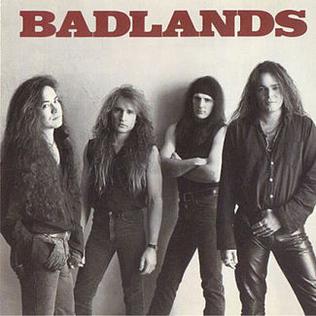
The four men who turned up on Atlantic in May 1989 with a blues record in the year of the biggest hairspray budgets were Badlands, and their self-titled debut, produced by Paul O'Neill with a guitarist fresh from Ozzy Osbourne's band and a singer who had fronted Black Sabbath on tour, spends its whole length dragging the decade's studio gloss off the desk and playing through a valve amplifier instead. It was not a hit. It is the finest exponent of what the style could have been.
The evidence is in the tracks nobody released. "Winter's Call" opens on a clean figure and builds for four minutes without a chorus doing the pulling, "Rumblin' Train" is a shuffle played by a rhythm section with nothing to prove, and the guitar tone across the whole record is one amplifier in one room rather than four stacked takes. Nothing here was written for a screen. That is exactly why it disappeared.
Ray Gillen died on 1 December 1993, aged thirty-four.
The Los Angeles quartet that made the last genuinely strange record the Strip produced answered to Love/Hate, and Blackout in the Red Room, put out by Columbia in February 1990 under producers Tom Werman and David Kahne, runs on a bass tone thick enough to chew and a singer who yelps, stutters and talks his way through songs that refuse to resolve where the format says they should. Nobody wrote a ballad for it. The album has been passed hand to hand ever since by people who were told it did not exist.
Records that sold three million copies turn out to be two songs and nine pieces of packing straw, while records nobody advertised turn out to be sequenced, paced and finished.
The Austin five whose singer Jason McMaster had come out of the progressive thrash band Watchtower and sang like a man arguing with a fairground barker went out as Dangerous Toys, and their self-titled debut, cut for Columbia with producer Max Norman in 1989, swings where its neighbours march, "Teas'n, Pleas'n" riding a dirty Texas shuffle that no Los Angeles band of the year could have played straight. The record went gold in America in 1994, five years after release and long after anyone was still calling it new.
The fourth is the one filed here by clerical error. The band from Blue Island, a Chicago suburb, that hid a Beatles record under the backcombing called itself Enuff Z'Nuff, and Strength, released on Atco in March 1991 and produced by Paul Lani with the band's own Donnie Vie and Chip Z'Nuff, is a pop album wearing the wrong coat to the wrong party. There is no filler anywhere on it. The lineage runs back through sixties songwriting, not through the Strip.
The famous ones under the same rule
The big sellers do not all fail the test, and pretending they do is its own kind of laziness. Shout at the Devil, produced by Tom Werman for Mötley Crüe on Elektra in September 1983, holds its second side as well as its first, and Def Leppard's Pyromania, engineered by Robert "Mutt" Lange that same January, was built to a standard nothing on the Strip could approach for another four years. Both were built as albums. Both still play as albums.
Two of the decade's biggest sellers fail it politely. Slippery When Wet, which Bon Jovi rode to the top of the American album chart for eight weeks in 1986 on two songs co-written with Desmond Child, and Whitesnake's self-titled record, which stalled at number two behind U2's The Joshua Tree in 1987, are both faultless for four songs and then thin out into material that exists because a contract said ten. Neither is a bad record. Neither is a whole one.
That record is the awkward one. Made in the same clubs, by a band photographed in the same hairspray, Appetite for Destruction refuses every finish the style applied, keeps the guitars dry and unstacked and runs twelve songs without a single one aimed at a programme director. It is the argument that the costume was never the music. The records that matter across the whole genre, measured against everything and not only against their own decade, are weighed in the records that matter.
Two more pass without difficulty and have already been argued elsewhere on their own terms: Skid Row's Slave to the Grind, which entered the American album chart at number one in June 1991, and Cinderella's Long Cold Winter, where a slide guitar took over a band that had arrived in eyeliner. Neither needs the defence. Both were made by writers rather than by a marketing department.
What is left when the fanfare stops
The failures are not embarrassing because they were popular. They are embarrassing because they were incomplete, delivered to a schedule with the middle of the running order left as ballast, and a listener who buys one today is buying two songs and a receipt. The costume had nothing to do with it, and the clothes themselves are worth their own argument in 80s hair metal fashion. Plenty of bands in spandex could write. Plenty of bands in denim could not.
Eight records hold: Pornograffitti, Badlands, Blackout in the Red Room, the Dangerous Toys debut, Strength, Shout at the Devil, Pyromania and Slave to the Grind, with Appetite for Destruction standing outside the fence it was built next to. Everything else is a single with an album attached. The seventh track settles it every time.