
In 1772, at a summer palace in rural Hungary, an orchestra told its employer it wanted to go home, and not one word of it was written down.
The Kapellmeister who had to get those men home without asking for anything was Joseph Haydn, and he put the request inside the last movement of a symphony in F sharp minor finished that autumn, where the closing adagio takes the players out one at a time, each man snuffing the candle beside him and walking off while the music thins under him. At the end the piece is left to two muted violins and then to nothing. Prince Nikolaus Esterhazy understood it, and the court set off for Eisenstadt the next day, or so Haydn told his biographers decades later. Nothing was printed, nobody spoke, the events arrived in a fixed order, that order could not be mistaken for its reverse, and the man they were aimed at, by Haydn’s own account, acted on them.
That is the standard, and the power metal concept albums spend most of their time walking under it. A concept album makes a structural promise, and the promise is forty minutes, one story, events in an order. The music of this genre is built to do the opposite, because every part of the apparatus exists to come back identical: stack one tenor eight deep over a double kick that never lifts and he buries every other voice on the record under his own throat. The tempo band is narrow, the chorus is riveted to the same four bars by design, and the forty first minute is built to sound like the second.
The Krefeld four who cut eleven short scenes into a Tolkien record in 1998 and hired two actors to narrate between the songs were Blind Guardian, and the credits of Nightfall in Middle-Earth are the most honest document the form has produced. At the point where the sound had to carry events, the band stopped playing and paid somebody to speak.
What has to happen to the sound before a story is in the record
The machinery that carries narrative information in audio is small, and every piece of it can be named. A voice cast as a person. A passage of speech. A short interlude dropped at a joint, where something has just happened. A theme that comes back with something done to it rather than merely played again. A key relationship that still means something forty minutes later. That is the entire kit, and the first three need nothing from a listener but a pair of ears.
Which gives a test anybody can run at home. Take the booklet and the track titles away, play the record to somebody who has never seen either, and ask what happens in it and in what order. Most of these records fail that flat, which makes them song cycles with a story standing next to them rather than records that tell one. A few do not fail it, and they pass with the two or three cheapest devices on the list.
The form reached metal long before this genre had a word for itself, and the question usually put to the concept album in heavy metal runs the other way round, which is whether the songs stand up once the story is pulled out from under them. That is a question about singles. Whether the record ever did the telling is a different question, and a harsher one.
Where the power metal concept albums keep the story
Hand four hundred people one printed line at the door telling them that the next twenty minutes are a wreck at sea, and after that nothing in the piece gets a word in edgeways. The storm turns up in bars that would otherwise have been a fast tune. The drowning is identified in a passage of plain accompaniment under a held note. The one page that argues with the story is trampled through as weather. Take the printed line off those people and the same twenty minutes say nothing whatever about a ship, and that is the condition in which most of this shelf gets heard.
Which is why the defenders of these records always reach for the sleeve. Take the two albums the form in this genre was begotten by, Helloween's pair of 1987 and 1988: eight tracks and thirty six minutes fifty eight on the first of them, bookended by "Initiation" at one minute twenty and "Follow the Sign" at one minute forty six, a title, a recurring phrase and a keeper who turns up in more than one song. No narrator sets anything up. No second lead voice arrives. Not one event on either record can be placed in time by ear, and what holds them together is a keeper laid over songs that stand on their own, which is how Michael Weikath described it in 2010.
What all this material is about, from dragons, battles and faith to the saints and the star atlas, is a separate question and a generously furnished one. The question on this shelf is narrower. Not what the story is. Whether the sound has it.
Two records that hire somebody to do the telling

Twenty two tracks across sixty five minutes twenty nine, and eleven of them run under two minutes. Ten of those eleven carry words and are the whole narrative apparatus of the record, the eleventh being "Lammoth", twenty eight seconds of a scream, and the two names that make it work are Norman Eshley and Douglas Fielding, credited for narration beside the singer and the three players. A listener who has never opened the sleeve can follow that album, and the reason is that it is explained to him out loud.
The method shows at one joint in particular. "Battle of Sudden Flame" runs forty four seconds and is a scene, not a song; "Time Stands Still (At the Iron Hill)" then runs four minutes fifty three and is a song, with a chorus and a tempo of its own. Take the eleven scenes out and what is left is eleven songs, and it was the scenes that said what happened between them.
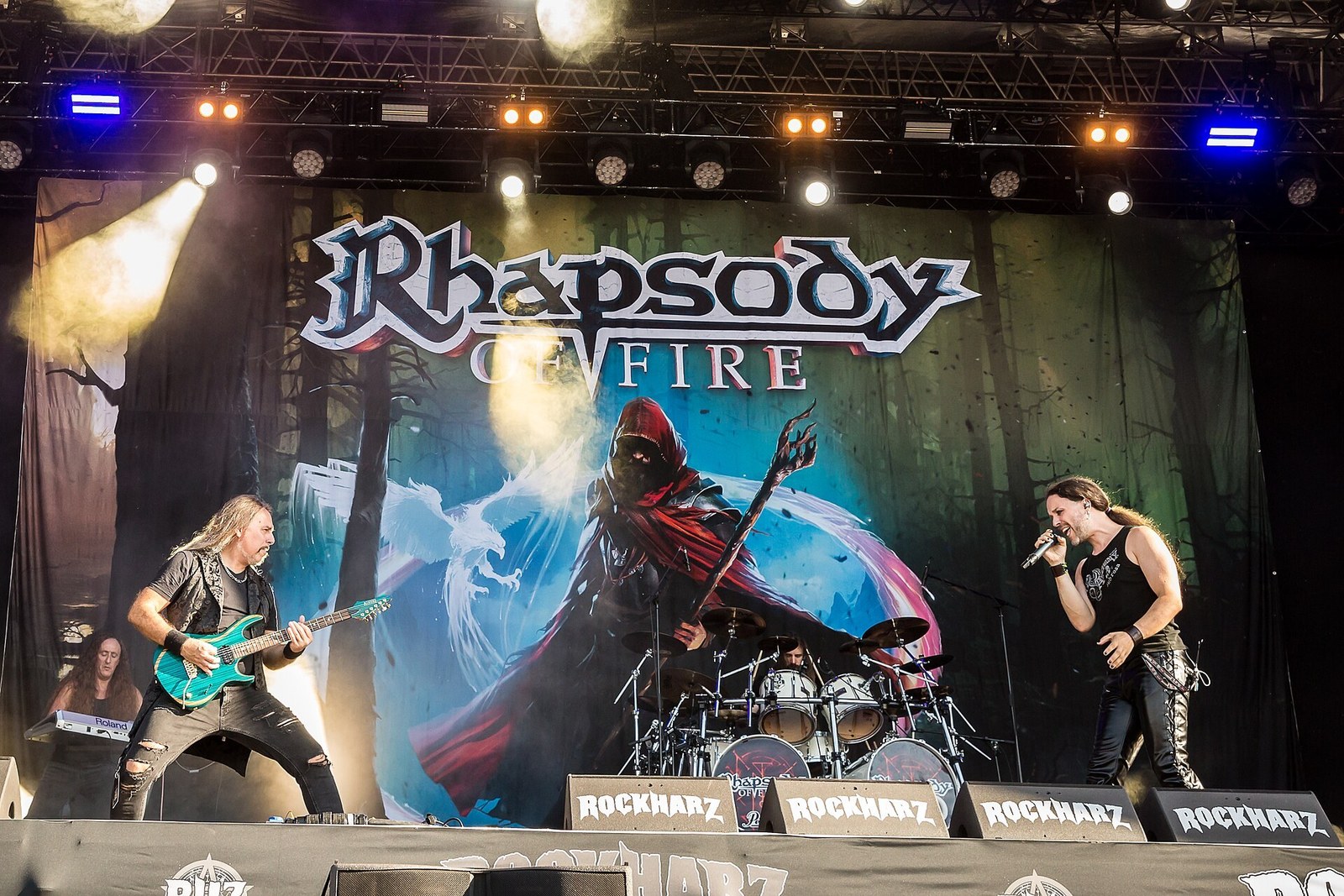
The Italians who went further and hired a film actor for the same job carried the shorter name Rhapsody in 2004, when Symphony of Enchanted Lands II: The Dark Secret came out, and answer today to Rhapsody Of Fire. That record credits two men for narration, Christopher Lee and Toby Eddington, and the first of its twelve tracks is printed as two numbered halves and spends four minutes twelve getting the situation set up before "Unholy Warcry" is allowed to sing a note. Hiring an actor is not a failure of nerve. It is an admission about the material, made in public, on the credits page.
An interlude is a band stopping the music in order to say the one thing the music could not.
A cast tells a listener that somebody arrived, and seldom who
The man who wrote every note and every word of a 2001 record and then handed nine of its ten parts to nine other singers was Tobias Sammet, and Avantasia's The Metal Opera prints the cast against the track numbers. Thirteen tracks run fifty nine minutes twelve, three of them instrumental, and the named parts are shared out between Michael Kiske, David DeFeis, Sharon den Adel, Rob Rock, Oliver Hartmann, Andre Matos, Kai Hansen, Ralf Zdiarstek and Timo Tolkki, with the closing nine minutes forty three carrying five of those voices inside one piece. That device works on a stranger, because a change of throat is the one event in this music nobody can miss.

Seven years later the same writer kept the cast and dropped the parts. The Scarecrow runs eleven tracks and sixty three minutes forty three with a guest voice credited against ten of them, two singers trading the title track across eleven minutes eleven and Alice Cooper alone on "The Toy Master", and not one character is named in the listing. The story as its author has described it is a creature's arc rather than a set of scenes. So a listener gets the grammar of a plot and none of its nouns: somebody has come in, somebody is answering him, and nothing in the sound says who either of them is.
The Tampa band that split a Faust story into three numbered interludes and then gave the devil a throat of his own was Kamelot, and The Black Halo is the strongest case on the shelf. Shagrath's guttural voice sits on the first track and returns at track twelve with Mari Youngblood's beside it. The three interludes run fifty seven seconds, forty seconds and one minute twenty one and sit where the plot turns, so a listener with no booklet at all can report a genuine event out of it: the thing that was there at the start has come back near the end, and this time something else is in the room with it. What the sound will not tell him is which woman that is, because three different women are credited across the record and only the print sorts them out.
Which of them are worth the name
Three records on this shelf carry their events in the audio. Two of the three get there by paying somebody to say the events out loud, which settles the question and concedes it in the same breath, Nightfall in Middle-Earth hiring two narrators and Symphony of Enchanted Lands II: The Dark Secret hiring two more. Only The Black Halo manages it with music, by giving one agent a voice nobody else on the record uses and dropping its interludes exactly where the turns are. The Metal Opera gets half the distance, because nine other singers and ten printed parts deliver the entrances and then the sleeve has to say who entered. The Scarecrow keeps the entrances and throws away everything that would have named them, and the two Keeper albums leave a listener nothing to place at all. The expensive device, a theme that comes back altered so that the alteration is itself the news, is the one nobody here is credited for, which is the fact that ought to sting: where these records wanted a story told, they hired a voice to tell it, and the canon weighed in the history it belongs to is full of records that are better than their plots and quieter about them.
The rule is unkind, and it is simple. A story needs something to have happened to the sound. A die-cast chorus, milled to one width and arriving for the third time under the same tonnage of orchestration, has reported nothing whatever, however much the sleeve has riding on it. This genre is better at what it can measure, which is why the fastest power metal songs settle in an afternoon what a plot on these records cannot settle at all, and why three albums out of a whole shelf get to keep the word.
