
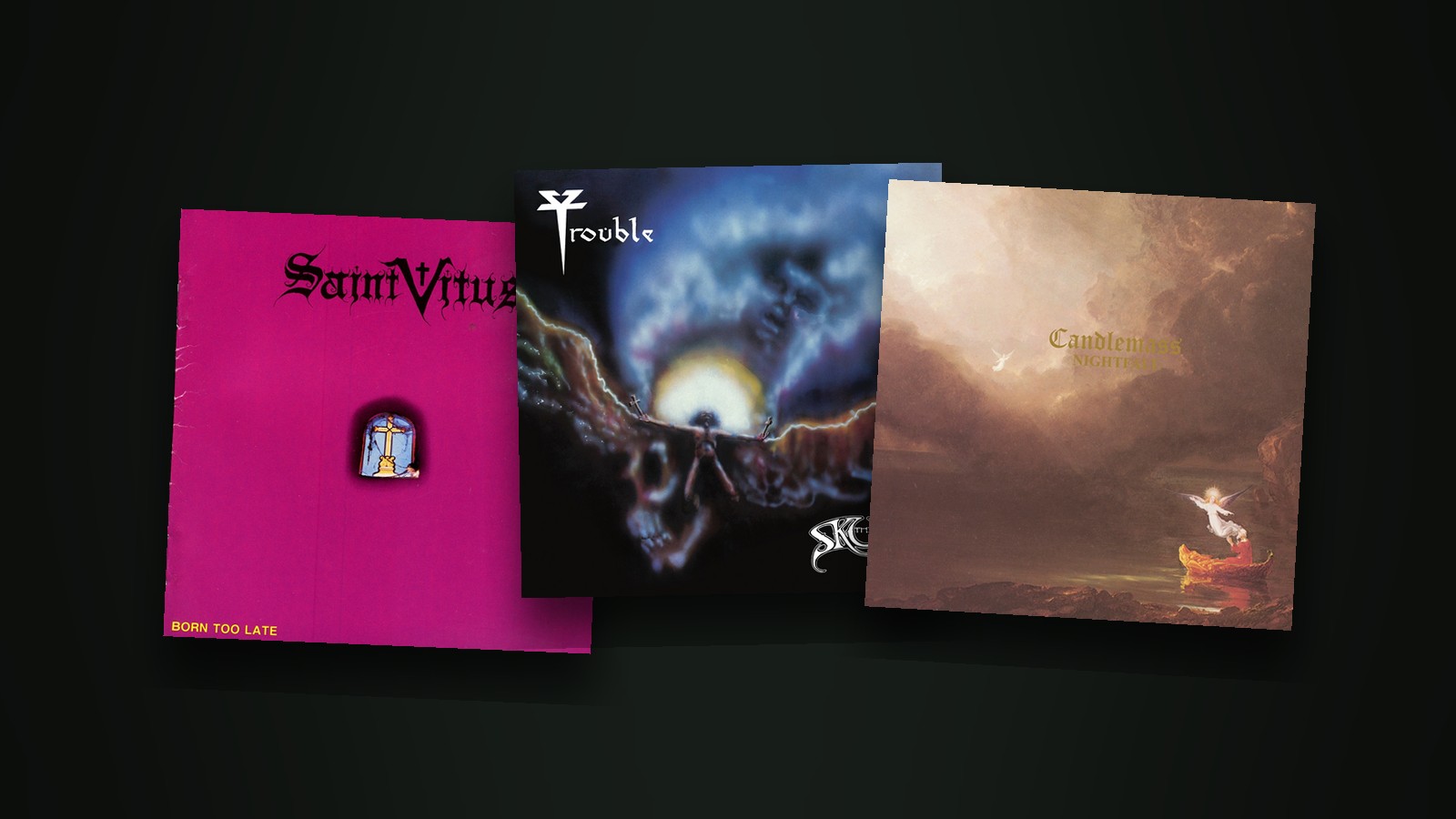
The room was a mixing desk in Los Angeles, the hour was close to four in the morning, and the five young men from Chicago bent over it in 1985 had already spent the whole day before recording vocals. Tracked at Track Record and at Preferred Studios in Woodland Hills for Metal Blade Records, with Brian Slagel credited as executive producer and Bill Metoyer at the controls, the second album by Trouble had to be mixed from top to bottom in about eight hours, guitarist Bruce Franklin recalled to Andrew Daly of VWMusic in February 2021, and he still hears the rush in it: far too much reverb on the drums, the vocals and the solos. The record was The Skull. Eight hours was all the night allowed it.
Nobody at that desk was thinking about a big four. The phrase arrived a quarter of a century later, and it came from the audience. The big four of doom metal is a name given after the fact to Saint Vitus, Pentagram, Trouble and Candlemass, four groups who in the middle eighties put slow, weighted, Sabbath-rooted heavy metal into the shops while the rest of the genre was tearing the brakes off its drummers, and who never once toured together under that title. It was never a bill. It was a verdict.
With both his arms on those two massie Pillars / That to the arched roof gave main support.
John Milton, Samson Agonistes
Samson needed two pillars to bring a hall down. The eighties needed four to hold one up. Picture a roof the metal business of 1985 had refused to raise, a long span of slowness over a music everyone else was accelerating, and under it four pillars driven into ground nobody had surveyed as one site, a hardcore label in southern California, a Chicago club circuit, a songbook kept since 1971 and a Stockholm studio budget that would not have paid for a thrash video, each sunk by a band that could not see the other three across the dark. How that roof went up is how the eighties built it. This page is about the name painted on it afterwards.
A title from the audience, not a tour
The word is borrowed from thrash, and the loan is easy to date. The four thrash bands the press had bracketed together for two decades first shared a bill on 16 June 2010, at the Sonisphere Festival at Bemowo Airport in Warsaw. Doom borrowed the word and never got the stage. On 24 May 2012 the news site Metal Underground reported a fan's online petition for a Big 4 of Doom Metal tour of Saint Vitus, Trouble, Pentagram and Candlemass, on the grounds that if thrash had one, doom deserved one, and that all four had released defining debuts between 1984 and 1986. The tour did not happen.
From there the phrase settled into print. A history of the genre on Ultimate Guitar, posted on 29 October 2016, called the four the proverbial Big Four of doom and conceded that big described their standing, never their sales. When Eric Wagner died in August 2021, David Rozycki's obituary in the Houston Press placed Trouble among the big four and pioneers of doom metal, and Wikipedia's doom metal entry now hangs the whole title on that obituary. The paper trail is thin and all of it is late. That is why the title holds: it was handed out by people who bought the records, not by anyone who sold them.
Why each of the four belongs

Signed by the Black Flag guitarist Greg Ginn to SST Records, a hardcore label with no business carrying a band that worshipped Black Sabbath, the Los Angeles quartet that had called itself Tyrant until 1980 released its debut in 1984, took on Scott Weinrich, known as Wino, from The Obsessed in 1986, and recorded Born Too Late at Total Access in Redondo Beach with Joe Carducci producing, issued by SST in October 1986. Six songs. The title track is a statement of exile from the metal of its own year, and "Dying Inside" runs past seven minutes. J. Bennett of Decibel, inducting it into the magazine's Hall of Fame in 2010, called it a stone-cold classic. Saint Vitus are the pillar that took the punk road, hauling slowness around a hardcore circuit to crowds who had come for speed.
The oldest pillar stood longest before anyone built on it. Rehearsing from Christmas Day 1971 with Bobby Liebling singing, Pentagram went fourteen years without an album, and when one came in 1985 on the band's own Pentagram Records, reissued in 1993 as Relentless, it was Liebling over the Tennessee line-up of Death Row, whose guitarist Victor Griffin wrote the title song, with Day of Reckoning following on Napalm Records in 1987. Pentagram are the direct line. Because one member was writing songs in the years of the first Sabbath records, the four can never be read as a club of eighties admirers.
Four pillars, each sunk by a band that could not see the other three across the dark.
Trouble are the pillar most often argued over, and the argument is about the words, never the weight. The Metal Blade debut of 1984, now known as Psalm 9, and The Skull, released on 15 April 1985, set Eric Wagner's scripture-heavy lyrics over the twin lead guitars of Wartell and Franklin, and on the second record "The Wish" drags its dirge past eleven and a half minutes. Rock Hard gave The Skull nine out of ten. Because the lyrics reached for God, the band were filed for decades beside the Christian Doom Metal Bands, a tag Eric Wagner told Luxi Lahtinen of Metal-Rules.com in 2004 he wished Metal Blade had never put on them. Trouble gave the Sabbath riff a second lead guitar and a theology the metal of 1984 rarely touched, and lost none of its tonnage.

The only pillar outside America stands in Sweden. Recorded at Thunderload Studios in Stockholm in February 1986 on a budget reported at eighteen hundred dollars and released by the small Paris label Black Dragon, Epicus Doomicus Metallicus gave epic doom its name; when Black Dragon let them go, Leif Edling's band returned with the operatic Messiah Marcolin, recorded Nightfall at Thunderload between July and September 1987 and saw Axis Records issue it on 9 November, a funereal record carrying "Marche funèbre" after Chopin and the singles "Samarithan" and "At the Gallows End". Bernard Doe of Metal Forces called it an essential buy for any true metal fan. Candlemass carried the roof out of Europe and onto the American charts, Ancient Dreams reaching 174 on the Billboard 200, the main American album chart, in 1988.
The rival lists
The commonest rival list seats the band all four were learning from. Thomas Newman's ranking of the ten best doom bands for Chaospin, posted on 28 May 2021, repeats the usual big four in its entry on Pentagram, then puts Black Sabbath at number one above all of them and leaves Trouble out of the ten altogether. The case for Sabbath is plain: the first six albums, 1970 to 1975, are the ground these bands stood on. The case against is plainer. A pillar is not the ground.
| List | Where it appears | Bands |
|---|---|---|
| The usual four | Metal Underground, 2012; Ultimate Guitar, 2016; Houston Press, 2021 | Saint Vitus, Pentagram, Trouble, Candlemass |
| With Sabbath | Chaospin, 2021 | Black Sabbath first; Trouble named in the big four but left out of the ten |
| With The Obsessed | Wikipedia, Heavy metal music | Saint Vitus, The Obsessed, Trouble, Candlemass |
| A big five | Metal Underground comments, 2012 | The usual four plus Witchfinder General |
The second rival swaps Pentagram for The Obsessed. Wikipedia's article on heavy metal dates the doom movement from California's Saint Vitus, Maryland's the Obsessed, Chicago's Trouble and Sweden's Candlemass, with no place for Liebling. Wino's band had the pedigree, an EP in the spring of 1983 and "Concrete Cancer" on a Metal Blade compilation, but the album it recorded for Metal Blade in 1985 sat on the shelf until Hellhound released it in 1990. For the decade in question, the largest thing The Obsessed gave the roof was the singer it lent to Saint Vitus.
The third rival is a matter of dates. Cathedral, formed by Lee Dorrian after he left Napalm Death in July 1989, released Forest of Equilibrium on Earache on 21 October 1991, a debut Decibel inducted into its Hall of Fame in February 2006. It is a major record from the wrong decade. Cathedral did not hold the roof up; they moved in under it, beside the bands who played as slowly and never reached a label, the Eighties Doom Bands Nobody Signed.
Our verdict on the big four of doom metal
The usual four are the right four, for a reason that has nothing to do with sales, which were small, or a shared tour, which never happened. Each put a full album of slow, leaden, Sabbath-derived metal into the shops between 1984 and 1986, when the rest of metal had decided speed was the only virtue left, and each came through a door that should not have opened: a hardcore label, a compilation label in its third year, a band's own imprint, a small French independent. Sabbath is the ground. The Obsessed is the pillar delivered five years late. Cathedral is the first tenant. Take any of the four away and a corner of the roof comes down: no punk road without Saint Vitus, no line back to 1971 without Pentagram, no scripture without Trouble, no epic without Candlemass.
The name is a fan's name, borrowed from thrash and applied late, and it is accurate all the same. It took four pillars to hold this roof up, sunk far apart by bands that never shared a stage under the title, and traditional doom still lives beneath it. What has been built on top since, from British death doom to sludge, is the long version.
