
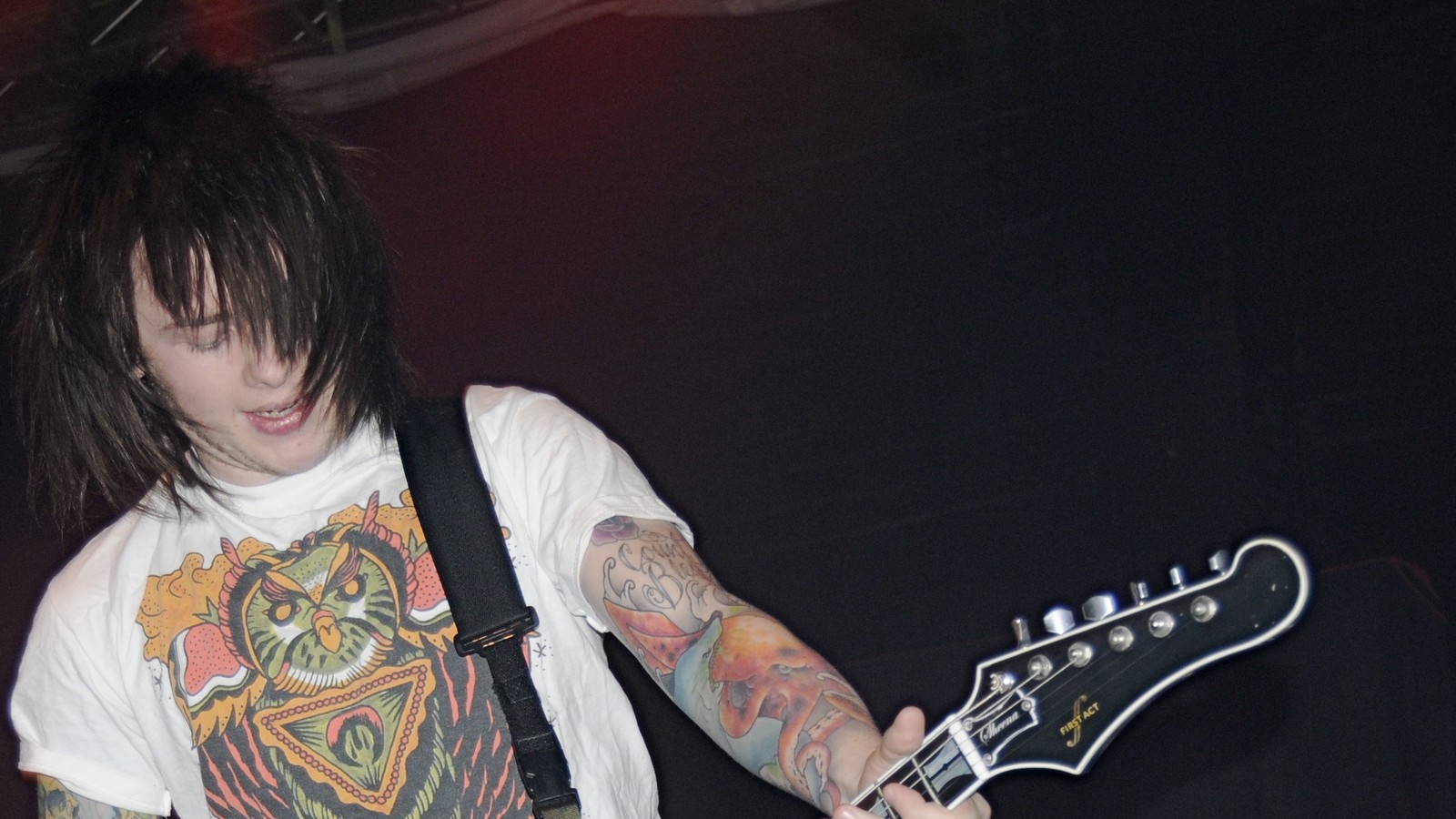
In 2005 a teenage singer in Sheffield started a clothing label.
Launched a year before his band had a full-length record in the shops, built on graphic tees and 1990s streetwear prints and sold to the same scene that was finding the songs on a profile page, the clothing label that put a deathcore singer into the rag trade ahead of his own debut album was Drop Dead, and the singer was Oli Sykes of Bring Me the Horizon, whose Count Your Blessings followed in October 2006, a record usually shelved with deathcore.
That is where deathcore fashion starts. Between 2005 and 2009 the swoop, the snakebites, the stretched ears, the black skinny jeans and the studded belt ripped the leather jacket and the cut-off denim off the backs of a whole generation of heavy music fans, and every one of those pieces earned its place doing a job: on a stage, in a pit, on a profile photograph the size of a matchbox, at a merch table under one bare bulb.
Think of the whole outfit as the black and yellow quartered targets painted on a crash test dummy, the ones that exist only so a high speed camera can read the head snapping forward when the sled slams into a concrete block at thirty miles an hour. The swoop, the lip rings, the white glint of the studs and the black of the jeans were targets of exactly that kind, painted onto a body so that the collision could be read, by the back of the room, by a cheap point and shoot, by a stranger scrolling past a thumbnail. The breakdown was the impact. The look was how you saw it land.
The records, the labels and the chart runs of the MySpace scene sit in the account that frames it. The clothes ran on a logic of their own, and it was a practical one.
Why deathcore fashion worked under bad light
Start with the stage. Club lighting in a two hundred capacity room is a couple of par cans and whatever the house left plugged in, and under that light a black shirt and black jeans vanish into the backline. What survives is skin, hair and metal: a fringe swinging across a face, two rings flashing at the corners of a mouth, a belt of studs throwing light back at the room. You read the singer from the shapes the black did not swallow.
Then the pit. Tight jeans give an elbow nothing to grab and a boot nothing to catch, a band shirt soaks through with sweat and dries on the drive home, and none of it costs enough to mourn when a stage diver's heel tears it open.
Then the photograph. A MySpace profile picture was a small square, usually shot with the camera held up at arm's length above the face, and at that size a swoop and a pair of snakebites were the only details that read at all. A band that looked like its fans could be found by its fans in a Top 8 before anybody pressed play.
| Piece | Where it worked | What it did |
|---|---|---|
| Swoop fringe, flat-ironed | Stage, photograph | Moved on the beat; framed the face in a thumbnail |
| Snakebites | Photograph, stage | Two points of metal that read at any size |
| Stretched ears | Merch table, stage | A commitment you could see across a room |
| Black skinny jeans | Pit, van | Nothing to snag, cheap to replace, matched everything |
| Studded belt | Stage | Threw light back where black cloth swallowed it |
| Band shirt | Everywhere | The one piece that named a band |
The mismatch between the look and the sound was part of the point. When the Phoenix New Times profiled Job for a Cowboy on 1 December 2005, its writer Chelsea Mueller noticed that the Glendale teenagers wore tight band shirts, tight pants and shaggy emo haircuts, while the music coming out of them was death metal with the hardcore floor bolted under it. The photograph and the first blast beat disagreed, and the disagreement did the advertising: the profile said fringe and tight shirt, the player said death metal, and a listener who clicked through got both in the same click.
The deathcore haircut and the bassist who led the charge
The deathcore haircut did not come from death metal. Death metal had spent fifteen years growing its hair to the waist and leaving it there. The deathcore haircut inherited its stagecraft from Orange County metalcore at the start of the 2000s, from the side of the family that dressed for the stage on purpose.
Named by a witness in the oral history Louder Than Hell as the man responsible for what became fashioncore, a trained hair stylist who led the charge with pink, blond and blue chunks in his bandmates' hair, the bassist whose band turned a haircut into a dress code half a decade before the word deathcore existed was Javier Van Huss of Eighteen Visions, and the style the band wore became known as fashioncore, carried into the suburbs by Atreyu and their peers and then handed down, like a set of stage clothes, to the younger and heavier bands behind them.
The mechanics were simple. Grow the fringe long on one side, cut the back short and choppy, run a flat iron through it until it lies like a sheet of black glass, then lock it in place with spray. Coloured streaks were optional.
On stage the cut did something no waist-length mane could do. A flat-ironed fringe, lacquered into a single blade, came down over the face on the downbeat of the breakdown like a butcher's cleaver driven into the block, chopped the singer's face out of the picture and flew back up on the headbang, so the drop was visible from the bar before it was audible over the talking. Long hair windmills. The swoop hit on the one.
The nearest thing to a record of the room is a tour film. Released in April 2009, the official video for "Diamonds Aren't Forever" is cut from Bring Me the Horizon's American touring: live shots, stage-diving crowds and backstage partying. The song comes off Suicide Season, released in September 2008.
Snakebites, gauges and ink
Snakebites are two rings, one at each corner of the lower lip, and the name comes from the two puncture marks they imitate. They were cheap at any piercing counter, they healed in a few weeks, and on a photograph they did what the fringe did: they put two bright points on the face that survived being shrunk to a thumbnail. Spider bites, two rings at the same corner, were the variation.
Stretched ears were the slow version of the same idea. You start at a small gauge and push a taper through every few weeks until the lobe holds a plug or a hollow tunnel a centimetre across, sometimes more, and the size is a record of how long you have been at it. Nobody stretches an ear for one weekend. The tunnel said you would still be in the room next year.
Ink went further. Tattooed across his arms, his torso, his neck, his hands and his fingers, and refusing only his back, which he told Noisecreep in June 2009 would be like owning an expensive painting he could never see, the singer who carried all of that ink was Mitch Lucker of Suicide Silence. The body was the merch. Fans copied the pieces they could afford.
"The Price of Beauty" comes from The Cleansing, which Century Media released on 18 September 2007, and it is the Suicide Silence song with a title about looks.
Deathcore makeup is a short answer. In the MySpace years it meant a line of black eyeliner and black nail polish borrowed from the scene side of the room, worn by some and skipped by most, and it never became a uniform the way corpse paint did in black metal. The face was decorated with metal and ink instead.
Skinny jeans, studded belts and the shirt
Black skinny jeans were the cheapest piece and the hardest working. They matched every shirt, hid every stain, fitted in a duffel bag, survived a month in a van and gave the pit nothing to hold. Jeans that tight shorten the jump, and the two-step is where the limit showed.
The studded belt was the punk piece. A row of pyramid studs round the hips worked like the steel plate bolted over the back bumper of a touring van: the stage lip, the barricade rail and the elbows of a two-step all scraped across it and the belt came home dented and whole. Under bad lights it was also the only thing below the shoulders that threw any light back.
The shirt was where the money went, and its design changed faster than the haircut. The first wave was black, with an oversized front print, a big logo across the chest, a gore or horror illustration under it and often a second print running down a sleeve. Later the all-over print arrived: dye sublimated onto polyester from hem to collar, so the whole shirt became the picture, seams and all. In a pit an all-over print took the punishment the graphic on the underside of a skateboard takes when it is slid down every handrail outside the venue before doors: ground to the wood along both edges, gouged through the middle, and still readable from across the car park. Drop Dead, whose graphic tees drew on 1990s streetwear, was the label printing the other kind of shirt.
The tour shirt was the trophy. A dated back print, the cities listed down the spine, a bill with a summer slaughter run or a Warped Tour leg on it: you could only buy that shirt at the table on the night, which made it the one piece of the outfit that proved you were there.
Everything else the audience built around the music, the whole culture of logos, covers, pits and memes, travelled on the same bodies.
Long hair windmills. The swoop hit on the one.
Caps, tattoos, masks and battle vests
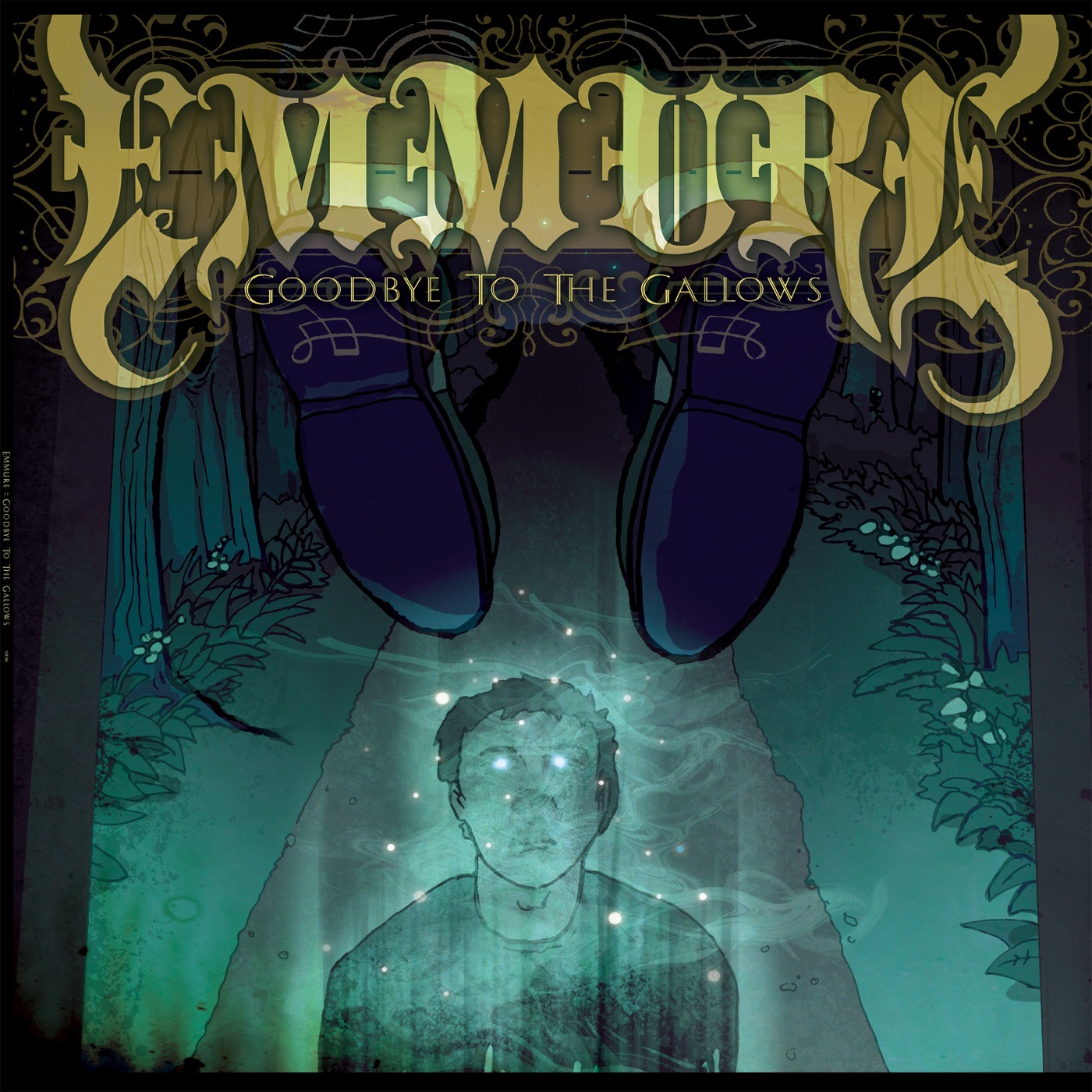
Not every band wore the swoop, and the exceptions show the other half of the inheritance. Released by Victory on 6 March 2007, Goodbye to the Gallows came from the Connecticut-born band Emmure. Aleksander Brunka, in a 2025 paper on the non-musical side of early deathcore, describes an image built from baseball caps, basketball and football jerseys and hip-hop sportswear, set beside the borrowings from emo of neck and hand tattoos, face piercings, stretched ears and the long dyed fringe swept to one side. The swoop was one half of the picture and the cap was the other.
The same paper counts the heads in the fan footage it examines, up to 2007, and finds short hair far outnumbering long. The fringe owned the photographs. The floor, by that count, was mostly cropped.
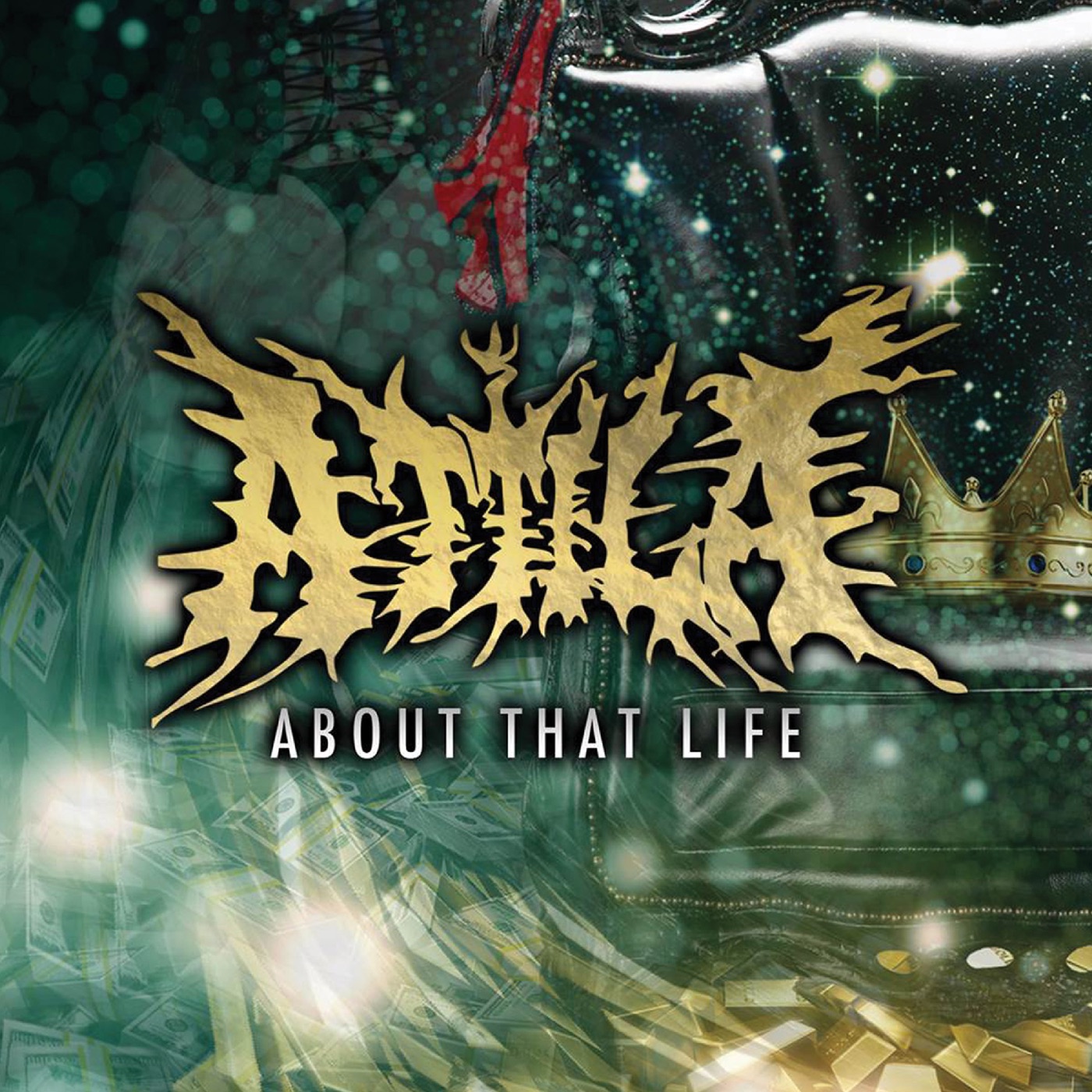
Formed in Georgia in 2005, signed to Artery Recordings and selling a little over 14,000 copies in its first American week after About That Life reached the shops on 25 June 2013, the standard-bearer of the party end of the scene, the band that drove it to number 22 on the Billboard 200 was Attila, and its singer Chris Fronzak ran a clothing line of his own, Stay Sick, which he says he started in 2011. The singer who sells you the shirt off his own label is the Drop Dead model again.
The title track's official video, premiered in August 2013, is the wardrobe on film: caps, sunglasses, a gold chain, a leather jacket, a cut-off denim vest and sleeves of tattoos where the fringes used to be.
The mask came next. Formed in Yekaterinburg in 2014, with the mask of its singer Alex Terrible in production by 2016 on his own account, the band whose masks a Wikimetal profile traces to Slipknot and Mushroomhead, and to a singer who pushed them through over the doubts of some bandmates, was Slaughter to Prevail. A mask on a deathcore singer is a welder's hood snapped down before the arc is struck: nobody watches the man any more, they watch the sparks, and the low growl comes out of a face that is no longer there to be photographed. In the clip era that was a gift. A mask reads on a phone screen the way a swoop read on a profile page.
The battle vest arrived last, and from the other end of the family. Denim with the sleeves cut off, patches sewn on by hand and a back patch across the shoulders, the battle vest is heavy metal's oldest piece of uniform, and the deathcore audience wears it the same way, with the battle jacket and its patches carrying deathcore logos in beside the old names, one more link in the lineage. Twenty years after the swoop ripped the denim off this audience's backs, the denim came home.
The pieces changed every few years and the reason for them did not. Each item was picked because it showed up under bad light, survived a pit, read at a small size or proved you had been at the show, and when one stopped doing that job something else replaced it. A swoop, a cap, a mask and a vest look nothing alike. They answered the same four questions.
