
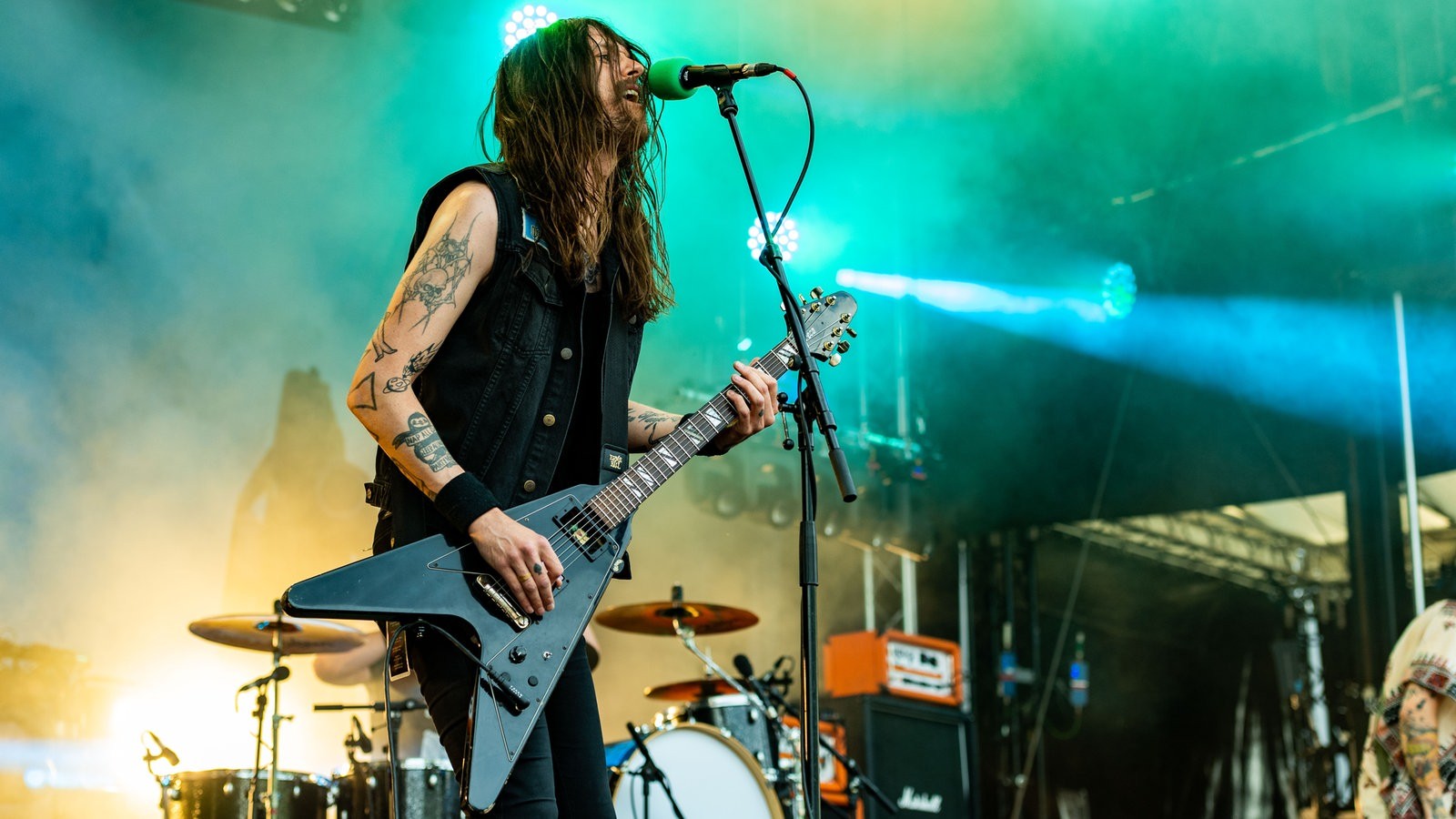
"If anyone wants to label it doom, stoner or sludge is entirely up to them." Esben Willems, the drummer of Monolord, said it to the blog Slugelord, and Chris Dick of Decibel opened with it on 31 March 2014, the day the magazine streamed Empress Rising. Willems added that the band took any labelling as a compliment. From the man behind the kit it is the right answer, because a band owes the press no taxonomy. As an account of what a listener hears, it is wrong. Doom metal and stoner metal share the fuzz, the Black Sabbath riff and very often the tempo, and still the name can be heard inside the first minutes of a record by anyone who knows which way the music is facing.
Picture a town square on a summer afternoon with two crowds in it. At one end a funeral march leaves the church, a brass band at its head and a bass drum struck on every downbeat, the mourners stepping behind the coffin at the pace the drum allows, each bar carrying the cortege one step nearer a grave that everyone walking can already see. At the other end, by the fountain, a street band has been playing one riff for forty minutes, the bassist turned towards the drummer, the guitarist turned towards the bassist, the listeners closed in a ring around them, and the tempo, by chance, is exactly the tempo of the march. One square, one afternoon, one speed. The two musics are facing different ways.
That is the difference, and it is the reason a metronome settles nothing. Doom metal faces forward, towards an end: its songs are built to arrive, one section handing the weight to the next, the heaviest chord held back for the moment the lid comes down. Stoner metal faces inward, towards the circle of players: its songs are built to return, the riff coming round and round again, and they end not when they have reached anything but when the musicians agree to stop. Both grew from the same Sabbath root, which is why any honest chart of how the branches divide sets them side by side, and why the only way to separate them is to listen to named records for direction rather than speed.
The two crowds share a great deal. Both tune low and push valve amplifiers until guitar and bass fuse into a single leaden band of sound, and both are filed under each other's names by magazines, labels and festival posters. The word stoner means a cannabis user, and its use as a genre name may come from a Roadrunner compilation of 1997 whose subtitle addressed stoners directly. It names an audience, not a sound.
A funeral march is finished when the coffin is in the ground. A jam is finished when the last player puts the instrument down, and not one bar sooner.
The march: records that walk towards a grave

Released by SST in 1986 as the first album sung by Scott "Wino" Weinrich, who had joined early that year in place of Scott Reagers, with Dave Chandler on guitar, Mark Adams on bass and Armando Acosta on drums, Born Too Late is the record on which the Los Angeles quartet that played doom on a punk label, Saint Vitus, left the hardcore influences of its first two albums behind for an even slower and darker sound, riffs that AllMusic heard as sludgy and ultra slow. The title track became an anthem of the doom underground, and it moves the way pallbearers move over uneven ground, every step tested before the weight is shifted onto it, until the song reaches its last bars the way a procession reaches the graveside, with nowhere left to walk. It does not circle. It arrives.
The Swedish school of the same year wrote in the same direction with far more ornament. Candlemass opened Epicus Doomicus Metallicus, released by Black Dragon in 1986, with "Solitude", a song of despair sung by the guest vocalist Johan Längqvist, and to our ear it sets out its grief, climbs towards it and closes on it. The drummer on records of this kind marks the downbeat like a tolling bell and carries the weight forward from one section to the next. The dirge has a destination.
The jam: records that turn in a circle
Recorded at Sound City in 1993 and released by Elektra on 28 June 1994, Welcome to Sky Valley by the Palm Desert quartet Kyuss was pressed on its original CD with ten songs locked into three long tracks, so that each song arrived as part of a sequence. To our ear the riffs on that record work the way a draught horse works a threshing floor, walking the same ring of ground again and again and doing its labour precisely by coming back to where it started. Brant Bjork, the drummer on those sessions, took the method into a solo career in which the Freak Valley announcement that JJ Koczan wrote and posted on The Obelisk on 27 December 2018 heard a "signature jammy smoothness".
Sweden supplied the circle as well as the march. Formed in Örebro in 2001 by the bassist and singer Oskar Cedermalm and the guitarist Niklas Källgren, Truckfighters released Gravity X in 2005 through Fuzzorama and through MeteorCity, the label at which, by the usual account, an intern coined the name desert rock around 1998. Nothing in those songs is marching anywhere. There is a third band in the square, the one that screams at the crowd instead of walking through it or circling inside it, and its quarrel with doom is set out in sludge Metal or Doom Metal.
| Listen for | Doom: the march | Stoner: the jam | Heard on |
|---|---|---|---|
| Where the song is going | Towards a last chord that closes it | Back to the riff it started from | Born Too Late; Welcome to Sky Valley |
| What the drummer does | Marks the downbeat and carries the weight forward | Leans into the groove and keeps the ring turning | Saint Vitus; Kyuss |
| How a song grows long | By adding sections, each heavier than the last | By letting the riff come round again | Epicus Doomicus Metallicus; Gravity X |
| What the voice does | Walks at the head of the song as its mourner | Stands inside the circle as one more instrument | Candlemass; Truckfighters |
| A band facing both ways | The lament in the vocal line | The riff that refuses to leave its ring | Monolord, Vænir and Rust |
Where the two crowds share a square
The singer of Born Too Late had come to Saint Vitus from a band of his own, and he went back to it. Weinrich left The Obsessed in 1986 to join the Los Angeles band and revived the Maryland group around 1989, and the records he made with it next, the self-titled album and Lunar Womb for Hellhound in 1990 and 1991 and The Church Within for Columbia, with Hellhound, in 1994, arrived in the years the major labels were signing desert bands. Here is a man who played in the funeral and then crossed the square to the fountain with his guitar still on, and the band has been filed under doom and under stoner ever since.
The square is not only a figure of speech. In June 2019 the German festival Freak Valley put The Obsessed, introduced in the announcement The Obelisk carried as "ultra-classic doomers", on one three-night bill with Brant Bjork, YOB and Corrosion of Conformity, and on 15 February 2019 the same site carried the news that Monolord would join them on the heels of Rust, their third album. Nobody in the field was asked to choose. The line is drawn inside the songs.
Monolord, facing both ways

Formed in Gothenburg in 2013 by Thomas V Jäger on guitar and vocals, Mika Häkki on bass and Esben Willems on drums, the same three who make its records today, the Swedish trio released Empress Rising through RidingEasy on 1 April 2014: five songs across forty-six minutes, opening on a title track that runs twelve minutes and nineteen seconds. Vænir followed on 28 April 2015 and closed on a title track of sixteen minutes and forty-nine seconds, and Rust, released on 29 September 2017, ended on "At Niceae", fifteen minutes and thirty-five seconds long. Chris Dick heard moments heavy as a mountain and despondent ones side by side on the debut in 2014. The length on those records is the circle's length, the riff allowed to come round until it has flattened everything standing in the room, while Jäger's voice, which JJ Koczan of The Obelisk hears as morose in the verse above the tar of the bass, walks at the front like a mourner who has not noticed that the band behind him stopped following the coffin long ago and formed a ring of their own.
Relapse released No Comfort on 20 September 2019 and Your Time to Shine on 29 October 2021, and the sixth album was made in Oregon in the autumn of 2025 with the producer Sylvia Massy. Jäger said that Massy asked him for everything the band had, not only the songs written for the album but "every stray riff and idea", and in the Relapse announcement that The Obelisk carried on 31 March 2026 he put it bluntly: "This isn't really what people would call a doom album." Neverending came out on 29 May 2026, and reviewing it on 12 June, Koczan found its use of repetition more wilful even than on Your Time to Shine. We take Jäger at his word about the label and disagree with him about the direction. The circle has grown wider on Neverending. The voice is still facing the grave.
Which way the record faces
The test needs no metronome. Play the last two minutes of a song and ask whether it closes or simply stops, whether the final riff has arrived somewhere or only come round again, whether the singer walks at the front or stands in the ring. Born Too Late closes. Welcome to Sky Valley circles. Vænir does both, which is why the band that made it has spent twelve years being called three things by people who were all partly right. Willems said in 2014 that the label was up to the listener. We agree, provided the listener first checks which way the band is facing.
Neither direction has anything to do with velocity, which leaves open whether a music built on weight alone belongs among the extremes at all: is Doom Metal Extreme Metal.
