
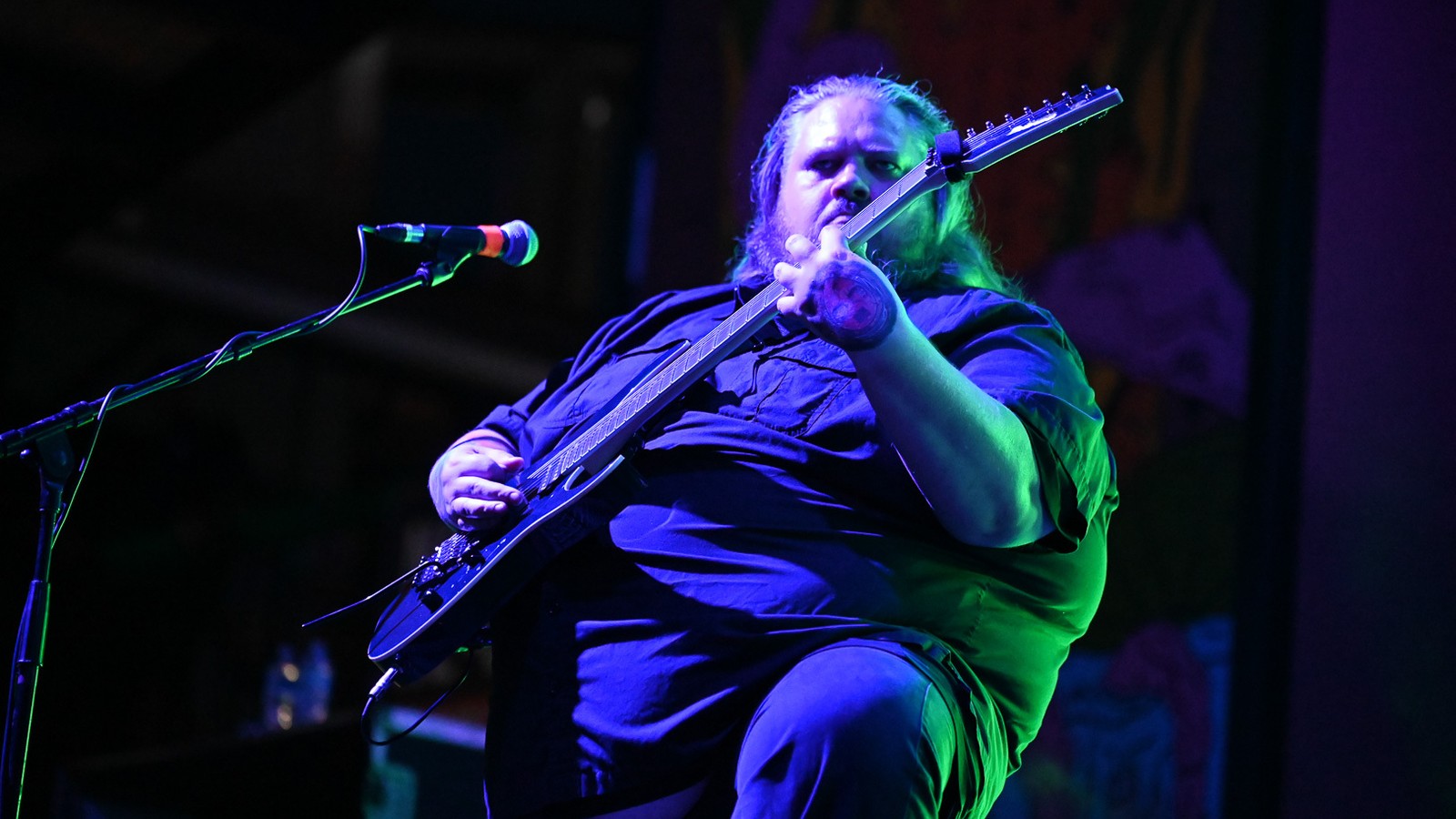
Fifty-five cycles a second, the second A up from the bottom of a piano keyboard, is the pitch of the open low string on a guitar in drop A, the one note that the drop A tuning songs lean on until the room gives in. Played on seven-string guitars by three players at once, signed to Metal Blade and turned loose in July 2008 on a second album whose title track flattened the folding chairs of every all-ages room that booked it, the Knoxville sextet with three guitarists in the front line was Whitechapel, and the record was This Is Exile.
Three guitars, one note. That was the arithmetic.
In a room that size the open A does not ring so much as work like a hydraulic jack set under the plywood stage, heaving the boards up on every hit of the breakdown and letting them drop on every rest, so that the kids on the barricade take the riff in the shins and the teeth as much as through the PA. Nothing else in the song needs to be that low. Everything else in the song is arranged around the moment it gets there.
Tuning is not the whole of the deathcore sound, which also needs the blast beat, the growl and the half-time drop, but it is the part every other element is measured against, because a breakdown is only as heavy as the lowest open string it is played on, and since the late 2000s that string has often been an A.
What drop A does to a guitar
Drop A is a tuning in which the lowest string sits on A and the string above it on E, a fifth higher. On a seven-string guitar it reads A, E, A, D, G, B, E from the bottom, which is ordinary seven-string tuning with the low B taken down a whole step. On a six-string it reads A, E, A, D, F sharp, B, the whole instrument lowered and the bottom string dropped one step further. Either way the root and the fifth of a power chord sit across a single fret, and the open bottom string rings the key of the song.
The shape is the same one heard on the songs in drop D, carried two and a half steps further down. That distance changes what the note is for. A drop D riff still reads as a riff, with a pitch you could hum back; a palm-muted A at fifty-five cycles, chugged in sixteenths through a high-gain amplifier, reads as a thud that stands beside the kick drum rather than above it, and a deathcore drummer who triggers that kick is really building a second instrument in the same register.
So the tuning is a rhythm decision first. The low string becomes percussion, the strings above it carry the tremolo riffs and the dissonant chords, and the song is a negotiation between the top of the neck and the open bottom, with the breakdown as the moment the negotiation ends and the bottom wins.
Seven strings and the rungs down to A
None of this was invented by deathcore. Built by Ibanez to the specification of a virtuoso who wanted more room for solos rather than for riffs, and first heard on Passion and Warfare in 1990, the first mass-produced seven-string guitar, the Universe, was the signature model of Steve Vai. For four years it was a shredder's instrument. Then it changed hands.
The five players from Bakersfield who put two Universes on a debut album in 1994 were Korn, and the guitars were tuned a whole step below standard seven-string, A, D, G, C, F, A, D, which planted the low A of deathcore on a major-label record more than a decade before deathcore had a name. It was not drop A. It was the same bottom note. The seventh string sat under the riff, and the riff got heavier because there was more of it underneath.
By the end of the nineties the seven-string carried a nu metal stigma, and the guitarists who kept it alive in heavier music took it somewhere colder. The five Swedes who made Nothing, released by Nuclear Blast on 6 August 2002 and played on detuned seven-strings, were Meshuggah, and that record taught a generation of players that a low string could carry syncopation as well as weight. Its influence runs straight into the djent wing of deathcore.
The first deathcore records did not start at A. The tunings of the deathcore years come from transcriptions that Songsterr and Ultimate Guitar agree on, unless a player or a label is named. The story of where it all began runs through Montreal, Glendale and Riverside, and on those early records the tuning was still a hardcore band's tuning pushed a little lower: the Doom EP of 2005 by Job for a Cowboy is transcribed in drop C, The Ills of Modern Man of 2007 by Despised Icon in B, and Count Your Blessings of 2006 by Bring Me the Horizon in drop B.
Those were the rungs the genre climbed down from, and death metal had already stood on most of them before any of these bands formed, as the tunings of heavy metal bear out. Deathcore's own contribution was to stop one rung lower and stay there.
Drop A tuning songs from the MySpace years
Then a debut out of Riverside kicked the ladder out from under drop C and B alike. Released by Century Media on 18 September 2007 and produced by Tue Madsen, The Cleansing by Suicide Silence is in seven-string drop A, and Guitar.com notes that Mark Heylmun and Chris Garza have played seven-string models since that record. "Unanswered", track two, and "No Pity for a Coward", track six, are the two songs from it that the tab sites carry that way.

"This Is Exile" is that arithmetic in full. Ben Savage, Alex Wade and Zach Householder are the three guitarists credited on the record, the title track is in seven-string drop A, and with three guitarists bolting the same open A into place the breakdown stops sounding like three parts and starts sounding like one slab, the way three box trucks idling nose to tail at a club's load-in stop sounding like three engines and become a single shudder that walks the bolts out of the roll-up door. The album sold about 5,900 copies in its first week in the United States.
The tuning travelled fast. Oceano, out of Chicago, put "District of Misery", the eighth track on Depths, out through Earache on 7 April 2009, and it is in drop A, so the note was in a Chicago band's hands inside two years of The Cleansing.
Two of the decisive drop A records came out on the same Tuesday. Chelsea Grin released Desolation of Eden through Artery, and Carnifex released Hell Chose Me through Victory, both on 16 February 2010. "Recreant" by the Salt Lake City band and the title track of the San Diego band's third album open their records, and both are in seven-string drop A. Premier Guitar's 2022 rig rundown found the seven-strings of Stephen Rutishauser, Chelsea Grin's lead guitarist since 2015, still covering every song the band plays in drop A and in drop G, which keeps the tuning at the centre of the set more than a decade on.
A breakdown is only as heavy as the lowest open string it is played on.
Songs in drop A after the first wave
The tuning outlived the MySpace years because it kept working on bigger stages. "You Only Live Once", the fourth track on The Black Crown, released by Century Media on 12 July 2011, came out on a record that reached number 28 on the Billboard 200, and it sits in the same seven-string drop A as The Cleansing. The tuning went with the band into the top 30.
On the border with metalcore, Emmure took the same note on six strings. "Solar Flare Homicide", from Speaker of the Dead, released by Victory on 15 February 2011, is in six-string drop A, and it shows what the lower string count costs: one string fewer above the open A to hang a riff on, so what is left is mostly sinew.

The next decisive one came from the other side of the world. The Sydney quintet whose Hate, released on 19 October 2012, came in at number 35 on the ARIA albums chart were Thy Art Is Murder, and "Reign of Darkness", the opener of that record, is in seven-string drop A. Andy Marsh on guitar told MusicRadar in June 2015 that they play drop A on seven strings, and he described the longest riff on that year's Holy War, "Fur and Claw", as a minute of descending two-notes-per-string runs across the high A, the E and the low A: drop A used as an onslaught rather than a punctuation mark. "Holy War", the title track, is in the same tuning on the guitarist's word.
| Song | Band | Record | Year | Tuning |
|---|---|---|---|---|
| Unanswered | Suicide Silence | The Cleansing | 2007 | Drop A |
| No Pity for a Coward | Suicide Silence | The Cleansing | 2007 | Drop A |
| This Is Exile | Whitechapel | This Is Exile | 2008 | Drop A |
| District of Misery | Oceano | Depths | 2009 | Drop A |
| Recreant | Chelsea Grin | Desolation of Eden | 2010 | Drop A |
| Hell Chose Me | Carnifex | Hell Chose Me | 2010 | Drop A |
| You Only Live Once | Suicide Silence | The Black Crown | 2011 | Drop A |
| Solar Flare Homicide | Emmure | Speaker of the Dead | 2011 | Drop A on six strings |
| Reign of Darkness | Thy Art Is Murder | Hate | 2012 | Drop A |
| Holy War | Thy Art Is Murder | Holy War | 2015 | Drop A on seven strings: the band's guitarist, MusicRadar, 2015 |
Below A, and the way back up
A was never the bottom. Once drop A on a seven-string was standard equipment the race lower moved to hardware, to seven strings, eight strings and baritone necks. Every band that tuned below A let more air out of the van's tires to squeeze under a lower overpass, and somewhere past F the rims were grinding sparks off the interstate and the thing carrying the band had stopped being a van at all: below a certain point the open string stops being a note you hear and becomes a pressure you feel, and the riff loses its pitch along with its edge.
Further down sit the specialists. The Last Ten Seconds of Life have played a six-string baritone in drop F since the Warpath EP of 2012, according to their label, Metal Blade.
The bands that went lower did not abandon A. In July 2023 Premier Guitar found Zach Householder of Whitechapel with a seven-string in drop G and, alongside it, a baritone seven-string kept in drop A, while Alex Wade's baritone handled the drop G material. In 2019 the same magazine reported that Knocked Loose, a hardcore band from Kentucky, had moved its seven-strings up from a G tuning to drop A. Chelsea Grin keep both.
That is the case for A in plain terms. It is low enough that the open string acts as percussion and high enough that the strings above it still carry a riff a crowd can follow, and the bands that pushed past it either kept a guitar tuned there or came back. Lower tunings are a specialism, and drop A is the gristle of the genre. Drop A is where deathcore lives.

