Not the same thing, though they point at many of the same records. On the question of glam metal vs hair metal the short answer is that every glam metal band of the eighties ended up filed under hair metal, while most of what was filed under hair metal never wore a trace of glam. The band whose 1986 debut sleeve set four faces in full lipstick, eyeliner and blusher in a grid under the band's name stands in both circles at once, and it was Poison.
The two words were not made at the same time, by the same people or for the same job. One was a family name, handed down from British glam rock and worn with pride. The other was a word of abuse, coined after the fall and swung at whatever was still standing in the rack, and it smashed the shop-window glass on a whole decade of records the way a thrown brick smashes a pane without asking what is on the shelf behind it.
Hair metal is a constellation. The stars of Orion lie hundreds of light years apart and have nothing to do with one another, yet somebody on the ground joined them with lines, hung a club and a sword on the figure, called it a hunter, and ever since every child who looks up sees the hunter first and the separate stars second. Whitesnake, Poison and Warrant were never one body. The word joined them.
The street where both words found their bands, with its clubs, its flyers and its cameras, is chronicled in where hairspray took over. The names are a separate matter, and they are worth getting right, because each one tells a different story about the same shelf.
Glam metal vs hair metal: two words, two dates
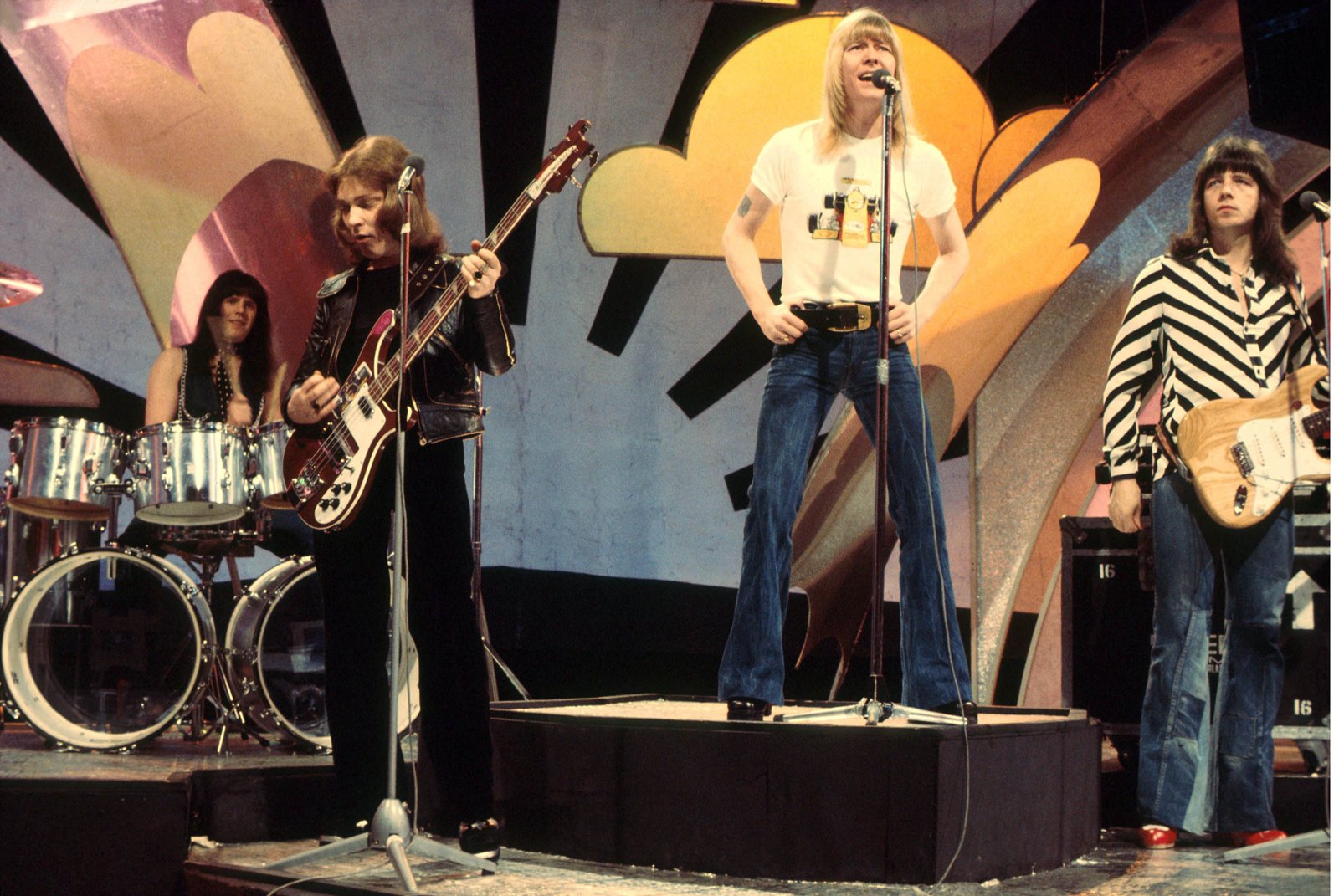
Glam is the older word, and it was a British one before it was ever attached to metal. The glam rock band whose "The Ballroom Blitz" went to number two in Britain in 1973, with a guitar riff as heavy as anything on the chart that year and a singer in satin and eyeshadow, was Sweet, and with Slade, T. Rex and David Bowie it gave the word its meaning: loud, catchy, dressed up and deliberately androgynous. The American bands of the next decade inherited both the noise and the wardrobe.
So glam metal names a lineage. It says where the make-up came from and who wore it first, and it only fits a band that actually took up the inheritance: the painted face, the teased hair, the pink and the lace, the stage run as a spectacle rather than a gig. The word describes the costume, not the sales.
The decade had other names for the rest of the rack. The rock writer credited with calling the melodic, radio-built end of the style metal pop as early as 1983, to describe bands like Van Halen and Def Leppard, was Philip Bashe, and the sociologist who later swept the whole commercial branch under the heading lite metal, alongside poodle bands and nerf metal and a string of other sneers, was Deena Weinstein, in Heavy Metal: A Cultural Sociology, published in 1991. Neither word was hair metal. Hair metal came later.
It came once the shooting had stopped. Through the early nineties the phrase spread as grunge took the radio, and it was written the way a keeper chalks up the bag at the end of a driven shoot, every pheasant, partridge and stray pigeon the guns had brought down laid out in rows on the grass, and one number chalked over the lot. Nobody sorts the birds while they are still flying. The tally only happens when everything is on the ground.
One was a family name, handed down from British glam rock and worn with pride. The other was a word of abuse, coined after the fall.
Where the two circles overlap
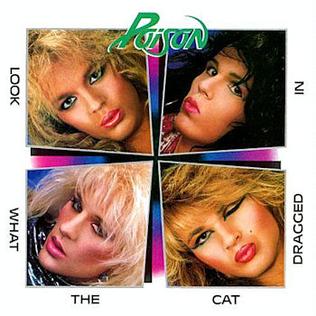
A few bands answer to both names without a quarrel, and the clearest of them is the one on that painted sleeve. Look What the Cat Dragged In, released by Enigma in 1986, put the four members of Poison on the cover in more make-up than any band on the Strip, and the music inside was party hard rock at a trot, with choruses built to be shouted from a car window; it reached number three on the Billboard 200. The ancestry of the look runs straight back to the British singles of 1973. So does the attitude.
"Nothin' But a Good Time", from Open Up and Say... Ahh! in 1988, is the overlap in a single song: a glam rock stomp with a heavier guitar, a chorus with nothing to hide, and a video that shows a restaurant dishwasher abandoning the sink to kick open a door onto the band's own stage. It reached number six on the Hot 100. The musicologist who read glam metal's make-up and androgyny as a deliberate play with gender rather than a joke was Robert Walser, in his 1993 study of the genre. That is glam. The date and the sales make it hair metal as well.
Mötley Crüe, Twisted Sister and the early W.A.S.P. sit in the same overlap, with the paint and the teased hair dating from the first half of the decade. Each came out of the glam wardrobe before the hair metal market existed. Each was filed under the later word once it did.
Hair metal without a trace of glam
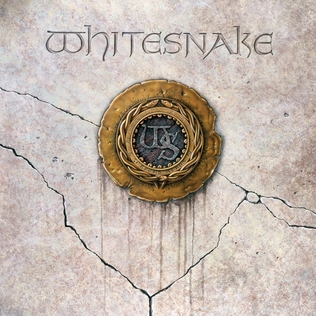
The other side of the ledger is larger. The singer who had fronted Deep Purple from 1973 and spent the early eighties leading a British blues rock band before rebuilding it for the American market was David Coverdale, and Whitesnake, released by Geffen on 16 March 1987, reached number two on the Billboard 200, held off the top only by U2's The Joshua Tree, with "Here I Go Again" at number one on the Hot 100. There was no lipstick anywhere near it. There was a great deal of hair.
"Is This Love", the ballad from the same album, is the proof that hair metal was a market rather than a look. Coverdale sings it with a blues singer's phrasing he had carried over from the seventies, and the video leans entirely on the MTV grammar of 1987, soft focus and wind machines, and on that alone it lands in the same rack as Poison; it reached number two on the Hot 100 that December, kept off the top only by George Michael's "Faith". Nothing in it is glam. Everything in it is 1987.
| Band | Glam metal | Hair metal | Why |
|---|---|---|---|
| Sweet | No, glam rock | No | The source of the word, a decade early |
| Poison | Yes | Yes | The make-up and the era together |
| Mötley Crüe | Yes | Yes | The lineage first, the market later |
| Twisted Sister | Yes | Yes | Greasepaint in the bars, then MTV |
| Whitesnake | No | Yes | Blues rock with the hair, no paint |
| Europe | No | Yes | Keyboards and a chart, no costume lineage |
| Skid Row | No | Yes | Filed by date, heavier than the label |
| Def Leppard | No | Yes | Filed by the American press, refused by the band |
The same goes for Europe, Skid Row and Tesla, and for Def Leppard, whose singer Joe Elliott told uDiscover Music on 20 March 2020 that the American press still pigeonholes the band as hair metal while the band itself has never worn the tag. None of them came out of the glam wardrobe. All of them were swept up by the later word all the same.
Which word fits which band
Used carefully, the two words do different work. Glam metal is a statement about ancestry, and it belongs to bands that carried the make-up and the androgyny of 1973 into the heavier music of the eighties. Hair metal is a statement about a period and a market, roughly MTV's arrival in 1981 to the collapse of 1991, and it takes in everybody the radio and the video channel sold in those years, painted or not. Hair metal is anathema to half the bands it covers. Glam metal, to most of its own, is a badge.
How the market behind the second word came apart, and whether grunge did it alone, is weighed in what killed hair metal. The word outlived the market that it named. That is usually what happens to an insult.
Both words also sit inside a longer line, back through the leather of the seventies to a Birmingham riff of 1970, and the KaosMetal history of heavy metal traces every branch of it. On that line glam is a branch with a clear root. Hair metal is a label tied round several branches at once.
So glam metal vs hair metal comes down to a simple rule. Every glam metal band of the eighties can be called hair metal without an error of fact. Most hair metal bands cannot be called glam without one. Poison is both. Whitesnake is only one.